
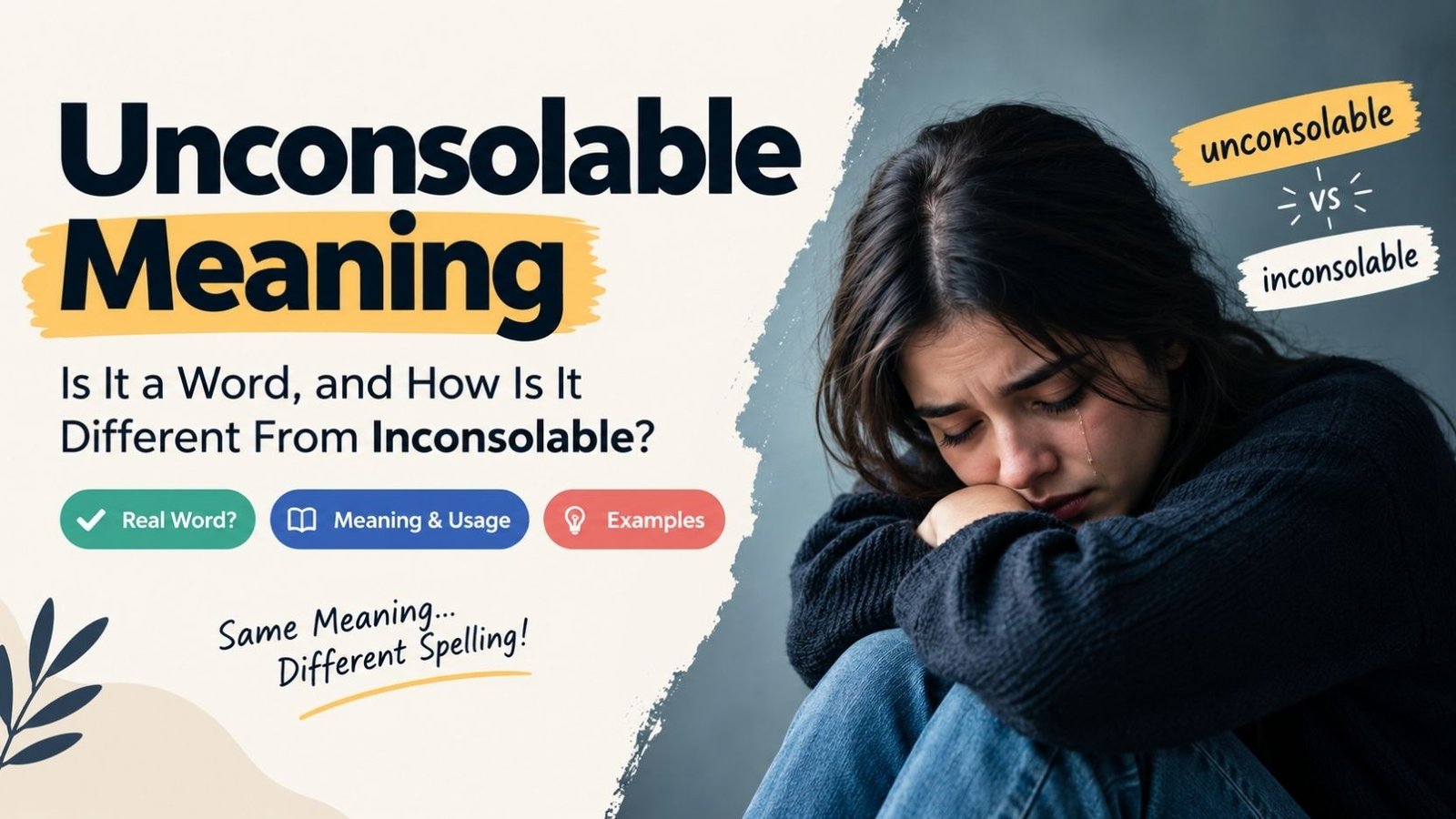
Unconsolable meaning is simple: it describes someone so upset that comfort does not seem to reach them. If a friend just lost a parent and cannot stop crying, you might call them unconsolable. The word means the same thing as inconsolable, and both describe grief or sadness that feels impossible to soothe.
Most readers land on this page because they are not sure which spelling is correct. That confusion is fair, since both forms exist in real dictionaries and real writing. This guide breaks down where each word comes from, how they differ in everyday use, and which one you should reach for in a school essay, a work email, or a text to a friend.
What Does Unconsolable Mean?
Unconsolable is an adjective. It describes a person, or a feeling, that cannot easily be calmed or made to feel better.
Think of a toddler who has dropped their ice cream cone. No amount of hugging, singing, or promising a new cone stops the tears. That child is unconsolable in the moment, even if the sadness passes a few minutes later.
The word usually shows up in situations involving:
- Grief after a death
- Deep disappointment
- Heartbreak after a breakup
- A baby or child crying without stopping
- Sudden, overwhelming sadness
Quick definition: So sad, upset, or grief stricken that nothing seems to help.
See More: HG Meaning Slang
Is Unconsolable A Word?
Yes. Unconsolable is a real, dictionary recognized word.
This surprises a lot of people, because many grammar sites and spell checkers flag it as wrong. It is not wrong. It is simply less common than its twin, inconsolable.
Merriam-Webster lists unconsolable directly, and its entry points to inconsolable as the core definition. The Oxford Advanced Learner’s Dictionary also includes unconsolable, describing it as meaning “very sad and unable to accept help or comfort,” while noting that inconsolable is the more frequent form. The Oxford English Dictionary traces written use of unconsolable back to the early 1600s, in the writing of explorer and courtier Walter Raleigh.
So the word has history behind it. It is not a modern typo that slipped into dictionaries by accident. It is an older variant that simply lost popularity over time.
| Dictionary | Recognizes Unconsolable? | Notes |
| Merriam-Webster | Yes | Defines it as meaning inconsolable |
| Oxford Advanced Learner’s Dictionary | Yes | Notes inconsolable is more frequent |
| Oxford English Dictionary | Yes | Traces use back to the early 1600s |
| American Heritage Dictionary | Yes | Defines it as impossible or difficult to console |
Unconsolable Or Inconsolable: What Is The Real Difference?
This is the question most readers actually want answered. Here is the short version.
There is no difference in meaning. Both words describe the same emotional state. The only real difference is how often each one is used, and which one style guides and teachers expect.
| Feature | Inconsolable | Unconsolable |
| Meaning | Cannot be comforted | Cannot be comforted |
| Frequency in modern English | Common, standard | Rare, considered a variant |
| Found in major dictionaries | Yes | Yes |
| Recommended for formal writing | Yes | No |
| Prefix used | in- (not) | un- (not) |
Both prefixes, in- and un-, mean “not” in English. That is why the two words can carry the same meaning even though they are built slightly differently. Inconsolable simply became the version that stuck, in the same way that “irregular” is common while an older form like “unregular” faded out of everyday use.
Tip: If you are writing an essay, a resume, a news article, or anything formal, choose inconsolable. If you are texting a friend or writing something casual, unconsolable will still be understood, but it may read as slightly unusual.
Grammar And Part Of Speech
Both inconsolable and unconsolable are adjectives. That means they describe a noun, usually a person or a feeling.
- She was inconsolable after the loss.
- His grief seemed unconsolable.
- They comforted the inconsolable child for hours.
Neither word changes form for singular or plural nouns, since adjectives in English generally stay the same regardless of number.
Adverb form: Both words have adverb versions.
- Inconsolably: “She cried inconsolably.”
- Unconsolably: “He sobbed unconsolably.”
Inconsolably is far more common than unconsolably, following the same pattern as the base adjectives.
How To Pronounce Inconsolable and Unconsolable?
Getting the pronunciation right helps you sound natural when the word comes up in conversation.
Inconsolable: in-kən-SOH-luh-buhl IPA: /ˌɪnkənˈsoʊləbəl/
Unconsolable: uhn-kən-SOH-luh-buhl IPA: /ˌʌnkənˈsoʊləbəl/
The stress in both words falls on the third syllable, the “SOH” sound. In British English, some speakers place slightly more weight on the second syllable, but the difference is subtle and rarely affects understanding.
Origin Of Inconsolable And Unconsolable
Understanding where these words came from helps explain why one became standard and the other did not.
Inconsolable entered English in the 1590s. It came from the Latin word inconsolabilis, which combined in- (“not”) with consolabilis (“able to be consoled”). That Latin word traced back to consolari, meaning “to comfort” or “to offer solace.” The word passed through Middle French before settling into English in roughly the form we use today.
Unconsolable followed a slightly different path. Instead of borrowing directly from Latin, English speakers built it using the native English prefix un- attached to “consolable.” Written evidence for this version goes back to the early 1600s.
Both words share the same root idea: the inability to receive comfort, tracing back to the Latin verb consolari, “to comfort.”
| Word | Century of First Known Use | Formed From |
| Inconsolable | 1590s | Latin inconsolabilis |
| Unconsolable | Early 1600s | English un- + consolable |
Over the following centuries, inconsolable simply won out. This happens often in English. Two words can exist for the same idea, and one eventually becomes the “correct” or expected choice through everyday use, without any official ruling ever being made.
Meaning of Console, Consolable, and Related Words
Since both words build on “console,” it helps to understand that root clearly.
Console (verb): to comfort someone who is sad, disappointed, or grieving.
- She tried to console her sister after the loss.
Consolable (adjective): able to be comforted.
- Even in tears, he was still consolable.
Consolation (noun): comfort given to someone who is sad or disappointed.
- Her kind words were a small consolation.
Note that “console” also refers to a piece of furniture or a gaming device in unrelated contexts. That meaning comes from a completely different word history and has nothing to do with comfort or grief.
How to Use Inconsolable in a Sentence?
Here are natural examples showing the word in different situations.
- The widow was inconsolable at the funeral.
- After the team lost the championship, the players were inconsolable in the locker room.
- The baby has been crying inconsolably since midnight.
- He remained inconsolable for weeks after the breakup.
- Her inconsolable sobbing could be heard through the wall.
How to Use Unconsolable in a Sentence?
Since unconsolable carries the same meaning, it works in the same kinds of sentences, though it appears less often in edited writing.
- He felt unconsolable when his childhood home burned down.
- The child was unconsolable after dropping her favorite toy.
- She seemed unconsolable, no matter what anyone said.
Common Mistakes
Most mistakes with this word pair come down to spelling confusion or mixing it up with a similar looking word.
❌ Incorrect: She was unconsolidated after the news.
✅ Correct: She was inconsolable after the news.
Unconsolidated is a real word, but it has nothing to do with sadness. It usually describes loose, unpacked material, such as unconsolidated soil or rock in geology. It is a common autocorrect mix-up because the spelling looks close to unconsolable.
❌ Incorrect: He was inconsolate about the loss.
✅ Correct: He was inconsolable about the loss.
“Inconsolate” is not a standard English word. Writers sometimes create it by blending “inconsolable” with “desolate.”
❌ Incorrect: They were inconsolably happy.
✅ Correct: They were overjoyed, or They were incredibly happy.
Inconsolable and its adverb form only describe sadness or distress, never happiness or excitement.
See More: Inconsolable Meaning
Synonyms And Related Words
These words overlap with inconsolable and unconsolable, though each carries a slightly different shade of meaning.
| Word | Meaning | How It Differs |
| Disconsolate | Very unhappy, without hope of comfort | Slightly more literary in tone |
| Heartbroken | Overwhelmed with sadness, often from loss or rejection | Focuses on emotional pain from a specific event |
| Devastated | Extremely upset or shocked | Often used for sudden bad news |
| Grief-stricken | Overcome with grief | Almost always tied to death or major loss |
| Distraught | Deeply upset or agitated | Can include visible panic, not just sadness |
| Comfortless | Without comfort | Less common, more formal |
Antonym: Consolable, meaning able to be comforted.
Inconsolable In Pop Culture
The word also shows up outside of dictionaries and grammar guides. American rock band X Ambassadors released a song titled “Unconsolable” in 2013, on their EP Love Songs Drug Songs. Lead singer Sam Harris has described the track as being about brotherhood and the bonds formed while growing up, rather than grief in the traditional sense.
This is a good example of how a less common spelling can still find its way into titles, lyrics, and creative writing, even while inconsolable remains the standard choice in everyday prose.
Meaning In Other Languages
Because this word describes such a universal feeling, people search for its meaning across many languages. Exact translations can vary slightly between dictionaries, since grief related words often carry cultural nuance that a single word cannot fully capture.
- Hindi: Common translations include गमगीन (gamgeen) and असांत्वनीय, both pointing to deep sadness that resists comfort.
- Urdu: Frequently translated as غمگین (ghamgeen), meaning sorrowful or grief filled.
For Bengali, Tamil, Marathi, Malayalam, and Telugu, bilingual dictionaries generally translate inconsolable using local words for “grief stricken” or “unable to be comforted,” rather than a single fixed term. If you need a precise translation for formal writing, a dedicated bilingual dictionary for that specific language will give you the most accurate and context appropriate word.
Frequently Asked Questions
What does unconsolable mean?
It means so sad, upset, or grief stricken that comfort does not seem to help. It carries the exact same meaning as inconsolable.
Is unconsolable a real word?
Yes. It appears in Merriam-Webster, the Oxford Advanced Learner’s Dictionary, and the Oxford English Dictionary, though it is far less common than inconsolable.
Inconsolable or unconsolable, which one should I use?
Use inconsolable for formal or professional writing, since it is the standard, widely accepted form. Unconsolable is understood but reads as an unusual choice in edited English.
What part of speech is inconsolable?
It is an adjective, used to describe a person or a feeling.
How do you pronounce inconsolable?
It is pronounced in-kən-SOH-luh-buhl, with the main stress on the third syllable.
What is the difference between inconsolable and disconsolate?
Both describe deep sadness, but disconsolate has a slightly more literary, old-fashioned tone and is used less often in casual speech.
Can inconsolable describe something other than a person?
Yes. It can describe grief itself, as in “inconsolable grief,” or crying, as in “inconsolable sobbing.”
Where does inconsolable come from?
It comes from the Latin word inconsolabilis, formed from in- (“not”) and consolabilis (“able to be consoled”), and entered English in the 1590s.
Is unconsolable used in British or American English differently?
No. Both varieties of English treat unconsolable as a rare variant, with inconsolable preferred in formal writing on both sides of the Atlantic.
What is a simple synonym for inconsolable?
Heartbroken or devastated both work well as simpler, everyday alternatives.
See more:BBWM Meaning
Final Thoughts
Unconsolable and inconsolable mean exactly the same thing: so upset that comfort does not seem to reach the person. Both words are real, both appear in respected dictionaries, and both trace back to the same idea of being unable to receive comfort. The real difference comes down to habit rather than meaning, since English speakers settled on inconsolable as the everyday standard while unconsolable remained a quieter, older variant.
If you remember one rule from this guide, let it be this: reach for inconsolable when you want your writing to feel natural and expected, and know that unconsolable is not a mistake if it slips into a song lyric, a casual message, or an older text you happen to be reading. Understanding both forms means you will never second guess yourself the next time this word comes up in conversation, writing, or search.

Hira Shah is a passionate writer and the author behind Meanz Corner. With 4 years of experience in researching words, meanings, slang, phrases, and names, she creates simple and helpful content for readers. Her goal is to make complex meanings easier to understand through clear, accurate, and reader-friendly explanations.



3 Comments