
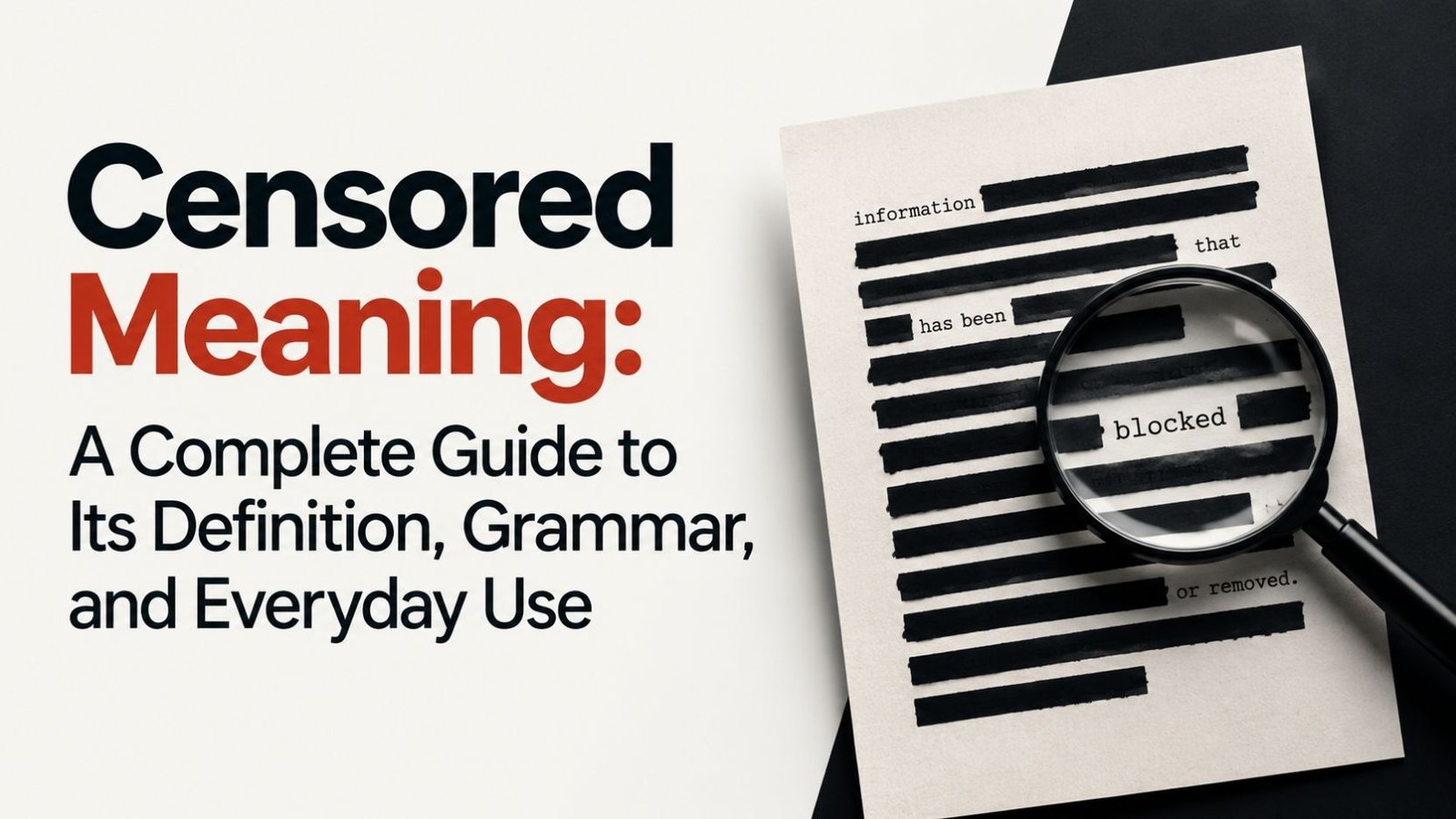
“Censored” means that something has been examined and then changed, blocked, or removed, usually because it was considered offensive, harmful, sensitive, or unsuitable for a certain audience. You will see this word attached to movies, books, social media posts, government records, and even personal conversations. At its core, the word always points to one idea: information that has been controlled before it reached you.
Understanding this word matters because it shows up in very different settings, from a bleeped-out song lyric to a blacked-out government document. The meaning stays connected to control and restriction, but the reason behind it changes depending on who is doing the censoring and why. Once you understand the core idea, every other use of the word becomes easy to follow.
What Does Censored Mean?
In simple terms, censored means suppressed, edited, or hidden from public view. It is the past tense and past participle form of the verb “censor,” which means to examine material and remove or restrict parts of it.
Here is the clearest way to think about it:
- If something is censored, someone in authority has reviewed it first.
- That authority then decided that part of it should not be shown, said, or shared.
- The final version reaches the audience with those parts changed or missing.
A censored film might have violent scenes removed. A censored book might have certain chapters banned in a specific country. A censored social media post might have words blocked or the entire post taken down. In every case, the underlying meaning is the same: something has been filtered before it was allowed to reach an audience.
See More: Inconsolable Meaning
Censored Meaning and Grammar
“Censored” is primarily used as a verb form, but it also works as an adjective. Understanding both roles helps you use the word correctly in a sentence.
Part of Speech
| Form | Function | Example |
| Censor | Base verb | The board will censor the film before release. |
| Censors | Present tense, third person | The committee censors sensitive content. |
| Censored | Past tense verb | They censored the interview before airing it. |
| Censored | Adjective (past participle) | This is a censored version of the song. |
| Censoring | Present participle / gerund | The network is censoring the broadcast. |
As an adjective, “censored” describes a noun directly, such as a censored video, a censored photo, or a censored document. As a verb, it describes an action that was completed, such as “The magazine censored the article before printing it.”
Sentence Structure
A typical sentence with “censored” as a verb follows this pattern:
Subject + censored + object
Example: The government censored the news report.
When used as an adjective, it usually comes before a noun or after a linking verb:
Example: The photo was censored. / This is a censored photo.
How to Pronounce Censored?
The word is pronounced as SEN-surd, with the stress on the first syllable. In IPA, it is written as /ˈsɛnsərd/.
- American English: SEN-surd
- British English: SEN-suhd (with a softer “r” sound)
The “c” is soft, sounding like an “s,” and the word rhymes with words like “answered” in rhythm, though not in spelling.
Origin of the Word Censored
The word “censor” comes from the Latin word “censere,” meaning to assess, judge, or estimate. In ancient Rome, a censor was an official who evaluated public morals and conducted the census, or population count. Over time, this role expanded to include judging what was appropriate for public life.
By the 16th and 17th centuries, the word had shifted in English to describe someone who reviews books, plays, and later films, deciding what could be published or performed. The past tense form “censored” naturally developed alongside this usage, describing material that had already gone through this review process.
The connection between judging people (the original Roman census officer) and judging content (the modern meaning) still shapes how we use the word today. Both meanings involve evaluation and control.
Censored in Different Contexts
The word “censored” changes slightly in tone depending on where it appears. Below is a quick overview, followed by a closer look at each context.
| Context | What Censored Usually Means There |
| Body censored | A body part is blurred, blocked, or covered in an image or video |
| Congress | Records, testimony, or documents are redacted or withheld from public release |
| Clinical trials | Data is statistically adjusted because some information is incomplete |
| Content is blurred, blocked, flagged, or removed under community guidelines | |
| Video or picture | Visual content is edited, blurred, or muted before being shown |
| Non-censored | The original, unedited version, with nothing removed |
| Self-censored | A person limits their own words or actions without being forced to |
Body Censored Meaning
“Body censored” usually refers to images or videos where a part of the body is blurred, blacked out, or covered with an emoji, sticker, or black bar. This is common on social media platforms, in artwork, and in media that follows content guidelines around nudity or violence. The purpose is to make the image acceptable for a wider or younger audience while still showing the general context of the scene.
Censored Meaning in Congress
In a political or legislative setting, “censored” often relates to information being withheld, redacted, or hidden from public records. Congressional testimony, internal communications, or classified documents may be released with sections blacked out. This is different from the word “censured,” which is a formal reprimand given to a member of Congress for misconduct. These two words are frequently confused, and the difference matters. More on this below.
Censored Meaning in Clinical Trials
This is a more technical, statistical use of the word. In clinical trials and medical research, “censored data” refers to information that is incomplete because a full outcome was not observed. For example, if a patient leaves a study early or the study ends before an event happens to them, their data point is described as “censored” in the statistical sense.
This does not mean anything was hidden on purpose. It simply means the researchers do not have the complete picture for that particular case, so statisticians treat it differently in their calculations. This is a specialized meaning, and it is very different from the everyday idea of blocking content.
Censored Meaning on Instagram
On Instagram and similar platforms, “censored” usually refers to content that has been blurred, hidden behind a warning screen, or removed entirely for violating community guidelines. This can include violent images, sexual content, hate speech, or graphic material. Instagram may also restrict the reach of a post, sometimes called “shadow banning,” which is a softer, less visible form of content control.
Censored Video or Picture Meaning
When people search for “censored video meaning” or “censored picture meaning,” they are usually asking about visual content that has been altered before being shown. This can include:
- Blurring
- Black bars over specific areas
- Muted audio
- Pixelation
- Warning screens before viewing
The goal is almost always to make the content acceptable for a broader audience or to comply with platform rules.
Non-Censored Meaning
“Non-censored” is the opposite of censored. It describes content in its original, complete, unedited form, without anything blurred, blocked, muted, or removed. You may also see “uncensored” used more commonly in everyday English, and the two terms mean the same thing.
See More: Swore Meaning
Self-Censored Meaning
“Self-censored” describes a situation where a person limits their own speech, writing, or behavior without anyone forcing them to. This often happens out of fear of criticism, legal trouble, social backlash, or personal discomfort. For example, a writer might self-censor a joke they think could be misunderstood, even though no one told them to remove it.
This is an important distinction from ordinary censorship, because self-censorship comes from within the person, not from an outside authority.
To Be Censored / Being Censored Meaning
“To be censored” and “being censored” both describe the passive experience of having something reviewed and restricted by someone else. These phrases are commonly used when talking about a person, platform, or piece of content that is currently undergoing this process.
Example: Her interview is being censored before it airs on national television.
Censored Meaning in Slang
In casual or online slang, “censored” is sometimes used loosely to describe anything that feels blocked, filtered, or hidden, even outside formal media contexts. For example, someone might jokingly say their opinion is “getting censored” in a group chat if a friend interrupts them or changes the subject. This is an informal, exaggerated use of the word, not its literal meaning, but it reflects how flexible the term has become in everyday conversation.
Censored or Censured? The Liz Cheney Confusion
One of the most common reasons people search for “censored meaning” alongside the name Liz Cheney is a simple case of word confusion between “censored” and “censured.”
These two words look and sound similar, but they mean very different things:
| Word | Meaning |
| Censored | To have content blocked, edited, or hidden |
| Censured | To receive a formal, official reprimand for conduct |
Liz Cheney, the former United States Representative from Wyoming, was formally censured, not censored, by political bodies during her time in Congress. The Wyoming Republican Party voted to censure her in 2021 over her vote to impeach former President Donald Trump, and the Republican National Committee later voted to censure both her and Representative Adam Kinzinger over their roles on the House committee investigating the January 6 Capitol riot. A censure like this is an official statement of disapproval, not an act of blocking or hiding content.
Because “censored” and “censured” sound alike and are often mistyped, many people search for one term while actually meaning the other. If you are looking into political news, it is worth double-checking which word applies, since using the wrong one can completely change the meaning of a sentence.
Censored Meaning in Different Languages
Because “censored” is searched in many regions, here is a simple guide to how the concept is expressed in several languages. These are general translations meant to help you understand the concept, not official dictionary entries, since exact word choice can vary by context and regional dialect.
| Language | Common Translation | Approximate Pronunciation |
| Hindi | सेंसर किया हुआ | sensor kiya hua |
| Marathi | सेन्सॉर केलेले | sensor kelele |
| Gujarati | સેન્સર કરેલું | sensor karelu |
| Tamil | தணிக்கை செய்யப்பட்ட | thanikkai seyyappatta |
| Malayalam | സെൻസർ ചെയ്ത | sensar cheytha |
| Urdu | سنسر شدہ | sensor shuda |
| Arabic | خاضع للرقابة | khadi lil-raqaba |
In most of these languages, the word borrows directly from the English “censor” and adapts it with a local suffix or grammar structure, since the concept of formal media review became widespread through shared global media and film regulation systems. Arabic, however, often uses a native root related to “raqaba,” meaning supervision or monitoring, which reflects the same underlying idea of oversight and control.
If you need a translation for official, legal, or academic use, it is best to confirm the exact wording with a native speaker or a verified dictionary for that specific language, since regional differences can affect which word sounds most natural.
Synonyms and Related Words
These words are related to “censored,” but they are not always interchangeable. Understanding the small differences will help you choose the right word for your sentence.
| Word | Meaning | Difference from Censored |
| Redacted | Specific information is blacked out or removed from a document | Usually refers to text documents, especially legal or government papers |
| Banned | Something is completely prohibited | Refers to a full block, not partial editing |
| Restricted | Access is limited to certain people or conditions | Focuses on who can access it, not what was removed |
| Blurred | Visually obscured | A visual technique, often used within censored content |
| Suppressed | Prevented from being expressed or known | Broader term, can apply to ideas, emotions, or facts |
| Filtered | Selectively allowed or blocked based on rules | Common in digital and algorithmic contexts |
While these words overlap with “censored,” each one carries a slightly different shade of meaning. “Redacted,” for example, is almost always about text and documents, while “censored” applies much more broadly across video, audio, images, and speech.
See More: Unconsolable Meaning
Common Mistakes with the Word Censored
⚠️ Mistake 1: Confusing “censored” with “censured”
- Incorrect: The senator was censored for his remarks.
- Correct: The senator was censured for his remarks.
These words are pronounced similarly but mean different things. “Censored” relates to blocking or editing content, while “censured” relates to a formal reprimand for behavior.
⚠️ Mistake 2: Using “censored” when you mean “banned”
- Incorrect: The book was censored in the country, and no one could buy it anywhere.
- Correct: The book was banned in the country, and no one could buy it anywhere.
If something is completely prohibited with nothing left available, “banned” is usually the more accurate word. “Censored” often implies that a modified version still exists.
⚠️ Mistake 3: Forgetting the correct verb form
- Incorrect: The board censor the film before its release last year.
- Correct: The board censored the film before its release last year.
Since this describes a completed action in the past, the past tense form “censored” is required.
✅ Correct usage tip: If part of something is missing, blocked, or edited, use “censored.” If something is completely forbidden with no version allowed, use “banned.” If someone is being formally criticized for their behavior, use “censured.”
Frequently Asked Questions
What does censored mean in simple words?
It means that something has been reviewed and then changed, blocked, or removed before being shown to an audience.
Is censored a verb or an adjective?
It can be both. As a verb, it describes a completed action, such as “They censored the video.” As an adjective, it describes a noun, such as “a censored video.”
How do you use censored in a sentence?
You can use it to describe media, speech, or documents that have been edited or blocked. Example: The interview was censored before it aired on television.
What is the difference between censored and censured?
Censored means content was blocked or edited. Censured means a person received a formal, official reprimand for their conduct. They are unrelated in meaning despite sounding similar.
What does self-censored mean?
It means a person limits their own speech or actions without being forced to by an outside authority, often out of caution or fear of consequences.
What does non-censored mean?
It means the original, complete version of something, with nothing blocked, blurred, or removed.
What does censored mean in clinical trials?
In this context, it refers to incomplete data, where a full outcome was not observed for a participant before the study ended.
How do you pronounce censored?
It is pronounced SEN-surd, with the stress on the first syllable.
What does body censored mean?
It usually means that part of a person’s body has been blurred, blocked, or covered in an image or video.
Where does the word censored come from?
It comes from the Latin word “censere,” meaning to judge or assess, originally linked to Roman officials who evaluated public morals and conducted the census.
Conclusion
“Censored” describes content, information, or speech that has been reviewed and then edited, blocked, or hidden before reaching an audience. The exact meaning shifts slightly depending on the setting, whether it is a blurred image on social media, a redacted government document, incomplete data in a clinical trial, or a person choosing to hold back their own words. What stays constant is the core idea of control: something was allowed through only after part of it was changed or removed.
Knowing how this word works, including how it differs from similar terms like “censured” and “banned,” makes it easier to use accurately in writing and to understand it correctly when you come across it in the news, on social media, or in everyday conversation. The next time you see the word “censored,” you will know exactly what it signals and why it was used.

Hira Shah is a passionate writer and the author behind Meanz Corner. With 4 years of experience in researching words, meanings, slang, phrases, and names, she creates simple and helpful content for readers. Her goal is to make complex meanings easier to understand through clear, accurate, and reader-friendly explanations.



2 Comments