
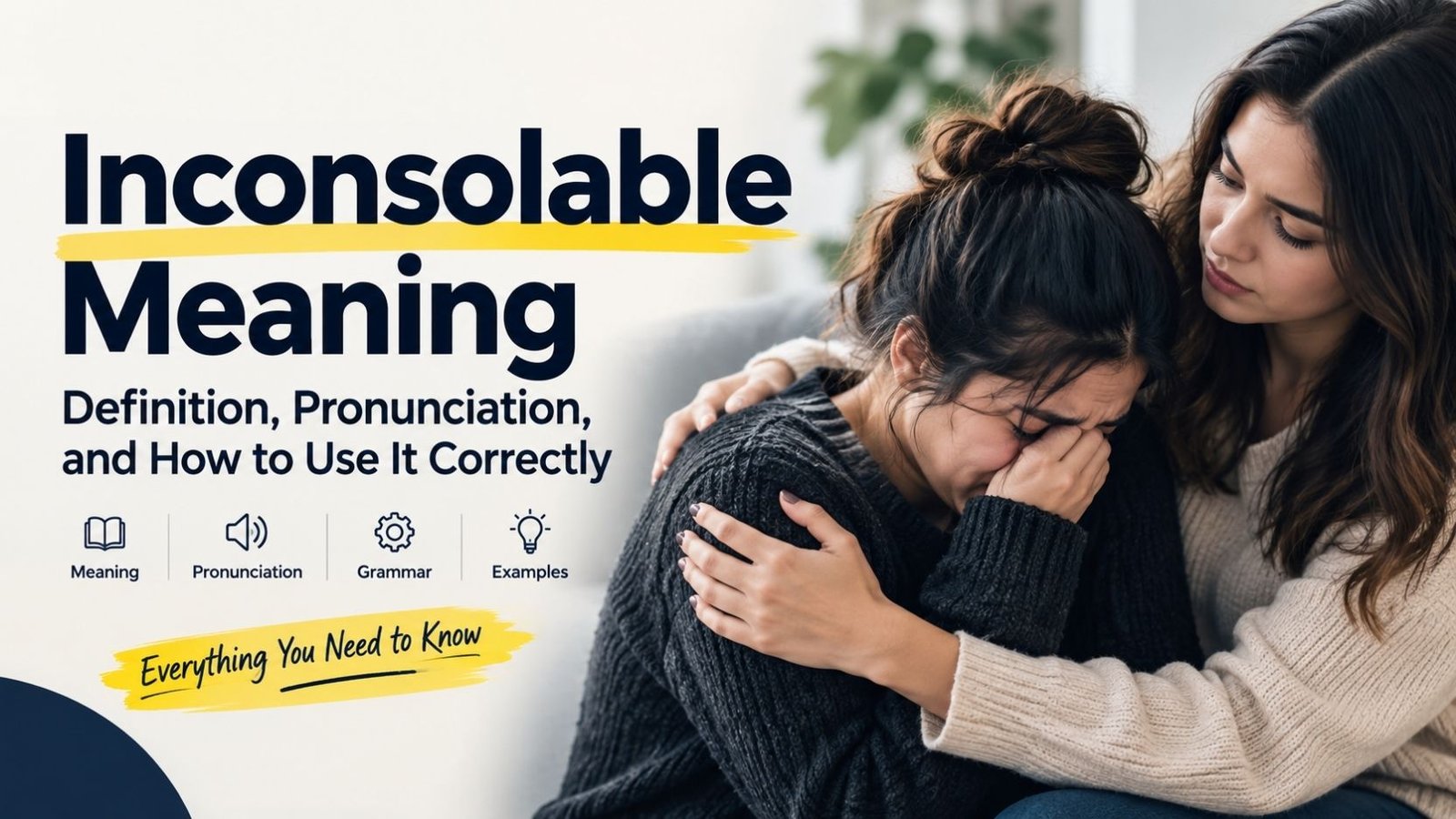
Inconsolable meaning, in simple terms, describes someone who is too sad to be comforted. It is an adjective used for grief, loss, or deep disappointment. When a person is inconsolable, kind words, hugs, or reassurance do not seem to help. Nothing anyone says can ease the sadness, at least not right away.
This word shows up often in news reports, medical notes about crying babies, and everyday conversation about grief. Understanding its exact meaning helps you use it correctly and avoid confusing it with milder words like “sad” or “upset.” It also helps you recognize the emotional weight the word carries, since it is stronger than most everyday sadness words.
Inconsolable Meaning: A Simple Definition
Inconsolable means unable to be comforted or consoled, usually because of extreme sadness, grief, or disappointment. Major dictionaries agree on this core idea, though they phrase it slightly differently.
| Source | Definition |
| Merriam-Webster | Incapable of being consoled, disconsolate |
| Cambridge Dictionary | So sad or disappointed that it is impossible for anyone to make you feel better |
| Britannica Dictionary | Extremely sad and not able to be comforted |
| Collins Dictionary | Very sad and cannot be comforted |
| Oxford Learner’s Dictionary | So unhappy that nothing can make you feel better |
Notice the pattern. Every definition points to two things: extreme sadness, and the failure of comfort to fix it. That second part is what makes inconsolable different from ordinary sad words. A person can be sad and still feel better after a hug or a kind conversation. An inconsolable person cannot, at least not in that moment.
See more:IMY Meaning In Text
What Type of Word Is Inconsolable?
Inconsolable is an adjective. It describes a person, a state of mind, or sometimes an emotion itself, such as inconsolable grief or inconsolable crying.
- Part of speech: adjective
- Comparative and superlative forms: inconsolable does not usually take “more” or “most” in casual speech, since it already expresses an extreme; writers use “utterly inconsolable” or “completely inconsolable” instead
- Adverb form: inconsolably, meaning “in a way that cannot be comforted”
- Related noun form: inconsolability, though this is rare in everyday writing
Example Sentence Table
| Form | Example |
| Adjective | She was inconsolable after hearing the news. |
| Adverb | He wept inconsolably at the funeral. |
How To Pronounce Inconsolable
Inconsolable is pronounced ihn-kuhn-SOH-luh-buhl, with the main stress falling on the third syllable, “SOH.”
- IPA (American English): /ˌɪnkənˈsoʊləbəl/
- IPA (British English): /ˌɪnkənˈsəʊləbəl/
The word has five syllables: in-con-so-la-ble. American and British pronunciations are almost identical. The small difference is in the vowel sound of the stressed syllable, where American English uses a clearer “oh” sound and British English uses a slightly rounded version of the same sound.
Tip: If you are unsure, break the word into two familiar pieces first. Think of “console,” as in comforting someone, then add “-in” at the front and “-able” at the end.
Origin Of Inconsolable
Inconsolable comes from Latin. It entered English in the late sixteenth century, either directly from Latin or through French. The root is the Latin word inconsolabilis, which combines “in-” meaning “not,” with “consolabilis,” meaning “able to be consoled.” That word traces back further to the Latin verb consolari, built from “con-” meaning “with,” and “solari,” meaning “to soothe” or “to comfort.”
So the word has always meant the same basic thing: not able to be soothed. English simply borrowed that meaning whole, without much change, which is part of why the word still feels formal and precise centuries later.
How Is Inconsolable Used in a Sentence?
Inconsolable almost always describes people, or the emotional state connected to a person, rather than objects or situations.
- She was inconsolable when she learned that her grandmother had passed away.
- The child became inconsolable after losing his favorite toy.
- After the layoffs were announced, several employees looked inconsolable.
- His inconsolable grief was obvious to everyone in the room.
- The widow remained inconsolable for weeks after the funeral.
Notice the pattern in these examples. The word almost always follows a form of “to be” (was, became, looked, remained) or comes right before a noun like “grief” or “crying.” That structure is worth remembering, since it reflects how native speakers naturally use the word.
Inconsolable in Different Contexts
The core meaning of inconsolable stays the same everywhere it appears, but the situations around it change depending on context.
Inconsolable Grief Meaning
Inconsolable grief refers to sorrow so deep that comfort does not seem to reach it. This phrase appears often in obituaries, news coverage of tragedy, and personal writing about loss. It usually describes the earliest, rawest stage of mourning, before any healing has had time to begin.
Inconsolable Crying Meaning
Inconsolable crying describes crying that will not stop, no matter what a comforter tries. This phrase is common in two very different settings.
- Everyday emotional contexts, such as a child crying after a disappointment
- Medical and parenting contexts, where it describes a baby who cannot be settled
Inconsolable Meaning Medical
In pediatric and medical writing, inconsolable crying refers to prolonged, intense crying in an infant that does not respond to normal soothing methods like feeding, rocking, or holding. Doctors sometimes use this term as a symptom to note in a medical history, since it can point to conditions like colic, or in rare cases, something that needs closer examination. Parents and caregivers should know that this specific medical use is descriptive, not diagnostic on its own. It simply flags a pattern worth discussing with a pediatrician.
Inconsolable Differences Meaning
You may see the phrase “inconsolable differences” used loosely online, often as a playful twist on the legal term “irreconcilable differences,” which is used in divorce filings. This is informal wordplay rather than an established phrase, so it is best avoided in formal writing. If you mean disagreements that cannot be resolved, “irreconcilable differences” is the correct and recognized phrase.
Inconsolable Meaning for Kids
For younger readers or English learners, here is the simplest possible explanation: inconsolable means “so sad that nothing helps.” Imagine a friend crying so hard that hugs, jokes, and kind words do not make them feel better right away. That is what it means to be inconsolable.
Common Mistakes: Unconsolable or Inconsolable?
Many people wonder whether the correct word is “unconsolable” or “inconsolable.” Both forms exist in English, but they are not equally accepted.
- ✅ Correct and standard: inconsolable
- ⚠️ Less common variant: unconsolable
Unconsolable does appear in some dictionaries and in casual writing, but it is considered a nonstandard variant. Inconsolable is the word found in every major dictionary as the primary entry, and it is the version expected in formal writing, publishing, and academic work. If you are unsure which to use, choose inconsolable.
Incorrect vs Correct Examples
- ❌ Incorrect: She was unconsolable after the accident.
- ✅ Correct: She was inconsolable after the accident.
- ❌ Incorrect: His unconsolable sobbing filled the room.
- ✅ Correct: His inconsolable sobbing filled the room.
The reason inconsolable wins out is simple. The Latin root uses the prefix “in-,” not “un-,” and English absorbed the word directly from that Latin and French history rather than building it fresh from an English root.
Synonyms and Related Words
Inconsolable belongs to a group of words describing deep, comfort-resistant sadness. These words are close in meaning, but they carry small differences worth knowing.
| Word | Meaning | Difference From Inconsolable |
| Heartbroken | Overwhelmed with sadness, often from lost love | Focuses on the cause being heartbreak specifically |
| Devastated | Emotionally destroyed by shocking or terrible news | Often used for sudden, large-scale bad news |
| Despairing | Feeling that there is no hope left | Emphasizes hopelessness more than grief |
| Desolate | Feeling utterly alone and without comfort | Carries a stronger sense of isolation |
| Disconsolate | Very unhappy and unable to be comforted | Nearly identical meaning, but more formal and less common in everyday speech |
| Grief-stricken | Overcome by grief | Ties the sadness specifically to mourning a loss |
Antonyms of inconsolable include words like comforted, consoled, and content, since these describe a state where comfort has actually worked.
Inconsolable in Songs and Pop Culture
The word inconsolable has inspired song titles from more than one artist, and readers researching the word sometimes land here because of a song rather than a dictionary search.
Backstreet Boys, “Inconsolable”
“Inconsolable” was released in 2007 as the lead single from the Backstreet Boys album Unbreakable. It was the group’s first single without member Kevin Richardson, who had left the group in 2006. Group member Nick Carter described the song as being about someone who loves another person deeply but cannot fully commit because of something that happened in the past. In this context, the title reflects heartbreak and unresolved emotional pain rather than literal grief.
See more:GNG Meaning In Text
Katie Gavin, “Inconsolable”
Katie Gavin, lead singer of the band MUNA, released a song called “Inconsolable” in 2024 from her debut solo album, What A Relief. The song explores the difficulty of being emotionally open in a relationship, framed around the idea of coming from a family history of people who are considered inconsolable.
Music writers have described the track as a reflection on generational patterns and their impact on emotional well-being, paired with a bluegrass-folk sound. Here, the word points to an inherited difficulty in accepting comfort or love, rather than grief over a single event.
Both songs use “inconsolable” in the same core sense the dictionary defines: an emotional state that resists being soothed. The Backstreet Boys use it for romantic longing, while Katie Gavin uses it for generational emotional patterns, showing how flexible the word is in creative writing.
Inconsolable Meaning In Indian Languages
English learners across South Asia often search for how “inconsolable” translates into their own language. Because the word describes an emotional state rather than a physical object, many Indian languages express it with a descriptive phrase rather than one single fixed word, and the exact word chosen can vary between dictionaries, regions, and formal versus everyday speech.
| Language | Commonly Used Translation | Notes |
| Hindi | असांत्वनीय | The standard dictionary equivalent, built the same way as English, from “not” plus “able to be consoled” |
| Telugu | ఓదార్చలేని | Roughly means “unable to be consoled or comforted” |
| Tamil | சமாதானமாக இல்லாத | Descriptive phrase meaning “not able to be pacified or comforted” |
| Marathi | असह्य दुःखी / सांत्वन न होणारा | Used to describe unbearable grief that cannot be soothed |
| Urdu | تسلی نہ ہونے والا | Descriptive phrase meaning “one who cannot be consoled” |
| Bengali | সান্ত্বনাহীন | Meaning “without consolation” |
| Malayalam | ആശ്വസിപ്പിക്കാനാവാത്ത | Meaning “unable to be comforted” |
⚠️ Note: These translations reflect the general meaning of inconsolable rather than one single official word, since several of these languages describe the idea with a short phrase instead of a single adjective. If you are translating for formal or professional writing, it is worth checking a dedicated bilingual dictionary for your specific dialect or region, since word choice can vary.
British English Vs American English Usage
Inconsolable behaves the same way in both British and American English. There is no spelling difference, no meaning difference, and no regional preference for one form over the other. This is unlike many English words that shift slightly between the two dialects, such as “colour” versus “color.”
The only real difference is pronunciation, and even that difference is small. British speakers tend to soften the stressed vowel slightly, while American speakers pronounce it a bit more openly. Either pronunciation is correctly understood anywhere English is spoken.
Formal usage is consistent across both dialects too. You will find inconsolable in British newspapers, American news coverage, academic writing on both sides of the Atlantic, and literature from every English-speaking country. It is not slang, and it is not informal. It belongs in professional writing just as comfortably as it belongs in a personal diary entry about grief.
Formal, Informal And Everyday Usage
Inconsolable works well across almost every register of English, which is part of why it appears so often.
- Formal usage: News reports, obituaries, academic writing, and legal or medical documentation often use inconsolable to describe a person’s emotional state with precision. “The victim’s family remained inconsolable throughout the proceedings” is a typical formal sentence.
- Everyday usage: In daily conversation, people use inconsolable to describe strong reactions to smaller disappointments too, not only tragedy. “My daughter was inconsolable when her ice cream fell on the ground” is common, everyday, slightly exaggerated usage.
- Informal usage: Friends might use the word playfully to describe someone overreacting to a minor setback, such as a favorite team losing a game. This lighter usage still relies on the core meaning, just applied with a wink rather than full seriousness.
This flexibility, moving from tragedy to mild exaggeration, is one reason the word remains common in modern English rather than fading into purely formal or literary use.
More Examples Of Inconsolable In A Sentence
Seeing the word in a range of situations helps make the meaning stick.
- The team was inconsolable after losing the championship game in the final seconds.
- Even her closest friends could not reach her; she stayed inconsolable for days.
- The toddler grew inconsolable the moment his mother left the room.
- Fans outside the stadium were visibly inconsolable when the concert was cancelled.
- He tried every joke he knew, but nothing worked. She was simply inconsolable.
- Grief counselors are trained to sit with people who are inconsolable, without rushing them toward comfort.
Notice how the sentences above cover a wide emotional range, from a lost sports game to genuine grief. The word scales naturally to fit the size of the sadness being described.
Word Forms Related to Inconsolable
| Form | Word | Example |
| Adjective | Inconsolable | She was inconsolable. |
| Adverb | Inconsolably | He cried inconsolably. |
| Root verb | Console | Friends tried to console her. |
| Related adjective | Consolable | A consolable disappointment fades quickly. |
| Related noun | Consolation | He offered a small consolation. |
Seeing the full word family together makes it easier to remember that “in-” simply reverses the meaning of “consolable,” turning “able to be comforted” into “not able to be comforted.”
See More: HG Meaning Slang
Similar Words That Are Easy to Confuse
A few words are close enough to inconsolable in spelling or sound that learners sometimes mix them up.
| Word | Meaning | How It Differs From Inconsolable |
| Irreconcilable | Impossible to bring into agreement, often used for conflicts or disputes | Describes disagreements, not sadness |
| Inconsiderate | Not thinking about the feelings of others | Describes rudeness, not grief |
| Inconsolable | Unable to be comforted because of deep sadness | The correct word for describing overwhelming grief |
Keeping these three apart is easier once you notice that only inconsolable is directly tied to comfort and sadness. The other two describe agreement and consideration, which are unrelated ideas.
Frequently Asked Questions
What does inconsolable mean?
Inconsolable means so sad or upset that nothing can comfort the person, at least not in the moment.
Is inconsolable a noun or an adjective?
Inconsolable is an adjective. It describes a person or an emotional state, such as inconsolable grief.
How do you pronounce inconsolable?
It is pronounced ihn-kuhn-SOH-luh-buhl, with stress on the third syllable.
Is it unconsolable or inconsolable?
Inconsolable is the correct and standard form. Unconsolable exists but is considered nonstandard.
What is the difference between inconsolable and heartbroken?
Heartbroken usually points to lost love as the specific cause of sadness. Inconsolable describes the intensity of sadness itself, regardless of cause, and can follow any kind of loss or disappointment.
Can inconsolable describe something other than sadness?
No. Inconsolable specifically describes an emotional state connected to grief, sorrow, or deep disappointment. It is not used for anger, fear, or other emotions.
What does inconsolable crying mean for a baby?
It describes crying that does not stop with normal soothing methods like feeding, rocking, or holding. Parents sometimes mention this term to a pediatrician if it happens repeatedly.
What is the adverb form of inconsolable?
The adverb form is inconsolably, as in “she cried inconsolably.”
Where does the word inconsolable come from?
It comes from Latin, through the word inconsolabilis, meaning “not able to be consoled,” built from the verb consolari, meaning “to soothe.”
Is inconsolable used in formal writing?
Yes. It appears often in news writing, literature, obituaries, and medical documentation, and it is considered standard, formal vocabulary rather than slang.
Conclusion
Inconsolable meaning comes down to one clear idea: a sadness so deep that comfort cannot reach it. The word has stayed remarkably close to its Latin roots for hundreds of years, keeping the same core sense of being unable to be soothed. Whether it appears in a news story about grief, a pediatrician’s notes about a crying baby, or a song lyric about heartbreak, the word always signals the same emotional weight.
Knowing the correct spelling, the right pronunciation, and the difference between inconsolable and similar words like heartbroken or disconsolate will help you use it with confidence. The next time you read or hear inconsolable, you will recognize exactly what it is describing, and exactly why comfort alone will not be enough to fix it.

Hira Shah is a passionate writer and the author behind Meanz Corner. With 4 years of experience in researching words, meanings, slang, phrases, and names, she creates simple and helpful content for readers. Her goal is to make complex meanings easier to understand through clear, accurate, and reader-friendly explanations.



3 Comments