
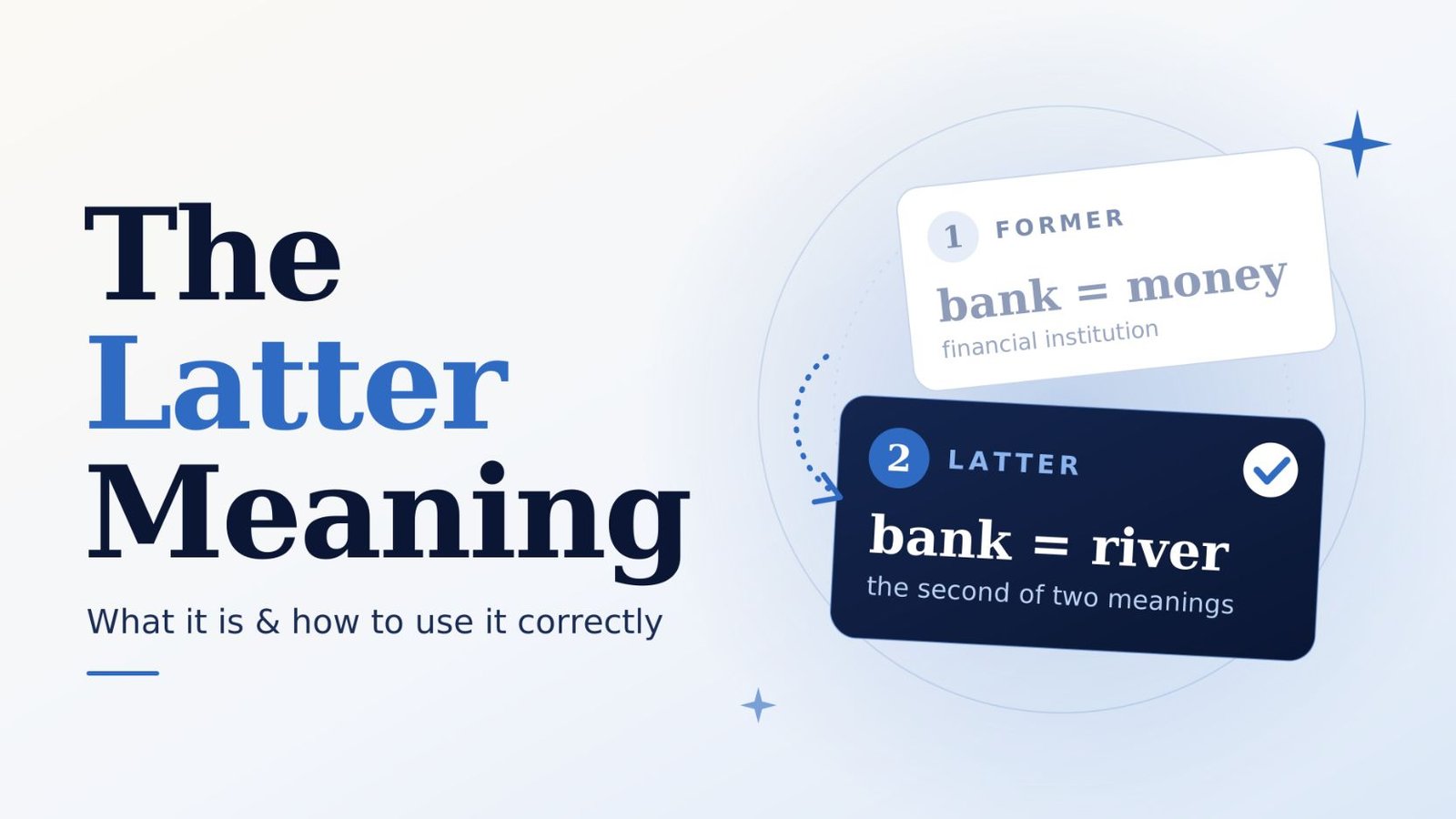
The latter meaning is the second of two meanings that have just been mentioned. The word “latter” points to the second item in a pair. If a word has two senses and someone says “I mean the latter,” they mean the second sense.
The phrase matters because it saves repeating yourself. It works only when two things have already been named. Used in the wrong place, it confuses readers, so it helps to know exactly how it works.
What Does “The Latter Meaning” Mean?
Quick answer: “The latter meaning” is the second of two meanings that were listed just before it. It does not point to a meaning that comes “later” in time. It points to the second one in a list of two.
Take this sentence: “The word ‘bank’ can mean a financial institution or the side of a river. Here, it has the latter meaning.” The two meanings are the financial institution and the riverside. The latter meaning is the riverside.
Two parts make up the phrase:
- The latter means the second of two things already named.
- Meaning is the sense or idea a word carries.
Together, they tell the reader which of two senses is intended.
See more:Uphill Battle Meaning
The Opposite: The Former Meaning
The opposite of “the latter” is “the former.” The former is the first of the two items.
| Term | What It Points To | Example |
| The former | The first of two things | “Tea or coffee? I prefer the former.” (tea) |
| The latter | The second of two things | “Tea or coffee? I prefer the latter.” (coffee) |
So “the former meaning” is the first meaning, and “the latter meaning” is the second. People often write “the former and the latter meaning” when they are comparing both senses side by side.
What Type of Word Is “Latter”?
“Latter” can work as an adjective, a noun, or a pronoun, depending on the sentence. Here is a quick guide.
| Part of Speech | Meaning | Example |
| Adjective | Near the end, or the second of two | “The latter half of the book is better.” |
| Noun or pronoun | The second of two things | “I read both books. The latter was longer.” |
In “the latter meaning,” “latter” is an adjective. It describes the word “meaning.” In “I prefer the latter,” it works as a pronoun that stands in for the second option.
Dictionaries list both uses. The adjective sense covers two ideas: the second of two, and the later or final part of something. These are close but not identical, and the difference matters.
How Do You Use “The Latter” in a Sentence?
Use “the latter” when you have named exactly two things and want to refer to the second one without repeating it. The pair must be clear from context.
Here are a few natural examples:
- “She offered me a train ticket or a bus ticket. I chose the latter.”
- “The word ‘light’ can mean not heavy or not dark. In your sentence, it has the latter meaning.”
- “Some people love summer and others love winter. I belong to the latter group.”
In each case, the reader can look back and find two items. The second one is the answer.
💡 Tip: Before you write “the latter,” check that you named two things right before it. If you cannot point to a clear pair, rewrite the sentence.
The Two Core Meanings of “Latter”
Let us separate the meanings so they do not blur together.
Meaning 1: The Second of Two Things
This is the most common use. It refers to the second item in a pair.
- “Jack and Tom came to dinner. The latter brought a cake.” (Tom brought it.)
Meaning 2: Near the End of a Period or Sequence
Here, “latter” means the later or final part of something. It does not need a pair.
- “He did his best work in the latter part of his career.”
- “The latter half of the year was busy.”
This second sense is why “latter” is sometimes confused with “later.” They are related, but they are not interchangeable. We cover that below.
“The Latter Meaning” in Everyday Phrases
Readers often search for the phrase in short, natural combinations. These are the most common patterns and what they mean.
| Phrase | What It Means | Example |
| I choose the latter meaning | I pick the second of the two senses | “Both readings work, but I choose the latter meaning.” |
| I prefer the latter meaning | I like the second sense better | “The word has two senses, and I prefer the latter meaning.” |
| Probably the latter meaning | It is likely the second sense | “The author is probably using the latter meaning.” |
| If it’s the latter meaning | If the second sense is the right one | “If it’s the latter meaning, the sentence makes more sense.” |
| It’s the latter meaning | The second sense is the correct one | “In this sentence, it’s the latter meaning.” |
| Go with the latter meaning | Use or accept the second sense | “I would go with the latter meaning here.” |
| Take the latter meaning | Accept the second sense as the answer | “I’ll take the latter meaning.” |
| The former or the latter meaning | Asking which of the two senses applies | “Is it the former or the latter meaning?” |
All of these work the same way. They point to the second of two senses that were already discussed. The words around “the latter meaning” only change how the writer feels about that choice.
When Should You Use “The Latter Meaning”?
Use it in situations where two senses of a word, phrase, or sentence are in play. Here are the most common settings.
- Dictionary work. A word has two senses, and you want to point to the second one.
- Reading and analysis. A line can be read two ways, and you pick the second reading.
- Editing and feedback. You are telling a writer which of two interpretations you mean.
- Everyday conversation. Someone asks, “Did you mean A or B?” and you answer, “The latter.”
It is especially useful when the two meanings are long or awkward to repeat. Instead of restating the whole second meaning, you simply say “the latter.”
See more:Latter Meaning
Latter vs. Later: A Common Confusion
These two words look alike and sound alike. Their meanings are different.
| Word | Meaning | Example |
| Latter | The second of two, or near the end | “The latter option is cheaper.” |
| Later | At a time after now, or after something else | “I will call you later.” |
Here is an easy way to remember it. “Later” is about time and works as an adverb or adjective in many sentences. “Latter” is about position in a pair or near the end of something.
⚠️ Common mistake: Writing “later” when you mean the second of two items.
Incorrect: “I read the report and the summary. The later was clearer.”
Correct: “I read the report and the summary. The latter was clearer.”
“The later” is not standard usage when you mean the second of two. “The latter” is the correct form.
Latter vs. Ladder: A Spelling and Sound Trap
Some searches use “the ladder meaning” when people actually mean “the latter meaning.” The reason is sound.
In American English, a “t” between two vowels often sounds like a quick “d.” This is called flapping. So “latter” and “ladder” can sound almost identical when spoken fast.
| Word | Meaning | Example |
| Latter | The second of two things | “I prefer the latter.” |
| Ladder | A set of steps for climbing | “He climbed the ladder.” |
They sound alike in American speech, but they are spelled differently and mean different things. When you are writing, always check which one you need.
Incorrect: “Of the two choices, I prefer the ladder.”
Correct: “Of the two choices, I prefer the latter.”
How Do You Pronounce “Latter”?
Here is the simple guide.
- Simple pronunciation: LAT-er
- American English (IPA): /ˈlætər/
- British English (IPA): /ˈlætə/
- Syllables: Two (lat·ter)
- Stress: On the first syllable
In American English, the middle “t” often softens into a quick “d” sound. That is why it can sound like “ladder.” In British English, the “t” is usually clearer and sharper.
The first vowel sounds like the “a” in “cat.” Do not stretch it like the “a” in “late.” That would turn it into “later.”
Where Does the Word “Latter” Come From?
“Latter” comes from Old English. It began as a form of the word “late,” which once meant slow or tardy. The older form was close to “lætra,” a comparative form meaning “later” or “slower.”
Over time, English developed two forms from this one root. “Later” became the regular comparative of “late,” used for time. “Latter” kept the older shape and developed a narrower role, pointing to the second of two or the final part of something.
This history explains why the two words feel so close. They share a root, but English gave them different jobs. For the exact dates and stages of this development, a major historical dictionary such as the Oxford English Dictionary is the most reliable place to check.
The Rule About “Two Things Only”
This is the point most readers miss. Traditional grammar says “the latter” should be used only when exactly two things have been named. It means the second of two.
When there are three or more items, the traditional choice is “the last” or “the last one.” Using “the latter” for the final item in a longer list is common in speech and writing, but some style guides treat it as less careful.
| Number of Items | Traditional Choice | Example |
| Two | The former / the latter | “Cats and dogs: I like the latter.” |
| Three or more | The first / the last | “Red, blue, or green: I like the last.” |
✅ Correct: “I tried the pasta and the pizza. The latter was better.”
❌ Less careful: “I tried the pasta, the pizza, and the salad. The latter was better.”
In the second example, a reader may not know whether “the latter” means the salad or the pizza. Writing “the last” avoids that doubt. Usage guides differ on how strict to be, so when clarity matters, rename the item instead of relying on “the latter.”
Common Mistakes With “The Latter Meaning”
Here are the mistakes that confuse readers most often.
Mistake 1: Using “Latter” for a List of Three or More
Incorrect: “The word has three meanings. I choose the latter meaning.”
Correct: “The word has three meanings. I choose the last meaning.”
With three meanings, “the latter” is ambiguous. Use “the last” or give the number, such as “the third meaning.”
Mistake 2: Using “The Latter” Without a Clear Pair
Incorrect: “I prefer the latter meaning.” (No meanings were mentioned before.)
Correct: “The word can mean a person or a thing. I prefer the latter meaning.”
“The latter” is a pointer. It needs something to point back to. If the reader has not seen the two meanings, the phrase has nothing to refer to.
Mistake 3: Mixing Up “Latter” and “Later”
Incorrect: “The later meaning is more common.”
Correct: “The latter meaning is more common.”
“Later” talks about time. If you mean the second of two meanings, “latter” is the right word. If you truly mean a meaning that developed later in history, “later” can be correct, but then you are describing time and not position in a pair.
Mistake 4: Confusing the Order
Incorrect: “The word means a bat (animal) or a bat (sports). The latter is the animal.”
Correct: “The word means a bat (animal) or a bat (sports). The former is the animal.”
The latter is always the second item named. Always check the order in your own sentence.
Mistake 5: Using “The Latter” When the Meaning Is Unclear
Sometimes a long sentence puts several noun phrases between the pair and the pointer. The reader then loses track of which one is the latter.
Unclear: “The editor told the author that the manuscript of the novel, which the publisher wanted, was too long. The latter needed cuts.”
Clearer: “The editor told the author the manuscript was too long. The manuscript needed cuts.”
When in doubt, repeat the noun. Clarity matters more than elegance.
“The Former and the Latter Meaning” Explained
People often use both words together to compare two senses. This is a clean way to organize a short analysis.
Consider the word “cleave.” It has two nearly opposite meanings:
- The former meaning: to split apart. (“He cleaved the log in two.”)
- The latter meaning: to cling or stick together. (“She cleaved to her faith.”)
Here, the former is “split apart” and the latter is “cling together.” Saying “the former and the latter meaning” makes the comparison tidy and short.
Writers often use this pattern for words that have two distinct senses, including words that mean opposite things. Linguists call such words contronyms, or Janus words. “Cleave” is a commonly cited example.
“The Former vs. the Latter Meaning” Side by Side
| Feature | The Former | The Latter |
| Position | First of two | Second of two |
| Memory trick | “F” for first | “L” for last |
| Example | “I like tea and coffee, the former more.” | “I like tea and coffee, the latter more.” |
| Points to | Tea | Coffee |
💡 Tip: Remember that “latter” and “last” both start with “L.” The latter is the last of the two.
Synonyms and Related Words
There is no perfect one word replacement for “the latter,” because it is a pointer and not a name. Still, a few phrases do similar work.
| Word or Phrase | Meaning | How It Differs |
| The second | The second item in order | Works for any list, not only pairs |
| The last | The final item | Works for pairs or longer lists |
| The second one | The second of a pair | More casual and conversational |
| The latter half | The second half of something | Describes a period, not a pair |
| The final | The one at the end | Stresses ending, not pairing |
Choose “the second” or “the last” when you have more than two items. Choose “the latter” when you have exactly two and want a polished, compact reference.
Opposites and Related Terms
The main opposite is “the former.” Other related words include:
- Preceding: coming before something.
- Following: coming after something.
- Previous: the one before.
- Subsequent: coming after in time or order.
Of these, only “the former” is the true partner of “the latter.” The others describe order or time, but they do not point to one of two named items in the same neat way.
The Phrase in Other Languages
Many readers look up how to say “the latter” in other languages. Here are close equivalents with their meaning.
| Language | Common Equivalent | Notes |
| Hindi | बाद वाला (baad wala) | Often means “the later one” or “the second one” |
| Bengali | শেষোক্ত (shesokto) | A formal word meaning “the last mentioned” |
| Tagalog | Ang huli / ang huling nabanggit | “The last” or “the last one mentioned” |
Translations can shift slightly based on context and formality. For formal or legal documents, a professional translator or a trusted bilingual dictionary is the safer choice.
Is There Slang for “The Latter”?
No widely recognized slang meaning exists for “the latter.” It is a standard, slightly formal English word. In casual speech, people often replace it with “the second one” or “the last one.”
Be careful with websites that claim a slang meaning for it. Without a reliable dictionary source, such claims should not be treated as fact. If you hear it in an unusual setting, check the context.
“The Glory of the Latter” and Other Famous Uses
Some readers search for “the glory of the latter” because it appears in a well known biblical verse. The Book of Haggai, chapter 2, verse 9, in the King James Version, speaks of the glory of the “latter house” being greater than the “former.” In that line, “latter” and “former” contrast two houses, and “latter” points to the second.
That usage shows how old the pair “former and latter” is in English. It also shows that “latter” has long been used in formal and solemn writing.
Another familiar use is in the name “Latter Day Saints,” where “latter days” refers to the last period of time. That is the “near the end” sense of the word, not the “second of two” sense.
Formal vs. Informal Use
“The latter” is somewhat formal. You will see it often in essays, reports, legal writing, news, and academic work. It is less common in casual chat.
| Setting | Typical Choice | Example |
| Formal writing | The latter | “Of the two proposals, the latter is more practical.” |
| Casual speech | The second one | “Of the two, the second one is more practical.” |
Neither is wrong. Pick the tone that fits your reader. Both American and British English use “latter” in the same way, so there is no major regional difference in meaning.
How to Choose Between Two Meanings in Practice?
When a word has two senses and you need to decide which one applies, try this simple method.
- List both meanings clearly. Write them in order.
- Read the sentence around the word. Look at the nearby words for clues.
- Test each meaning. Swap in the meaning and see if the sentence makes sense.
- Pick the one that fits. Then say “the former” or “the latter” to name your choice.
For example, take the word “bark” in “The bark was rough.” If the sentence is about a tree, you choose the tree meaning. If the sentence is about a dog, you choose the sound. If those were listed as the former (tree) and the latter (dog sound), you would say which one the sentence uses.
This is the exact situation behind phrases like “probably the latter meaning” or “I choose the latter meaning.” They express a careful pick between two senses.
Hedging Your Choice: “Probably” and “If”
Some phrases soften the choice. They are common when the writer is not fully sure.
- “Probably the latter meaning” shows that the second sense is likely, but not certain.
- “If it’s the latter meaning” sets up a condition, as in “If it’s the latter meaning, then the sentence is a joke.”
- “Not the latter meaning” rules out the second sense.
- “Better than the latter meaning” compares one option against the second.
These small words let the writer show how confident they are. They are useful in editing notes, class discussions, and dictionary comparisons.
A Quick Reference Box
Definition: “The latter meaning” is the second of two meanings just mentioned.
Opposite: The former meaning.
Part of speech: Adjective (before a noun) or pronoun (alone).
Use with: Exactly two items.
Do not confuse with: Later (time), ladder (climbing tool).
Pronunciation: LAT-er.
See more:Sweet Tooth Meaning
Frequently Asked Questions
What does “the latter meaning” mean?
It means the second of two meanings that were just named. The word “latter” points to the second item in a pair.
What is the difference between “the former” and “the latter”?
“The former” is the first of two things. “The latter” is the second. Both need a clear pair before them to make sense.
Is “latter” a noun, adjective, or pronoun?
It can be any of the three, depending on the sentence. In “the latter meaning,” it works as an adjective. In “I prefer the latter,” it works as a pronoun.
How do you pronounce “latter”?
Say it as LAT-er, with stress on the first syllable. In American English, the middle “t” often sounds like a soft “d.”
Can you use “the latter” for three or more items?
Traditionally, no. “The latter” is meant for exactly two items. For three or more, use “the last” or name the item.
What is the difference between “latter” and “later”?
“Latter” refers to the second of two, or to the final part of something. “Later” refers to a time after now or after something else.
Is “latter” the same as “ladder”?
No. They can sound alike in American English, but “latter” points to the second of two, and “ladder” is something you climb.
Is there slang for “the latter”?
No widely accepted slang meaning exists. It is a standard English word, and casual speakers often say “the second one” instead.
What does “the glory of the latter” mean?
It comes from a verse in the Book of Haggai, where “latter” contrasts with “former” when speaking of two houses. In that verse, the latter refers to the second of the two.
Can I say “I choose the latter meaning”?
Yes. It is correct as long as two meanings have already been named. It tells the reader you are picking the second one.
Conclusion
“The latter meaning” is the second of two meanings that have just been mentioned. It depends on a clear pair, and it is the partner of “the former meaning.” It is not the same as “later,” and it should not be confused with “ladder.” Used with exactly two items, it keeps your writing short and clear.
The best habit is simple. Before you write “the latter,” check that you named two things and that the second one is obvious. If there are three or more, or if the reader might lose track, say the meaning plainly instead. That small check makes your writing clearer, and it makes the phrase work every time.

Hira Shah is a passionate writer and the author behind Meanz Corner. With 4 years of experience in researching words, meanings, slang, phrases, and names, she creates simple and helpful content for readers. Her goal is to make complex meanings easier to understand through clear, accurate, and reader-friendly explanations.


One Comment