
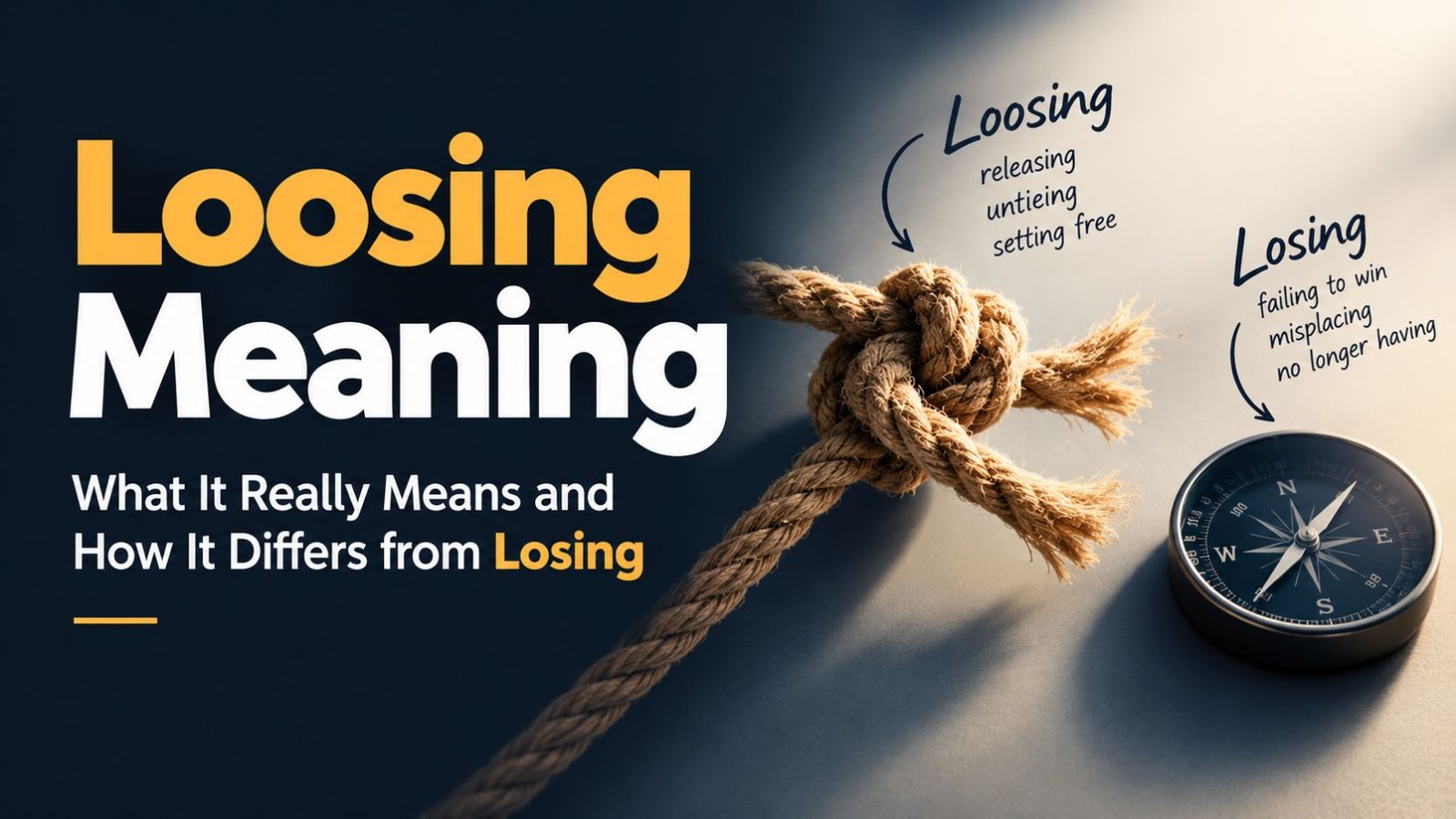
Loosing means setting something free, untying it, or making it less tight. It is the present participle of the verb “loose,” which means to release or unfasten. It is not the same as “losing,” which comes from “lose” and means failing to keep something or failing to win.
Many people type “loosing” when they mean “losing.” That is the most common spelling mistake with this word. This guide explains what loosing really means, when it is correct, and how to tell it apart from losing. It also covers the Bible phrase “binding and loosing,” pronunciation, origin, and meanings in several languages.
Quick Answer: Loosing vs Losing
| Word | Base verb | Meaning | Example |
| Loosing | loose | Releasing, untying, setting free | The guard is loosing the dog’s leash. |
| Losing | lose | Misplacing, failing to win, no longer having | I keep losing my keys. |
Tip: If you mean “misplacing” or “not winning,” use losing with one “o.” Use loosing only when you mean releasing or unfastening.
See more:Supposably Meaning
What Does Loosing Mean?
Loosing is a verb form. It describes the action of releasing, untying, or freeing something. It can also mean making something less tight, or firing an arrow or shot.
The base verb is “loose.” Do not confuse it with the adjective “loose,” which means not tight or not firmly fixed. A loose button is an adjective use. Loosing a button is the verb action.
Meaning 1: Releasing or Setting Free
This is the most common meaning of loosing. It means letting something go from restraint.
- The farmer is loosing the horses into the field.
- The rescuers were loosing the ropes that held the boat.
Meaning 2: Untying or Unfastening
Here, loosing means undoing a knot, strap, or fastening. This use sounds a little formal or old fashioned today. Most people now say “untying” or “loosening.”
- She spent a minute loosing the knot on the bag.
Meaning 3: Firing or Shooting
In older and literary English, to loose means to shoot an arrow or fire a weapon. You may see this in historical writing and fantasy fiction.
- The archers were loosing arrows at the wall.
Meaning 4: Releasing Something Abstract
Loosing can also describe releasing a force, feeling, or power. This use is often figurative.
- The speech was loosing a wave of anger in the crowd.
Loosing Grammar: Part of Speech and Word Forms
Loosing is the present participle and gerund form of the verb “loose.” It is built by adding “ing” after dropping the silent “e.” The same rule gives “losing” from “lose,” which is one reason the two words get mixed up.
| Form | Loose (verb) | Lose (verb) |
| Base form | loose | lose |
| Third person singular | looses | loses |
| Past tense | loosed | lost |
| Past participle | loosed | lost |
| Present participle | loosing | losing |
Notice the past tense. “Loosed” and “lost” are not alike at all. That gap is a quick way to check which verb you need. If your past tense would be “lost,” the word you want is “losing.”
See more:Resignate Meaning
Loosing in a Sentence
Loosing works in continuous tenses and as a gerund.
- Continuous tense: The crew is loosing the sails.
- Gerund as subject: Loosing the dogs too early ruined the hunt.
- After a preposition: He is known for loosing arrows with great accuracy.
⚠️ Is “loosing” a word? Yes. It is a real English word, listed in major dictionaries as a form of “loose.” It is just not the word people usually want when they write about losing a game, a person, or weight.
Losing or Loosing: Which One Is Correct?
Use this simple check. Ask yourself whether you mean “failing to keep or win.” If yes, use losing.
Losing or Loosing a Game?
The correct form is losing a game. You are failing to win.
✅ Our team is losing the match.
❌ Our team is loosing the match.
Losing or Loosing a Person?
For the death of someone or the end of contact, the correct form is losing a person. “Losing someone” means that person is gone from your life.
✅ She is afraid of losing her best friend.
❌ She is afraid of loosing her best friend.
Losing or Loosing Weight?
The correct form is losing weight. You are reducing your body weight, which is a form of no longer having it.
✅ He is losing weight slowly.
❌ He is loosing weight slowly.
Other Common Phrases with Losing
These phrases all take the single “o” spelling:
- Losing interest: no longer feeling curious or engaged.
- Losing control: being unable to manage a situation or yourself.
- Losing hair: hair falling out, often called hair loss.
- Losing my mind: feeling confused or overwhelmed, often said as an exaggeration.
- Losing up: this is not standard English. If you mean to relax or become less tense, the phrase is “loosening up.” If you mean “lose out,” that is different again.
⚠️ Common mistake: “Loosing weight” and “loosing a game” are both wrong. They are spelling errors, not alternate forms.
Common Mistakes with Loosing and Losing
Mistake 1: Using loosing for “not winning.”
Incorrect: We are loosing 3 to 1.
Correct: We are losing 3 to 1.
Why: “Losing” is the form of “lose,” which means failing to win.
Mistake 2: Using losing for “releasing.”
Incorrect: The keeper is losing the lion from its cage.
Correct: The keeper is loosing the lion from its cage.
Why: Here the meaning is to set free, which needs “loose.”
Mistake 3: Mixing up loose and lose in other forms.
Incorrect: I always loose my phone.
Correct: I always lose my phone.
Why: The base verb for misplacing is “lose,” pronounced with a “z” sound.
Mistake 4: Confusing the adjective with the verb.
Incorrect: My tooth is loosing.
Correct: My tooth is loose. Or: My tooth is loosening.
Why: “Loose” is an adjective here. The process word is “loosening.”
How to Pronounce Loosing and Losing?
The difference in sound helps explain the spelling difference.
| Word | Simple pronunciation | IPA (American) |
| Loosing | LOO sing (with an “s” sound) | /ˈluːsɪŋ/ |
| Losing | LOO zing (with a “z” sound) | /ˈluːzɪŋ/ |
The verb “loose” is pronounced like “juice.” The verb “lose” is pronounced like “booze.” In both words the first syllable is stressed. British and American speakers say these words the same way, apart from small differences in accent.
💡 Tip: If you can say “loo-zing” in your head, you probably need the single “o” spelling.
Origin of Loose and Lose
The two words have different roots. That is why their meanings are so different.
Loose entered English in the Middle Ages. It comes from Old Norse lauss, which meant free or not tied. It is related to words in other Germanic languages meaning “free” or “empty.” The idea of being not fixed or not held is still the core of the word.
Lose comes from Old English losian, which meant to be destroyed or to perish. It is connected to an older noun meaning loss. Over time, the meaning shifted from “perish” to “no longer have.” The spelling “lose” settled into standard English, while “loose” took its own path.
So the confusion is not historical. It comes from the fact that the two words look similar, sound close, and share an “ing” ending rule.
Binding and Loosing Meaning in the Bible
The phrase “binding and loosing” appears in the New Testament. It is one of the most searched uses of “loosing” for readers who are not looking up grammar at all.
Where the Phrase Appears?
The phrase appears in two key passages in the Gospel of Matthew:
- Matthew 16:19: Jesus speaks to Peter about the keys of the kingdom of heaven. He says that what Peter binds on earth will be bound in heaven, and what he looses on earth will be loosed in heaven.
- Matthew 18:18: A similar statement is made to the disciples as a group, in the context of settling disputes and church discipline.
What Does Binding and Loosing Mean?
The core idea is authority to declare what is forbidden and what is permitted. In this reading, “binding” means forbidding or declaring something not allowed. “Loosing” means permitting or declaring something allowed.
This use matches language in Jewish teaching of that period. Rabbis used paired terms for forbidding and permitting, such as declaring a practice prohibited or allowed. Many scholars see Matthew’s wording against that background.
How Different Christian Traditions Understand It?
Christians do not all read the phrase the same way. It helps to state this honestly.
| Tradition | Common understanding |
| Catholic | Binding and loosing refers to the authority given by Christ to Peter, and to the apostles and their successors. It connects strongly to the forgiveness of sins and church teaching authority. |
| Many Protestant readers | The phrase refers to the apostles’ authority and the church’s role in declaring forgiveness and discipline, based on the gospel message. Some emphasize it applies to the whole church community. |
| Some charismatic and Pentecostal readers | The phrase is often connected to spiritual authority, including prayer against spiritual opposition. |
These are broad summaries. Within each tradition there are variations, and scholars debate details such as the exact scope of the authority and how to translate the Greek verbs deō (to bind) and lyō (to loose or release).
Why the Greek Matters
The Greek verb lyō can mean to untie, to release, to set free, or to declare permitted. This range explains why “loosing” is the English word used in many translations. It fits both the literal idea of untying and the figurative idea of releasing or permitting.
A Related Phrase: “Loosing the Pangs of Death”
In Acts 2:24, the King James Version says God raised Jesus up, “having loosed the pains of death.” The wording “loosing the pangs of death” comes from the same sort of language. Here, “loose” means to release or free from. The phrase describes being set free from the grip of death. Modern translations often use words like “freeing” or “putting an end to.”
Loosing Meaning in Other Languages
Many readers look for the meaning of loosing in their own language. The table below gives common translations of the sense “to release, untie, or set free,” along with the word for “losing” for contrast. Translations can vary by context, so treat these as starting points rather than fixed rules.
| Language | Loosing (releasing, untying) | Losing (failing to keep or win) |
| Hindi | ढीला करना, खोलना, छोड़ देना | खोना, हारना |
| Urdu | کھولنا، چھوڑ دینا | کھونا، ہارنا |
| Bengali | খুলে দেওয়া, ছেড়ে দেওয়া | হারানো |
| Tamil | தளர்த்துதல், விடுவித்தல் | இழத்தல், தோற்றல் |
| Telugu | విప్పడం, వదిలేయడం | కోల్పోవడం, ఓడిపోవడం |
| Kannada | ಬಿಚ್ಚುವುದು, ಬಿಡುಗಡೆ ಮಾಡುವುದು | ಕಳೆದುಕೊಳ್ಳುವುದು, ಸೋಲುವುದು |
| Malayalam | അഴിക്കൽ, മോചിപ്പിക്കൽ | നഷ്ടപ്പെടൽ, തോൽക്കൽ |
| Marathi | सोडणे, सैल करणे | गमावणे, हरणे |
| Tagalog | pagkakalag, pagpapalaya | pagkawala, pagkatalo |
⚠️ Note: These are general translations. For legal, religious, or formal work, check with a native speaker or a trusted bilingual dictionary. The Bible phrase “binding and loosing” is often translated with words closer to “forbidding and permitting” or “tying and untying,” depending on the translation.
Loosing Synonyms and Related Words
Loosing has several close synonyms. Their meanings overlap, but each has a slightly different feel.
| Word | Meaning | Difference from loosing |
| Releasing | Letting go of something held | The most common everyday alternative |
| Freeing | Setting someone or something free | Often used for people, animals, or captives |
| Untying | Undoing a knot or tie | Specifically about knots and ropes |
| Unfastening | Opening a clasp, button, or buckle | About fasteners |
| Loosening | Making less tight | About degree, not full release |
| Unleashing | Setting free with force or intensity | More dramatic, often used figuratively |
| Firing | Shooting a weapon | Used for weapons; “loosing an arrow” is more literary |
Loosing vs loosening: Loosing often means full release. Loosening means making something less tight, not fully free. If you loosen a tie, it is still on your neck. If you loose a rope, it is free.
Antonyms of loosing: binding, tying, fastening, tightening, restraining, holding.
See more:Reckless Meaning
Loosing vs Losing: Side by Side
| Feature | Loosing | Losing |
| Base verb | loose | lose |
| Core idea | Release, free, untie | Fail to keep or win |
| Past tense | loosed | lost |
| Sound of the middle consonant | “s” | “z” |
| Typical objects | Animals, knots, arrows, forces | Games, keys, people, weight, hair |
| Frequency in modern English | Rare, formal, or literary | Very common |
| Example | He is loosing the boat from the dock. | He is losing the argument. |
Simple Ways to Remember the Difference
- Count the letters. “Lose” has lost one “o” compared with “loose.” That is a way to remember that losing means something is gone.
- Think of the past tense. If the past tense is “lost,” use “losing.” If it is “loosed,” use “loosing.”
- Say it out loud. A “z” sound points to losing. An “s” sound points to loosing.
- Check the meaning. If it is about failing to win or no longer having, use losing. If it is about letting go or untying, use loosing.
Tip: When writing quickly, search your text for “loosing” and ask whether you mean “releasing.” If not, change it to “losing.”
Frequently Asked Questions
What does loosing mean?
Loosing means releasing, untying, setting free, or shooting. It comes from the verb “loose.” It is not the usual spelling for failing to win or misplacing something.
Is it losing or loosing a game?
It is losing a game. “Loosing a game” is a spelling mistake because you are failing to win, not releasing anything.
Is it losing or loosing a person?
Use losing. “Losing a person” means that person has died or left your life. “Loosing” would not carry that meaning.
Is loosing a word?
Yes. It is the present participle of “loose,” which means to release or untie. It is a real word, but it is much less common than “losing.”
Is loosing a noun or a verb?
Loosing is a verb form. It can also work as a gerund, which acts like a noun in a sentence, as in “Loosing the dogs was a mistake.”
How do you pronounce loosing?
It is pronounced LOO sing, with an “s” sound in the middle. Losing is pronounced LOO zing, with a “z” sound.
What does binding and loosing mean in the Bible?
It refers to authority to declare what is forbidden (bound) and what is permitted (loosed). It appears in Matthew 16:19 and Matthew 18:18. Different Christian traditions explain its scope in different ways.
What does binding and loosing mean in the Catholic Church?
In Catholic teaching, it is linked to the authority Christ gave to Peter and the apostles. That authority includes teaching and the forgiveness of sins through the Church.
Is it losing weight or loosing weight?
It is losing weight. “Loosing weight” is incorrect.
What is the difference between loosing and loosening?
Loosing usually means fully releasing something. Loosening means making something less tight without fully freeing it.
Conclusion
Loosing meaning comes down to one idea: letting something go. It is the present participle of “loose,” and it covers releasing, untying, setting free, or shooting. It is a real word, but it is not the correct choice for games, people, weight, or hair. Those uses need “losing.”
The easiest way to remember is to check the sound and the past tense. If you hear a “z” and the past tense is “lost,” write losing. If you hear an “s” and you mean releasing, loosing is right, and the same word shapes the biblical phrase “binding and loosing.”

Hira Shah is a passionate writer and the author behind Meanz Corner. With 4 years of experience in researching words, meanings, slang, phrases, and names, she creates simple and helpful content for readers. Her goal is to make complex meanings easier to understand through clear, accurate, and reader-friendly explanations.



3 Comments