
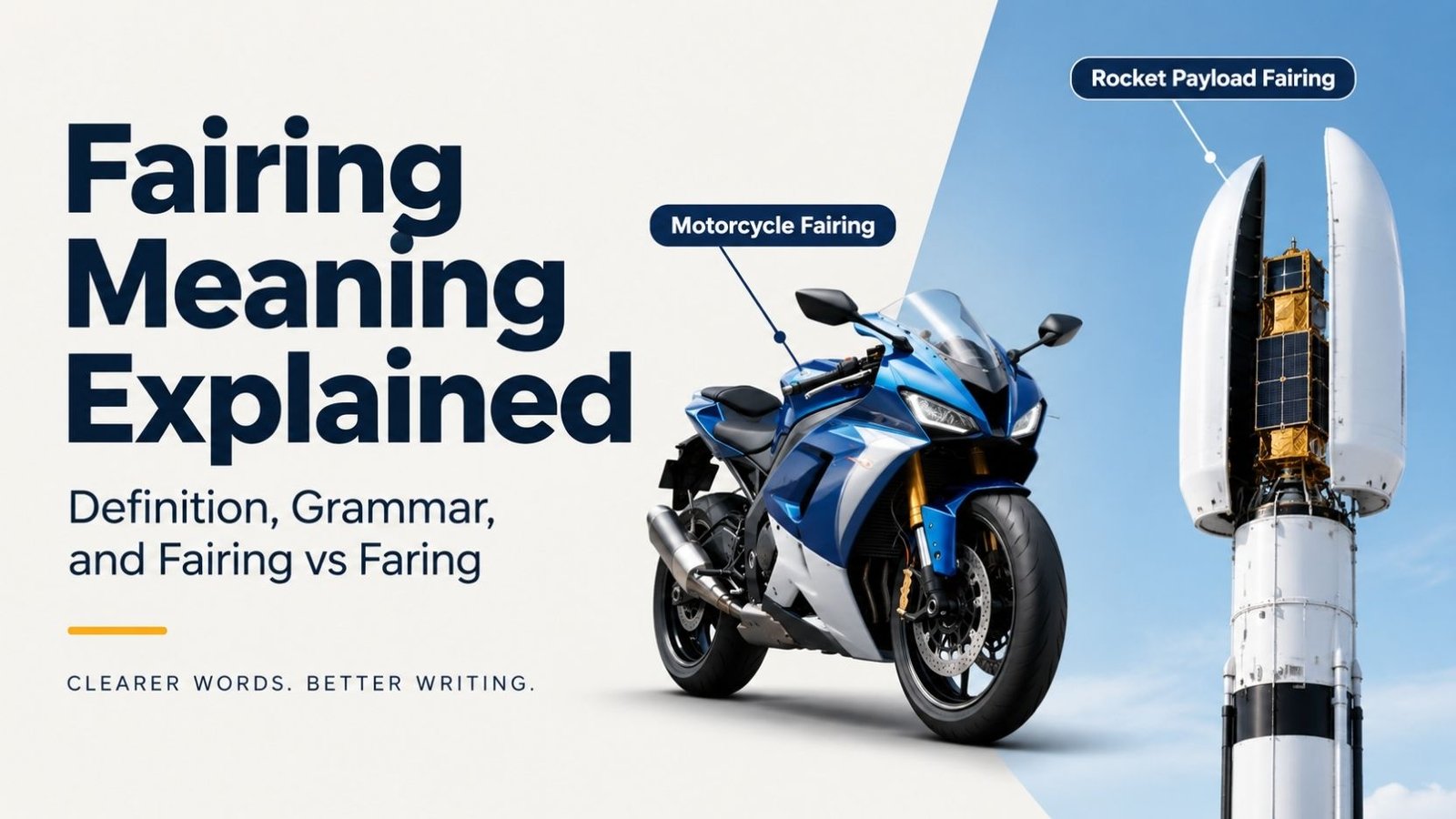
Fairing meaning depends almost entirely on context, and that is what makes this word so easy to misunderstand. In engineering, a fairing is a smooth outer covering fitted to a vehicle to reduce drag. In everyday speech, many people type “fairing” when they actually mean “faring,” the present participle of the verb “fare,” as in “how are you faring.” Both words are correct English, but they mean completely different things and come from completely different roots.
This guide explains every common meaning of fairing in clear, simple language. It covers the grammar behind fairing versus faring, the technical meanings used in aviation, motorcycles, and rockets, the older meaning tied to gifts from a fair, and the specific confusion many readers have around the phrase “how are you fairing.” Each section is written to answer one clear question, so you can read the whole article or jump straight to the part you need.
What Does Fairing Mean?
Fairing has two distinct dictionary meanings, and neither one is a misspelling of “faring.” Both are legitimate nouns that come from different origins.
Meaning 1: A gift or treat, especially from a fair. This is the older sense of the word. A fairing was originally a small present, often a cake, ginger biscuit, or trinket, bought or given at a country fair. This meaning dates back to the 1570s and comes from the noun “fair,” meaning a market or festive gathering, combined with the suffix “ing.”
Meaning 2: A smooth structural covering that reduces drag. This is the meaning most people search for today. A fairing is a shell or panel fitted to a vehicle, aircraft, rocket, or piece of equipment to create a smoother, more aerodynamic shape. This sense comes from the verb “fair,” meaning to smooth or even out a surface, not from the noun “fair” at all.
So when someone asks what fairing means, the honest answer is that it depends on the sentence. A “motorcycle fairing” and a “fairing from the county fair” share a spelling but not a history.
See More: Reenforce Meaning
Fairing or Faring: The Most Common Confusion
This is the single most searched question connected to this word, so it deserves a direct answer before anything else.
Faring comes from the verb “fare,” which means to get along, manage, or progress, usually in terms of health, success, or wellbeing. “Faring” is the present participle form, used after “be” verbs like “is,” “are,” and “was.”
Fairing is a noun. It refers to either a gift from a fair or a smooth aerodynamic covering. It is not the correct word to use when asking how someone is doing.
| Word | Part of Speech | Meaning | Example |
| Faring | Verb (present participle) | Getting along, progressing, doing well or badly | How are you faring after the move? |
| Fairing | Noun | A drag-reducing cover, or a gift from a fair | The motorcycle has a new fairing. |
💡 Quick Tip: If you can replace the word with “doing,” you need “faring.” If you can replace it with “a cover” or “a gift,” you need “fairing.”
How Are You Faring or Fairing: Which Is Correct?
The correct phrase is “how are you faring.” This is a standard, slightly formal English expression that asks how someone is coping with a situation, task, or period of time. It is closely related to “how are you doing” or “how are you getting on.”
“How are you fairing” is a common misspelling. It shows up constantly in casual writing, text messages, and even in published articles, because “fairing” and “faring” sound identical when spoken aloud. Spellcheck tools do not always catch the mistake either, since both words exist in the dictionary.
✅ Correct: How are you faring in your new job? ❌ Incorrect: How are you fairing in your new job?
✅ Correct: How is he faring after the surgery? ❌ Incorrect: How is he fairing after the surgery?
The reason this mistake is so persistent is that “fairing” looks like it should be the verb form of “fair,” in the sense of being treated fairly. But that is not how the word works. “Fair” as an adjective does not have a standard “-ing” verb form in this context. The verb you want is “fare,” and its correct present participle is “faring.”
How Am I Fairing or Faring Meaning
The same rule applies in the first person. “How am I faring” means “how am I doing” or “how am I managing this situation.” It is often used when someone is checking in on their own progress, such as during a difficult project, a health recovery, or a new responsibility.
“How am I fairing” is incorrect for the same reason explained above. The correct spelling is always “faring” when the meaning relates to progress or wellbeing.
Example in context: “After three weeks on the new diet, I wanted to know how I was faring, so I stepped on the scale.”
Grammar of Fare and Faring
Understanding the grammar behind “fare” makes the fairing versus faring confusion much easier to avoid permanently.
Fare is a verb meaning to get along, to experience good or bad fortune, or to travel. It is one of the older verbs in English, and it survives today mostly in a few fixed expressions.
| Form | Example |
| Base form | They hope to fare well in the exam. |
| Present participle | She is faring better than expected. |
| Past tense | He fared poorly in the negotiation. |
| Past participle | The team has fared well this season. |
“Fare” is also a separate noun meaning the price paid for a journey, such as a bus fare or taxi fare, and it can describe food, as in “traditional fare.” These noun uses are unrelated to the “how are you faring” expression, though they share the same root word.
“Fairing,” by contrast, has no verb form in standard usage. It functions only as a noun. You cannot say “I am fairing well” and be grammatically correct, even though it may sound similar to “faring well” when spoken.
Fairing Meaning in Aircraft
An aircraft fairing is a structural covering added to an airplane to smooth out the airflow around parts that would otherwise create drag or turbulence. Aircraft designers use fairings where the wing meets the fuselage, around landing gear, and at other junctions where two different shapes come together.
The purpose of an aircraft fairing is almost entirely aerodynamic. Without a fairing, air moving over these junction points becomes turbulent, which increases drag and reduces fuel efficiency. A well-shaped fairing lets air flow smoothly across the surface, which can noticeably improve an aircraft’s performance and reduce noise.
Common aircraft fairing locations include:
- Wing root fairings, where the wing joins the fuselage
- Landing gear fairings, which cover the wheel wells when gear is retracted
- Tail cone fairings, at the rear of the aircraft
- Engine nacelle fairings, around jet engines
Aircraft fairings are usually made from lightweight composite materials or aluminum, shaped precisely to match the airflow requirements calculated during design and wind tunnel testing.
Rocket Fairing Meaning and Payload Fairing Meaning
A rocket fairing, also called a payload fairing, is the protective nose cone section of a rocket that shields the payload, such as a satellite or spacecraft, during launch.
The payload fairing serves two main jobs. First, it protects the payload from aerodynamic pressure, heat, and acoustic vibration while the rocket travels through the thickest part of Earth’s atmosphere. Second, it gives the rocket a smooth, tapered shape at the nose, which reduces drag during the early phase of flight.
Once the rocket reaches a high enough altitude, where atmospheric resistance is no longer a threat to the payload, the fairing separates into two halves and falls away. This event is often called “fairing separation,” and it is one of the milestones tracked closely during live rocket launches.
Some modern rocket companies, most notably those working on reusable launch systems, also work to recover and reuse payload fairings after they separate, since they are expensive components to manufacture.
| Term | Meaning |
| Payload fairing | The nose cone structure that protects the payload during launch |
| Fairing separation | The moment the fairing halves detach and fall away |
| Fairing recovery | The process of retrieving and reusing fairing halves after launch |
Fairing Meaning Motorcycle and Bike Fairing Meaning
A motorcycle fairing is the shell of plastic, fiberglass, or carbon fiber panels mounted around the frame of a motorcycle, covering the front and sometimes the sides of the bike.
Motorcycle fairings serve several practical purposes:
- Reducing wind resistance, which improves fuel efficiency and top speed
- Protecting the rider from wind, rain, and road debris
- Shielding the engine and internal components from the elements
- Giving the motorcycle a distinct visual style, often used for branding and racing liveries
Motorcycle fairings come in different styles depending on how much coverage they provide.
| Fairing Type | Coverage | Common Use |
| Full fairing | Covers the entire front and sides of the bike | Sport bikes, racing motorcycles |
| Half fairing | Covers the front only, up to around the engine | Touring and sport touring bikes |
| Quarter fairing | Covers just the headlight area | Standard and naked bikes with minimal styling |
Full Fairing Meaning
A full fairing refers to bodywork that wraps around nearly the entire motorcycle, from the front headlight area down past the engine and often around the rider’s legs. Full fairings are most associated with sport bikes and racing motorcycles because they offer the greatest reduction in aerodynamic drag, which matters significantly at high speeds.
Full fairing motorcycles are usually heavier and more expensive to repair after a crash, since replacing damaged panels can involve several separate pieces. Riders who prioritize top speed and a sporty appearance tend to choose full fairing models, while riders who want easier maintenance often choose naked or half faired bikes instead.
Golf Fairing Meaning: A Common Spelling Mix-Up
Searches for “golf fairing meaning” are almost always looking for a different word entirely: fairway. In golf, the fairway is the mown strip of grass between the tee and the green, where golfers aim to land their shots. “Fairing” is not a recognized golf term.
This mix-up likely happens because “fairway” and “fairing” share the same first syllable and both relate loosely to open, well-maintained spaces. If you are researching golf terminology, the word you need is fairway, not fairing.
Finger Fairing Meaning and Cable Fairing Meaning
Two more technical uses of fairing appear in specialized fields.
Cable fairing refers to a streamlined covering fitted around a towed cable, most often used in marine and naval applications. When a cable is towed through water, it can vibrate and create drag or noise, a problem known as strumming. A cable fairing, sometimes shaped like small fins or a helical wrap, smooths the water flow around the cable and reduces this vibration.
Finger fairing, sometimes searched as a variant term, generally refers to small, finger-like fairing components used to smooth airflow or water flow around narrow structural elements, such as antenna mounts or small protrusions on a vehicle or vessel. This is a niche engineering term and is less standardized than aircraft or cable fairing.
Fairing Meaning in Business
“Fairing meaning in business” does not point to an established business term. In professional and corporate contexts, the word most people are actually thinking of is again “faring,” as in “how is the company faring this quarter” or “the business is faring well despite the downturn.”
In this context, faring describes how well or poorly a company, project, or investment is performing.
Example: “Analysts want to know how the retail sector is faring heading into the holiday season.”
If you saw “fairing” used in a business article, it is worth checking whether the writer meant “faring” instead, since this is one of the most frequent spelling errors in business journalism and casual writing alike.
Fairing Meaning in Life
Similarly, “fairing meaning in life” almost always reflects a search for “faring in life,” meaning how someone is progressing or coping with their circumstances overall.
“How are you faring in life” is a broader, more reflective version of “how are you doing,” often used in check-ins between friends, therapy contexts, or personal writing. It asks not just about a single event but about someone’s general wellbeing and progress.
Example: “After the divorce, her friends often asked how she was faring in life.”
See More: Thank You Both Meaning
Fairing Meaning Slang
There is no widely recognized slang meaning of “fairing” itself. When people search for “fairing meaning slang,” they are typically encountering the word in casual online writing where it has been used incorrectly in place of “faring,” or they have seen it used in its standard technical sense, such as a bike or rocket fairing, and assumed it might carry a hidden informal meaning.
Because slang dictionaries and casual usage sites do not list a distinct slang definition for fairing, the safest and most accurate answer is that fairing does not have an established slang meaning separate from its standard noun definitions.
God Faring Meaning
“God faring” is another common misspelling, this time of the phrase “God fearing.” A God fearing person is someone who is deeply religious and reverent toward God, often associated with strong moral conviction and traditional religious observance. “Faring” and “fearing” sound somewhat similar in fast speech, which likely explains the mix-up, though the correct phrase uses “fearing,” not “faring” or “fairing.”
Faring Well Meaning
“Faring well” means doing well, succeeding, or managing a situation successfully. It is one of the most common ways the verb “fare” appears in modern English.
Example: “Despite the tough market, the small business is faring well this year.”
The opposite construction, “faring poorly” or “faring badly,” describes struggling or underperforming.
Example: “The team fared poorly in their first few matches but improved by midseason.”
Fairing Meaning in Hindi, Urdu, Malayalam, and Other Languages
Because “fairing” is a technical English word without a single simple translation, its meaning shifts depending on which sense of the word is intended, and translations generally follow the specific context rather than the word alone.
- When fairing refers to the aerodynamic covering on a vehicle, aircraft, or rocket, translations in Hindi, Urdu, Malayalam, and other South Asian languages typically use descriptive technical phrases equivalent to “streamlined cover” or “aerodynamic shell,” since there is often no single native word that captures the engineering concept exactly.
- When the intended word is actually “faring,” as in “how are you faring,” the translation follows the meaning of “doing” or “managing,” matched to whatever verb each language uses for wellbeing or progress.
Because translation accuracy depends heavily on context and regional dialect, readers looking for a precise translation into Hindi, Urdu, Malayalam, Bengali, Tamil, or Marathi should confirm which meaning of fairing, or whether faring, applies to their specific sentence before translating, ideally with a native speaker or a context-aware translation tool.
Pronunciation of Fairing and Faring
Fairing and faring are pronounced identically in standard American and British English. Both are pronounced as “FAIR-ing,” with two syllables and the stress on the first syllable.
- IPA: /ˈfɛərɪŋ/ (British) or /ˈfɛrɪŋ/ (American)
- Rhymes with: airing, caring, daring, sharing, wearing
Because the two words sound exactly the same, pronunciation offers no clue to which spelling is correct. The only way to know which word you need is to look at its grammatical role in the sentence, as explained in the grammar section above.
Origin of Fairing
The word fairing actually traces back to two separate origins, which explains why it carries such different meanings today.
The older sense, meaning a gift from a fair, dates to the 1570s. It comes from the Middle English noun “fair,” referring to a market or festive gathering, combined with the suffix “-ing.” Historically, a fairing was a small treat, biscuit, or trinket that someone would buy or bring back from a local fair, often as a token for a sweetheart, child, or family member.
The newer sense, meaning an aerodynamic covering, developed much later, during the 1800s and into the early 1900s, as shipbuilding, then aviation and automotive engineering matured. This sense comes from the verb “fair,” meaning to smooth or even out a surface, a term long used by shipwrights to describe fairing the lines of a boat’s hull. As aircraft design advanced in the early twentieth century, engineers adopted the same word to describe the smooth panels used to reduce drag, and the term later extended naturally to motorcycles, cars, and rockets.
The verb “fare,” which gives us “faring,” has an entirely separate and much older root, tracing back to Old English “faran,” meaning to travel or journey. Over time, its meaning expanded from physical travel to the broader idea of how someone is progressing or getting along in general, which is why we now ask how someone is “faring” in a new job, a recovery, or life in general.
Fairing Meaning in English: A Summary Table
| Sense | Part of Speech | Definition | Typical Use |
| Fairing (gift) | Noun | A present or treat from a fair | Historical or literary writing |
| Fairing (aerodynamic) | Noun | A smooth covering that reduces drag | Aviation, motorcycles, rockets, boats |
| Faring | Verb (participle) | Doing, managing, progressing | How are you faring, faring well |
Common Mistakes With Fairing and Faring
Understanding these frequent errors will help you avoid the most common mistakes readers and writers make with this word pair.
⚠️ Mistake 1: Using “fairing” instead of “faring” in questions about wellbeing. ❌ How are you fairing? ✅ How are you faring?
⚠️ Mistake 2: Using “fairing” instead of “fearing” in the phrase “God fearing.” ❌ He comes from a God fairing family. ✅ He comes from a God fearing family.
⚠️ Mistake 3: Assuming “fairing” has a verb form. ❌ The company is fairing well this quarter. ✅ The company is faring well this quarter.
⚠️ Mistake 4: Confusing “fairing” with “fairway” in golf contexts. ❌ He hit the ball onto the fairing. ✅ He hit the ball onto the fairway.
Fairing Synonyms And Related Words
Because fairing has two very different meanings, its synonyms depend entirely on which sense is intended.
| Word | Meaning | Difference From Fairing |
| Cowling | A removable metal covering, usually over an engine | More specific to engine covers, especially in aviation |
| Shroud | A protective covering around a part or mechanism | Broader term, used outside vehicle design too |
| Nose cone | The pointed front section of a rocket or missile | Refers to shape and location, not the smoothing function specifically |
| Streamlining | The general process of shaping something to reduce drag | Describes the action or design goal, not a physical object |
For the verb sense related to wellbeing, useful related words to “faring” include:
| Word | Meaning | Difference From Faring |
| Doing | General state of being or performing | More casual, broader in tone |
| Coping | Managing a difficult situation | Implies more struggle or effort |
| Progressing | Moving forward toward a goal | More formal, implies measurable advancement |
See More: Affirm Meaning
Frequently Asked Questions
What does fairing mean?
Fairing is a noun with two meanings: a smooth covering fitted to a vehicle or aircraft to reduce drag, or, in an older sense, a gift bought or given at a fair.
Is fairing the same as faring?
No. Fairing is a noun describing a covering or a gift. Faring is a verb describing how someone is doing or progressing, as in “how are you faring.”
How do you use fairing in a sentence?
“The motorcycle’s fairing cracked after the accident” uses fairing correctly as a noun describing a protective covering.
Is fairing a noun or a verb?
Fairing is a noun in standard English. It does not function as a verb form of “fair.”
How do you pronounce fairing?
Fairing is pronounced “FAIR-ing,” with two syllables, and it sounds identical to “faring.”
What is the correct phrase, how are you faring or fairing?
The correct phrase is “how are you faring.” “How are you fairing” is a common spelling mistake.
What is a payload fairing on a rocket?
A payload fairing is the nose cone structure that protects a satellite or spacecraft during launch and separates once the rocket clears the atmosphere.
Does fairing mean the same thing as fairway in golf?
No. Fairway is the correct golf term for the mown strip of grass between the tee and the green. Fairing is not a golf term.
What does God fearing mean, and is it related to fairing?
God fearing describes someone who is deeply religious and reverent toward God. It is unrelated to fairing, though it is sometimes mistakenly written as “God faring” or “God fairing.”
Conclusion
Fairing meaning ultimately comes down to context. As a noun, fairing describes either a smooth aerodynamic covering used on aircraft, rockets, motorcycles, and boats, or, in its older and less common sense, a small gift traditionally given at a fair. Neither of these meanings has anything to do with checking in on how someone is doing, which is where the frequent mix-up with “faring” comes from.
If you remember one rule from this entire guide, remember this: fairing is a thing you can touch, and faring is something you do. Whether you are writing about a rocket’s payload fairing, a motorcycle’s full fairing, or simply asking a friend how they are faring, choosing the right word will make your writing clearer, more accurate, and easier for readers to trust.

Hira Shah is a passionate writer and the author behind Meanz Corner. With 4 years of experience in researching words, meanings, slang, phrases, and names, she creates simple and helpful content for readers. Her goal is to make complex meanings easier to understand through clear, accurate, and reader-friendly explanations.



One Comment