
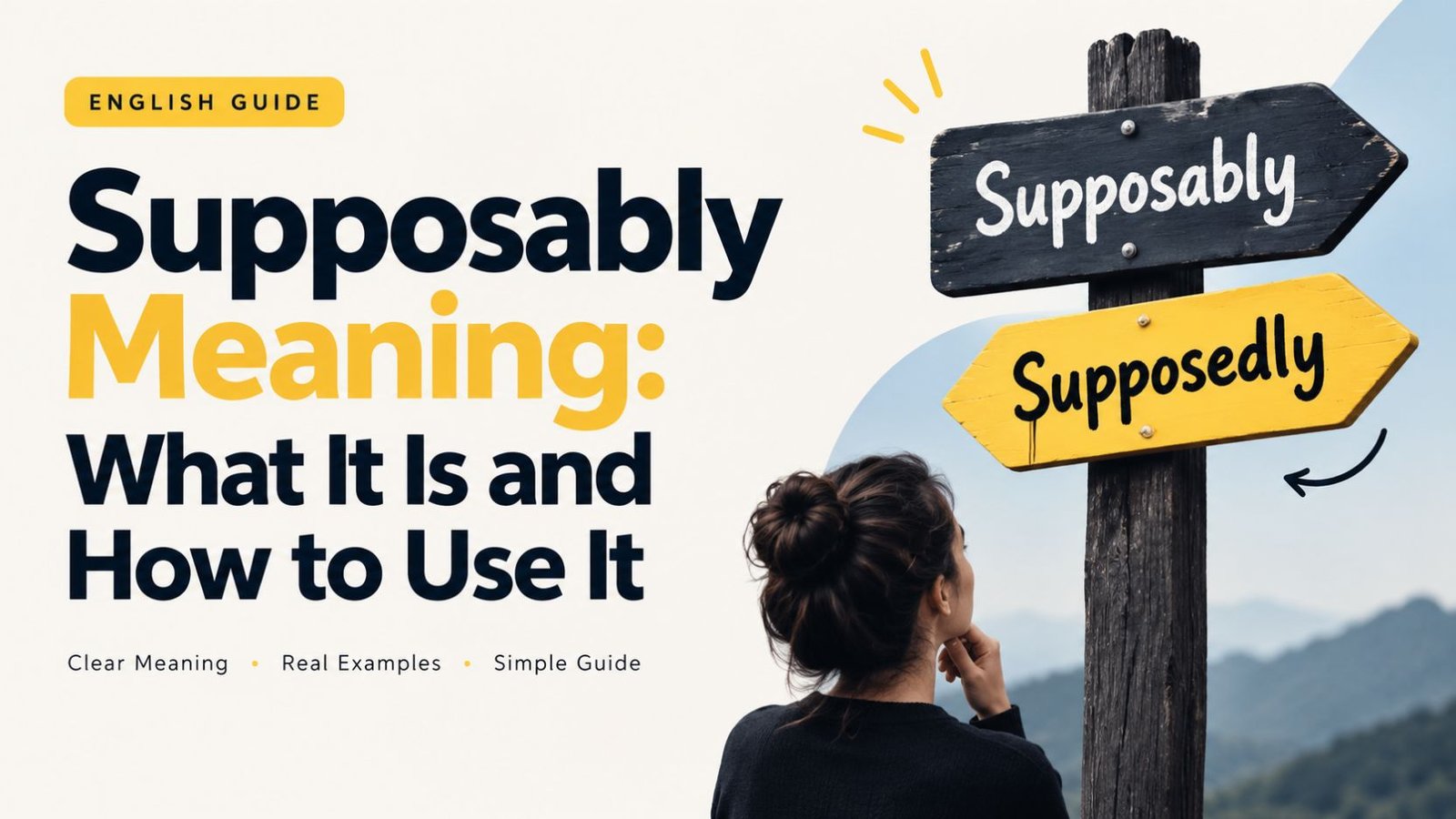
Supposably means “in a way that can be supposed” or “conceivably.” It is a real English adverb found in major dictionaries. You use it when you talk about something that could be imagined or assumed, not something people merely say is true.
Many readers think it is a mistake for “supposedly.” The two words sound alike, and they often overlap in everyday speech. Still, they carry different shades of meaning. Knowing the difference helps you write and speak with more confidence.
What Does Supposably Mean?
Supposably means “conceivably” or “in a manner that can be supposed.” Something that is supposably true is something you can reasonably imagine or assume to be true.
Here is a quick summary:
- Part of speech: Adverb
- Simple meaning: Conceivably, possibly, in a way that can be supposed
- Related adjective: Supposable (able to be supposed)
- Root verb: Suppose
Example: “If the café really trained in Paris, it would supposably make excellent croissants.”
The speaker is not repeating a rumor here. They are reasoning from an idea and saying what could follow from it.
Is Supposably a Word?
Yes, supposably is a word. Merriam-Webster records it, and a Merriam-Webster based explainer from Wordsmarts says its first use dates to 1627. That makes it older than many words people consider “proper.”
The confusion comes from usage. Most speakers say supposedly. So when someone says supposably, it can sound like a slip. It is not an error, but it is rare. In many sentences, supposedly is the word the speaker really wants.
⚠️ Common mistake: Using supposably when you mean “according to what people say.” That is the job of supposedly.
Supposably vs. Supposedly: The Main Difference
Both words come from the verb suppose. Each one grew from a different form of it.
| Word | Core meaning | Used when you are… | Example |
| Supposedly | According to what is said or believed | Passing on a claim you cannot confirm | “Supposedly, the store closes at nine.” |
| Supposably | Conceivably, in a way that can be supposed | Reasoning about what is possible | “Supposably, the plan could work if we start early.” |
The easiest test is this. Ask yourself whether you are repeating a report or exploring a possibility.
- Repeating a report? Use supposedly.
- Exploring a possibility? Use supposably.
💡 Tip: If you can replace the word with “allegedly” or “reportedly,” you want supposedly. If you can replace it with “conceivably,” you want supposably.
See more:GLHF Meaning:
Why Supposedly Is the Default?
Supposedly dates to the late 1500s. It became the common choice for most situations. In ordinary speech, people use it even for the “conceivably” sense. That is why supposably feels unusual today.
How to Use Supposably in a Sentence?
Supposably is an adverb. It usually comes before a verb or at the start of a clause. It modifies the whole idea of the sentence.
Correct examples:
- “Supposably, anyone could learn this skill with enough practice.”
- “The bridge would supposably hold twice that weight.”
Both sentences talk about what could be the case. Neither one passes on gossip or a rumor.
Where Supposedly Fits Better
- “He supposedly left the city last week.” (A report you cannot check)
- “The movie is supposedly based on a true story.” (A claim made by others)
In both sentences, supposably would sound odd. The speaker is repeating what others say. They are not reasoning about a possibility.
Common Mistakes With Supposably and Supposedly
Mistake 1: Using supposably for hearsay
❌ Incorrect: “Supposably, the owner sold the house last year.”
✅ Correct: “Supposedly, the owner sold the house last year.”
The sentence passes on a claim. Supposedly fits better.
Mistake 2: Writing “supposebly”
❌ Incorrect: supposebly
✅ Correct: supposably
The adverb is built from supposable plus ly. The ending is able, not ebl.
Mistake 3: Dropping the “d” in writing
People often say “supposably” quickly when they mean “supposedly.” That happens in speech. In writing, check the meaning and pick the word that matches it.
Mistake 4: Mixing it up with “supposed to”
Supposed to is a separate phrase. It means “expected to” or “required to,” as in “You are supposed to arrive early.” Supposably has no part in that structure.
See more:LMAO Meaning In Chat:
How to Pronounce Supposably?
| Word | Pronunciation guide | IPA (American) |
| Supposably | suh POH zuh blee | /səˈpoʊzəbli/ |
| Supposedly | suh POH zid lee | /səˈpoʊzɪdli/ |
Both words stress the second syllable. The main difference is the ending. Supposably ends in ably, and supposedly ends in edly. Many speakers shorten supposedly to “suh POHZ lee,” which makes the two words sound closer.
Origin and Etymology of Supposably
Supposably comes from the adjective supposable, which means “able to be supposed.” That adjective comes from the verb suppose. Merriam-Webster dates the verb to the 14th century.
The word suppose came into English through French. Its deeper roots go back to Latin, where the idea involved placing something under or putting something forward. In English, it came to mean “to take as true for the sake of argument” and “to believe.”
The meaning of supposably stayed close to that original sense. It is the “can be supposed” adverb. Supposedly took a different path and came to mean “as people say or believe.”
For the dates, a Merriam-Webster based explainer from Wordsmarts puts supposedly at the end of the 16th century and supposably at 1627. Exact first-use dates can shift as dictionaries update their records. If you need a precise citation, check the current dictionary entry.
When Was Supposably Added to the Dictionary?
There is no single “added” date that applies to every dictionary. Each dictionary keeps its own history. Merriam-Webster lists the first known use as 1627, according to the Wordsmarts explainer. That means the word has been in written English for centuries.
So supposably is not a new invention or a recent slang item. It simply fell out of everyday use.
Synonyms and Related Words
These words overlap with supposably, but each one differs slightly.
| Word | Meaning | How it differs |
| Conceivably | In a way that can be imagined | Closest synonym for supposably |
| Possibly | It may be true or may happen | Broader and more common |
| Presumably | Assumed to be true based on likelihood | Suggests a stronger expectation |
| Allegedly | Claimed without proof | Used for accusations or unproven claims |
| Reportedly | According to reports | Points to a source |
| Supposedly | According to what is said | Hearsay, not possibility |
💡 Tip: In most everyday writing, conceivably or presumably is clearer than supposably. Your reader will not stop to wonder if you made an error.
Supposably Friends and Supposably Friends Meaning
Some people search for “supposably friends.” This is usually a mix of two ideas.
The phrase you probably want is supposedly friends, which means “people who are said to be friends, but may not act like it.” Merriam-Webster also uses the adjective supposed in this way, with the example “supposed friends” in the sense of “alleged friends.”
Example: “My supposed friends never showed up.” (Adjective form)
Example: “They are supposedly friends, but they hardly speak.” (Adverb form)
“Supposably friends” would mean “friends in a conceivable way.” That meaning rarely fits real conversation.
See more:NVM Meaning In Text:
Supposedly Meaning in Other Languages
Many readers search for the meaning of supposedly in their own language. The words below are common translations of the idea “supposedly” or “allegedly.” Different contexts can call for different wording, so treat these as general guides, not exact matches.
| Language | Common rendering | Notes |
| Urdu | مبینہ طور پر (mubayyina taur par) | Often used for “allegedly” |
| Malay | kononnya | Used for “supposedly” or “so they say” |
| Tagalog | umano, diumano | Used to show something is reported |
| Marathi | कथितरित्या (kathitarityā) | Formal and written style |
| Tamil | என்று கூறப்படுகிறது (enru kūṟappaṭukiṟatu) | A phrase meaning “it is said that” |
| Telugu | అని చెప్పబడింది (ani cheppabadindi) | Also a phrase meaning “it is said that” |
| Kannada | ಎಂದು ಹೇಳಲಾಗುತ್ತದೆ (endu hēḷalāguttade) | A phrase meaning “it is said that” |
| Bengali | কথিত (kothito) | Means “so said” or “alleged” |
Tagalog sentence example: “Umano, darating siya bukas.” This means “Supposedly, he is coming tomorrow.”
⚠️ Note: These are translations of supposedly, not supposably. The word supposably has no common one word equivalent in these languages. A native speaker or a trusted bilingual dictionary can confirm the best choice for a formal text.
Quick Reference: Which Word Should You Use?
Use this short checklist.
- Are you repeating a claim or rumor? Use supposedly.
- Are you describing something that could be imagined or assumed? Use supposably or conceivably.
- Do you mean “required” or “expected”? Use supposed to.
- Are you unsure? Pick supposedly. It is the safer, more common choice.
Frequently Asked Questions
What does supposably mean?
Supposably means “conceivably” or “in a way that can be supposed.” It describes something that could be imagined or assumed.
Is supposably a real word?
Yes. Major dictionaries list it, and its first recorded use is from the 1600s.
What is the difference between supposably and supposedly?
Supposedly means “according to what is said.” Supposably means “conceivably.” One reports a claim, and the other explores a possibility.
Is supposably a noun or a verb?
Neither. Supposably is an adverb.
How do you pronounce supposably?
Say “suh POH zuh blee.” The stress falls on the second syllable.
Is supposably correct in formal writing?
It is correct, but readers may find it odd. In formal writing, conceivably or presumably is usually clearer.
Why do people say supposably instead of supposedly?
Mostly because the two words sound close in fast speech. Some people also use it on purpose for the “conceivably” sense.
Does supposedly have a negative tone?
Often it does. It can hint that the speaker doubts the claim. Context decides how strong that doubt feels.
What does “supposably friends” mean?
People usually mean “supposedly friends,” which describes people who are said to be friends but may not behave that way.
Conclusion
Supposably means “conceivably.” It is a genuine English adverb that has been around for centuries. Supposedly, by contrast, means “according to what is said” and is the word most speakers want.
The practical takeaway is simple. Use supposedly when you pass on a claim, and use supposably only when you mean “conceivably.” If you want to avoid any doubt, choose conceivably or presumably, and your meaning will be clear to every reader.

Hira Shah is a passionate writer and the author behind Meanz Corner. With 4 years of experience in researching words, meanings, slang, phrases, and names, she creates simple and helpful content for readers. Her goal is to make complex meanings easier to understand through clear, accurate, and reader-friendly explanations.


3 Comments