
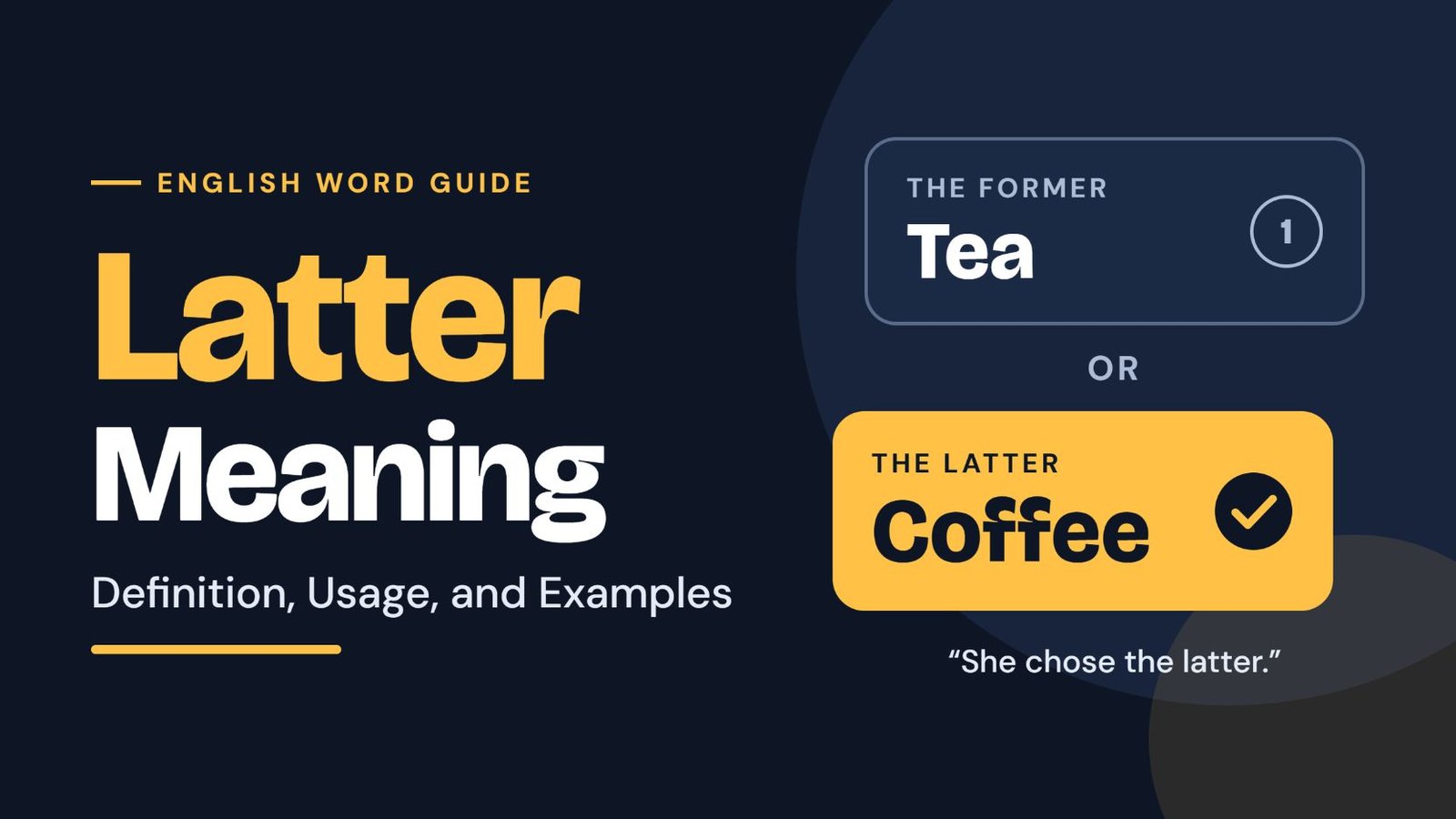
The word latter has one main meaning in modern English. It points to the second of two things you just mentioned. For example, in “I offered tea or coffee, and she chose the latter,” the latter means coffee.
The word also has a second meaning. It can describe something that comes near the end, as in “the latter part of the year.” Both meanings come from the idea of “later” or “last.” Once you know which one you are looking at, the word is easy to use.
What Does Latter Mean?
Latter means the second of two things named earlier, or something near the end of a period. It is the opposite of former, which means the first of two things named earlier.
| Meaning | Simple explanation | Example |
| Meaning 1 | The second of two things mentioned | “We have a cat and a dog. The latter is older.” |
| Meaning 2 | Near the end of a period or sequence | “She moved abroad in the latter half of 2020.” |
| Meaning 3 | More recent or later in time (older, formal use) | “The latter years of his life were quiet.” |
Meaning 1 is by far the most common. Most people searching “the latter meaning” want this one.
Part of Speech
Latter works in three ways:
- Pronoun: “Of the two plans, I prefer the latter.”
- Adjective: “The latter option costs less.”
- Noun: “The latter of the two was cheaper.”
In everyday writing, you will most often see it as a pronoun with “the” in front of it.
See more:Restive Meaning
Former and Latter Meaning
These two words work as a pair. They help you refer back to two items without repeating their names.
| Word | Refers to | Example |
| Former | The first of two | “Anna and Maya both applied. The former got the job.” |
| Latter | The second of two | “Anna and Maya both applied. The latter got the job.” |
In that example, the former is Anna and the latter is Maya.
Tip: Think of the order of the list. The former comes first. The latter comes last.
Former vs Latter in a Longer Sentence
“The company sells phones and laptops. The former are cheaper, but the latter have better margins.”
Here, “the former” means phones and “the latter” means laptops. Both can stand for plural things. The word does not have to refer to a single item.
How to Use “The Latter” in a Sentence?
Follow these steps to use the word correctly.
- Name exactly two things.
- Add your next point.
- Use “the latter” to point back to the second thing.
Examples:
- “You can take the train or the bus. I recommend the latter because it is cheaper.”
- “He studied law and history. He enjoyed the latter more.”
The reader must be able to tell which two things you mean. If the sentence is long, repeat the noun to stay clear.
Common Phrases With “Latter”
People often search phrases that include the word. Here is what they mean.
| Phrase | Meaning |
| Choose the latter | Pick the second option you listed |
| I prefer the latter | I like the second one better |
| Go with the latter | Pick the second option |
| Probably the latter | The second option is most likely |
| If it’s the latter | If the second possibility is true |
| The former and the latter | The first and the second of two things |
What Does “I Prefer the Latter Meaning” Say?
This phrase is used when a word or sentence has two possible meanings. The speaker is choosing the second one. For example: “The word can mean ‘to leave’ or ‘to give up.’ I prefer the latter meaning.” That speaker likes the meaning “to give up.”
What Does “Choose the Latter Meaning” Mean?
You will see this in quizzes, tests, and instructions. It tells you to pick the second meaning listed. If a question lists two meanings, A and B, the latter meaning is B.
What Does “If It’s the Latter” Mean?
It means “if the second option is the true one.” For example: “Either the file is damaged or the app has a bug. If it’s the latter, an update will fix it.” The latter here is the app bug.
Latter vs Later: What Is the Difference?
This is one of the most searched confusions. The words look alike and sound different.
| Word | Meaning | Pronunciation | Example |
| Latter | The second of two, or near the end | LAT-er | “The latter option is better.” |
| Later | After the present time | LAY-ter | “I will call you later.” |
⚠️ Common mistake: People write “later” when they mean “latter.”
❌ Incorrect: “I like tea and coffee, but I prefer the later.”
✅ Correct: “I like tea and coffee, but I prefer the latter.”
A simple test: if you can replace the word with “the second one,” use latter. If you mean “after now,” use later.
Latter vs Letter
Letter is a different word altogether. It means a written character, such as A or B, or a written message sent to someone. Search engines often show “letter meaning” next to “latter meaning” because people mistype or mishear the word.
- “She wrote a letter to her friend.”
- “The latter of the two is correct.”
Latter Meaning in Different Contexts
Many people search for the meaning of latter in a specific field, such as law, biology, or physics. In these fields, latter is not a special technical term. It keeps its normal meaning of “the second of two things named.”
- In law: Contracts and legal writing often use “the latter” to refer to the second party or clause in a pair. The meaning is the same as in everyday English.
- In biology and anatomy: Writers use it to point to the second structure or organism mentioned, such as “the heart and the lungs, the latter being…” It is not a body part or a scientific term.
- In physics: The same applies. “The latter” simply points back to the second item in a comparison.
If you see the word in a technical text, check the two things named just before it. The answer to what it means is almost always there.
See more:Silver Lining Meaning
Latter Part and Latter Half
These phrases use the second meaning, “near the end.”
| Phrase | Meaning | Example |
| Latter part | The later portion of something | “The latter part of the book is slower.” |
| Latter half | The second half | “He scored twice in the latter half of the game.” |
| Latter end | The final stage | “The latter end of the story is sad.” |
| Latter one | The second one of two | “I will take the latter one.” |
Notice that “latter half” has a close cousin in “second half.” Both work. “Latter half” sounds a little more formal.
What Does “Latterly” Mean?
Latterly is an adverb. It means “recently” or “in the later part of a period.” For example: “Latterly, she has worked from home.” It is less common than “lately” or “recently” and sounds more formal, especially in British English.
Latter-day and Latter Rain
Latter Day and Latter-day Saints
“Latter days” or “latter-day” means the last days or the final period of history. The name The Church of Jesus Christ of Latter-day Saints uses this sense. “Latter-day” in the name refers to the belief that the church was restored in the last era before the end of time. “Saints” is the church’s word for its members.
Latter Rain
In the Bible, the “latter rain” is the late rain that comes before the harvest. It appears in passages such as Deuteronomy 11:14, Joel 2:23, and James 5:7. In the farming climate of ancient Israel, the “former rain” fell in autumn when seeds were planted. The “latter rain” fell in spring and helped the crops finish growing.
Some Christian groups also use “latter rain” in a spiritual sense, to describe a hoped-for renewal of faith. That is a religious interpretation, not the dictionary meaning.
Latter Meaning in the Bible
The word appears in many verses, and it always means “later” or “final,” or “the second.” Job 42:12 contrasts the “latter end” of Job’s life with his beginning, meaning the last part of his life. In Haggai 2:9, the “latter glory” of a temple is compared with its former glory.
How to Pronounce Latter
- Simple spelling: LAT-er
- IPA (American): /ˈlætər/
- IPA (British): /ˈlætə/
The first syllable gets the stress. It rhymes with “matter” and “batter.” In American English, the “tt” often sounds like a soft “d,” so it can sound like “LAD-er.” It does not rhyme with “later,” which is LAY-ter.
Origin of Latter
Latter comes from Old English lætra, an old comparative form of læt, meaning “slow” or “late.” In older English, it served as a comparative form of “late,” the way “bigger” does for “big.” Over time, “later” took over the job of the regular comparative. “Latter” stayed with its more specific meaning of “second” or “last-mentioned.” This is why the two words look alike but are used differently today.
Synonyms and Related Words
| Word | Meaning | Difference |
| Second | Next after the first | More casual and common than “latter” |
| Last mentioned | The item listed last | Wordier but very clear |
| Final | The very last | Works for any number of items, not only two |
| Later | Coming after in time | Describes time, not position in a list |
| Former (antonym) | The first of two | The direct opposite |
Related terms: “the latter,” “the former,” “latter half,” “latter part,” “latterly.”
Common Mistakes With Latter
Using It for More Than Two Items
Latter is for two things only. For three or more, use “last” or “the last one.”
❌ Incorrect: “We have apples, pears, and plums. I prefer the latter.”
✅ Correct: “We have apples, pears, and plums. I prefer the last.”
Mixing Up Latter and Later
❌ Incorrect: “I will see you latter.”
✅ Correct: “I will see you later.”
Creating Unclear References
❌ Unclear: “Maya told Anna that her sister, the latter, was late.”
✅ Better: “Maya told Anna that Anna’s sister was late.”
If the two things are not obvious, skip “the latter” and name the thing directly.
Writing “Latter” When You Mean “Letter”
❌ Incorrect: “She sent me a latter.”
✅ Correct: “She sent me a letter.”
See more:Paucity Meaning
Latter Meaning in Other Languages
Many readers look up this word in their own language. These are common translations. The best choice can change with the sentence.
| Language | Common translation of “latter” |
| Hindi | बाद वाला, बाद का (baad wala, baad ka) |
| Urdu | مؤخر الذکر (muakhkhar ul zikr) |
| Bengali | শেষোক্ত (sheshokto) |
| Tamil | பிந்தையது (pindhaiyadhu) |
| Telugu | తరువాతి (tharuvathi) |
| Marathi | नंतरचा (nantarcha) |
| Malayalam | പിന്നത്തേത് (pinnathethu) |
| Kannada | ನಂತರದ (nantarada) |
Check a bilingual dictionary for your exact sentence, since these words can shift with context.
Frequently Asked Questions
What does latter mean in simple words?
It means the second of two things you just named. It can also mean “near the end,” as in “the latter part of May.”
What does “the latter” mean in a sentence?
It points back to the second of two items. In “I like jazz and rock, but I prefer the latter,” the latter means rock.
Is latter a noun, adjective, or pronoun?
It can be all three. Most often it is a pronoun (“the latter”) or an adjective (“the latter half”).
What is the opposite of latter?
The opposite is former, which means the first of two things named.
What is the difference between latter and later?
Latter means the second of two. Later means after the present time. They are also pronounced differently: LAT-er and LAY-ter.
Can latter be used for three or more things?
No. Standard usage keeps latter for exactly two items. For more, use “last.”
How do you pronounce latter?
Say “LAT-er,” like “matter.” The IPA is /ˈlætər/ in American English.
What does “latter half” mean?
It means the second half of a period or event, such as “the latter half of the year.”
What does “latter day” mean?
It means the final period of history, or recent times in some uses. In religious names such as Latter-day Saints, it refers to the last era before the end of time.
Conclusion
The word latter most often means the second of two things named earlier, and it is the pair of former. It can also mean “near the end,” as in latter part or latter half. It works as a pronoun, an adjective, and a noun, and it should be used only when there are exactly two items. In fields like law, biology, and physics, it keeps this same plain meaning.
Next time you see “choose the latter meaning” or “I prefer the latter,” look at the two options just before it and pick the second. If you are unsure, replace “the latter” with “the second one” and see if the sentence still makes sense. When the reference might be unclear, name the item directly. Clear writing beats formal writing.

Hira Shah is a passionate writer and the author behind Meanz Corner. With 4 years of experience in researching words, meanings, slang, phrases, and names, she creates simple and helpful content for readers. Her goal is to make complex meanings easier to understand through clear, accurate, and reader-friendly explanations.


2 Comments