
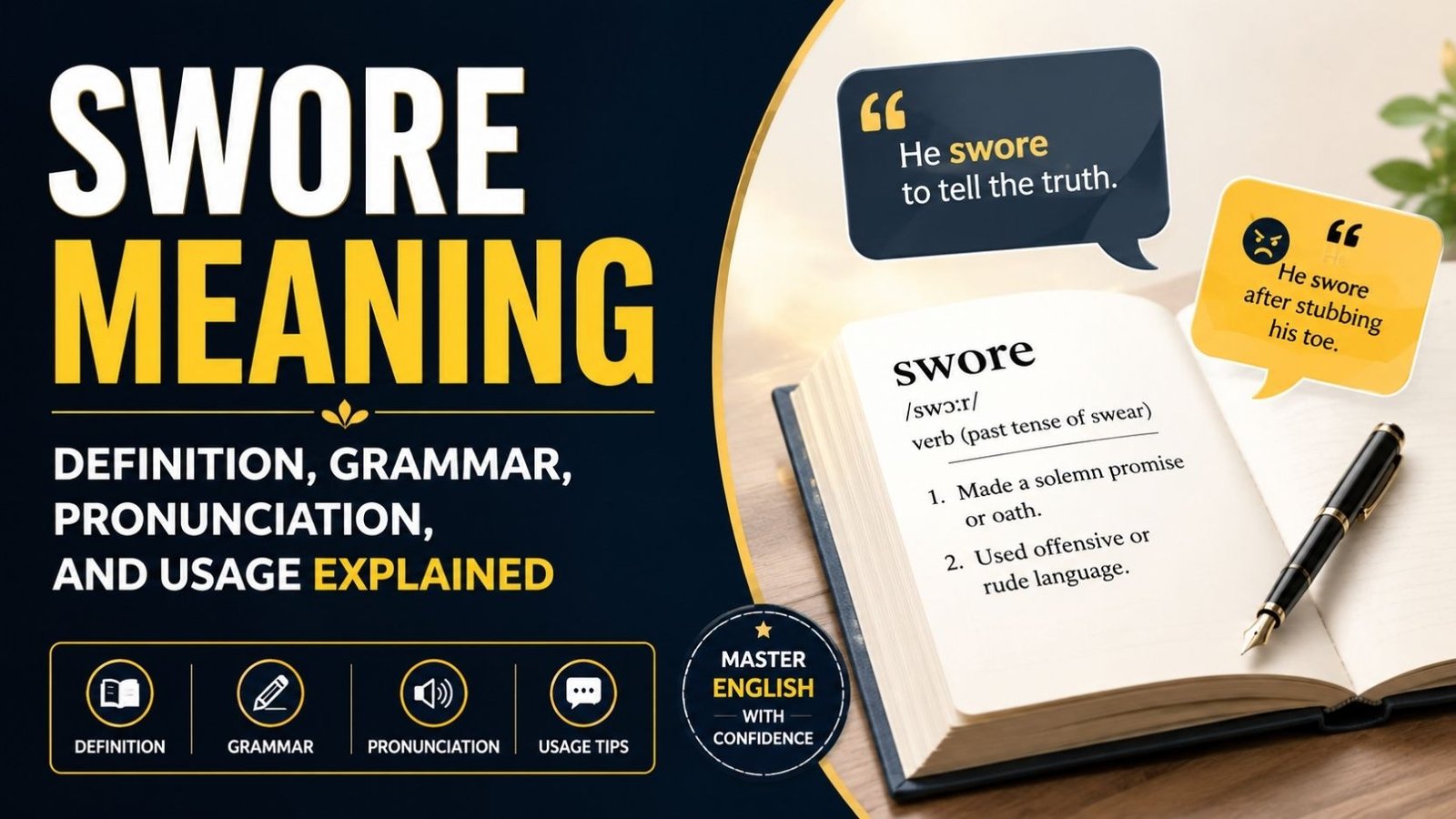
Swore is the simple past tense of the verb swear, and it has two everyday meanings. It can mean that someone made a solemn promise or oath, such as swearing to tell the truth. It can also mean that someone used offensive or rude language out of anger or frustration.
Both meanings are common in English, and readers often get confused between them. The word also causes grammar confusion, especially when people mix up swore and sworn. Understanding the difference helps you write and speak more accurately, whether you are filling out a legal document, reading a novel, or just texting a friend.
What Does Swore Mean?
At its core, swore describes something that already happened. It is not something happening now, and it is not a general habit. It refers to a completed action in the past.
The word carries two distinct meanings, and the correct one depends entirely on context.
Meaning 1: Made a solemn promise or oath
This is the older and more formal sense of the word. It describes a serious, binding statement, often made in front of another person, a court, or a higher power.
- She swore to tell the truth in court.
- He swore an oath of loyalty to the company.
- They swore that they would never betray each other.
Meaning 2: Used offensive or rude language
This is the informal, everyday sense. It describes cursing or using profanity, usually because someone was angry, hurt, or startled.
- He swore loudly after stubbing his toe.
- My neighbor swore at the delivery driver.
- She swore under her breath when the bus left without her.
| Meaning | Simple Explanation | Example |
| Made a promise or oath | To formally commit to something, often with seriousness or legal weight | The witness swore to tell the truth. |
| Used offensive language | To curse or use rude words, usually from anger or frustration | He swore when he hit his thumb with the hammer. |
Context almost always makes the intended meaning obvious. If the sentence mentions a court, a promise, an oath, or a vow, the word means “promised solemnly.” If it mentions anger, frustration, or a rude reaction, it means “used bad language.”
See More : Puting Meaning
Swore Grammar: Part Of Speech And Verb Form
Swore is a verb. Specifically, it is the simple past tense form of the irregular verb swear.
English verbs are either regular or irregular. Regular verbs add “-ed” to form the past tense, like walk becomes walked. Swear does not follow this pattern. Instead, it changes form completely, which is typical of irregular verbs.
| Base Form | Simple Past | Past Participle | Present Participle |
| swear | swore | sworn | swearing |
You use swore for the simple past tense, without any helping verb.
- I swore I would call her back.
- We swore to finish the project on time.
You use sworn only with a helping verb such as have, has, had, was, or been, or as an adjective before a noun.
- I have sworn to protect this family.
- The document was sworn before a notary.
- She is a sworn officer of the court.
How Swore Is Used in a Sentence?
Swore follows a few predictable sentence patterns. Recognizing these patterns makes it easier to use the word correctly and to spot mistakes in your own writing.
Pattern 1: Subject + swore + to + verb
This pattern describes a promise to do something.
- She swore to protect her younger brother.
- The company swore to fix the issue within a week.
Pattern 2: Subject + swore + that + clause
This pattern reports what someone stated or insisted was true.
- He swore that he had never met her before.
- The witness swore that the car was speeding.
Pattern 3: Subject + swore + at + person or thing
This pattern almost always signals the cursing meaning, not the oath meaning.
- The driver swore at the traffic.
- She swore at her computer when it crashed.
Pattern 4: Subject + swore + off + noun
This pattern means someone promised to give something up entirely.
- He swore off social media for a month.
- They swore off fast food after the documentary.
Noticing which preposition follows swore, whether it is “to,” “that,” “at,” or “off,” is often the fastest way to understand which meaning applies before reading the rest of the sentence.
Swore vs Sworn: What Is the Difference?
This is one of the most common grammar mix-ups related to this word. The confusion happens because both words come from the same base verb, swear, but they serve different grammatical roles.
Swore stands alone as the simple past tense. It does not need any other verb next to it.
Sworn is the past participle. It always needs a helping verb, unless it is functioning as an adjective.
✅ Correct: He swore he was innocent.
❌ Incorrect: He sworn he was innocent.
✅ Correct: He has sworn he is innocent.
❌ Incorrect: He has swore he is innocent.
A simple way to remember this: if you can replace the verb with a form of “did,” use swore. If the sentence already contains have, has, had, was, or been, use sworn.
Swore vs Sweared: Which One Is Correct?
Sweared is not a standard English word. Because so many English verbs form the past tense by adding “-ed,” it is a common mistake to assume swear follows the same rule.
Swear is irregular. Its correct past tense is swore, and its correct past participle is sworn. Sweared does not appear in major dictionaries and is generally considered incorrect in both American and British English.
| Incorrect | Correct |
| She sweared she would win. | She swore she would win. |
| He has sweared to protect them. | He has sworn to protect them. |
If you see “sweared” in casual writing or social media, treat it as a common spelling or grammar slip, not an accepted alternative.
How to Pronounce Swore?
Swore is a one-syllable word, which makes pronunciation fairly simple once you know the sound pattern.
- American English: /swɔːr/, rhyming with “more,” “store,” and “floor”
- British English: /swɔː/, with a softer ending sound and less emphasis on the final “r”
To say it naturally, start with the “sw” sound, similar to the beginning of “swim” or “sway,” then move into a long “or” sound. The whole word takes less than a second to say clearly.
Tip: If you already know how to pronounce “wore,” you already know how to pronounce “swore.” Simply add the “s” sound at the start.
American English Vs British English
The meaning of swore stays the same in both American and British English. The only real differences are pronunciation and, occasionally, tone.
- American English tends to pronounce the final “r” clearly, giving the word a firmer, rhotic sound.
- British English, particularly Received Pronunciation, softens or drops the final “r” sound, so the word ends more smoothly.
In terms of usage, both varieties of English use swore for oaths, courtroom testimony, and everyday cursing. British speakers may lean slightly more toward formal phrases like “swore an oath” in legal writing, while American speakers use “swore under oath” just as often. Neither difference changes the underlying meaning of the word.
Origin Of Swore (Etymology)
The word traces back to Old English. Swear developed from the Middle English sweren, which itself came from the Old English swerian, meaning to take an oath or make a solemn declaration, often with an appeal to a higher power. In Old English, this was what linguists call a strong verb, a category that changes its internal vowel to form the past tense rather than simply adding an ending. That older pattern is the reason swear became swore instead of “sweared.”
The Old English root goes back further to a shared Proto-Germanic ancestor. Related words for “swear” show up across many other Germanic languages, including German, Dutch, and the Scandinavian languages, which explains why so many European languages sound similar when talking about oaths and vows. Scholars are not completely certain what the word meant before that point, though most trace it to an ancient root connected to speaking or declaring something aloud.
The negative sense, meaning to curse or use profane language, developed centuries later, around the early fifteenth century. It likely grew out of the older, more serious meaning: invoking a sacred name carelessly or disrespectfully eventually became associated with using “bad” or taboo language in general. In other words, the “cursing” meaning and the “oath” meaning share the same root idea. Both involve invoking something serious, whether it is a formal promise before witnesses or an emotional outburst using a forbidden word.
Swore In Different Contexts
The meaning of swore shifts slightly depending on where and how it is used. Here are the most common contexts readers search for.
Legal And Formal Context
In legal settings, swore almost always refers to the oath meaning. Witnesses, officials, and jurors swear to tell the truth or to fulfill a duty honestly.
- The witness swore under oath that she saw the accident.
- The new judge swore to uphold the constitution.
Everyday Promise Context
In daily conversation, swore is often used to emphasize sincerity, even without a formal ceremony. It shows strong commitment or certainty.
- I swore I would never do that again.
- He swore he saw a shooting star last night.
This casual use does not involve any legal weight. It simply signals that the speaker felt very certain or very determined.
Cursing And Frustration Context
When paired with words like “at,” “loudly,” or a specific curse word, swore usually means someone used offensive language.
- He swore at the referee after the bad call.
- She swore when she dropped her phone.
Religious And Ceremonial Context
In religious or ceremonial writing, swore often describes a vow made in front of a congregation, a deity, or a sacred text. This usage overlaps closely with the legal sense, since both involve a formal, witnessed promise.
- He swore before the altar that he would honor his vows.
- The knight swore fealty to the king in a solemn ceremony.
This context tends to appear in historical texts, religious literature, and formal storytelling, where the language is deliberately elevated compared to everyday speech.
Literary And Emotional Context
Writers sometimes use swore in a looser, more emotional way to express intense certainty or strong feeling, rather than a literal oath. A line such as “I foamed, I raved, I swore” uses three past-tense verbs together to build a sense of overwhelming frustration or anger.
In this kind of usage, swore does not describe a formal promise at all. It simply emphasizes how strongly the speaker reacted, closer to the cursing or exclaiming sense of the word than the oath sense.
Common Phrases And Idioms With Swore
Several fixed expressions use swore, and each one carries its own specific shade of meaning.
| Phrase | Meaning | Example |
| Swore off | Promised to stop or give up something completely | He swore off sugar after his checkup. |
| Swore up and down | Insisted strongly and repeatedly that something was true | She swore up and down that she had locked the door. |
| Swore allegiance | Formally promised loyalty, often to a country or leader | The soldiers swore allegiance to their new commander. |
| Swore an oath | Made a formal, solemn promise, often in a legal or ceremonial setting | He swore an oath before taking office. |
| Swore revenge | Promised to get back at someone for a wrong they suffered | She swore revenge after losing the competition unfairly. |
| Swore in | Officially installed someone in a role through an oath | The mayor was sworn in on Monday. Note this phrase typically uses “sworn,” not “swore,” when paired with a helping verb. |
| Swore not to disperse | Promised not to leave or break up a group, often in a protest or gathering context | The crowd swore not to disperse until their demands were heard. |
| Swore by | Trusted something completely, treating it as reliable or effective | She swore by her grandmother’s home remedy for colds. |
Pinky Swore Meaning
A pinky swear is an informal, often childlike, promise made by linking little fingers with another person. “Pinky swore” simply means someone made this small, symbolic promise.
- We pinky swore we would always be best friends.
It carries no legal weight. It is a playful way to add a sense of seriousness or trust to an everyday promise, especially between children or close friends.
See More: Off Putting Meaning
You Swore Meaning
“You swore” is typically used to remind or accuse someone of breaking a promise they made earlier.
- You swore you would call me back, but you never did.
This phrase places emphasis on a broken commitment. It often appears in personal, emotional conversations rather than formal writing.
I Swore Meaning
“I swore” is the first-person version of the same idea. The speaker is confirming that they made a serious promise or statement in the past.
- I swore I would finish this project no matter what.
- I swore I heard someone at the door.
The second example shows the word being used loosely, almost like “I was certain,” rather than describing a formal oath.
Swore Meaning In Different Languages
Because swore expresses two different ideas, oath and profanity, translations can vary depending on which sense is meant. The table below gives commonly used equivalents for the general sense of “made a solemn promise” or “took an oath,” which is the most searched meaning across languages. Always check local context, since informal cursing may use a completely different word in each language.
| Language | Common Translation Concept |
| Hindi | कसम खाई / शपथ ली (took an oath or promise) |
| Bengali | শপথ করেছিলেন / কসম খেয়েছিলেন |
| Urdu | قسم کھائی (took an oath) |
| Malayalam | സത്യം ചെയ്തു (made a solemn statement) |
| Tamil | சத்தியம் செய்தார் (took an oath) |
| Telugu | ప్రమాణం చేశాడు / చేసింది |
| Kannada | ಪ್ರಮಾಣ ಮಾಡಿದರು |
| Marathi | शपथ घेतली |
| Tagalog | sumumpa (took an oath or vow) |
| Arabic | أقسم (took an oath) |
| Chinese | 发誓了 / 曾发誓 (made a vow or promise) |
Note that in each of these languages, the word used for cursing or rude speech is usually different from the word used for a formal oath, just as in English. When translating, it helps to clarify which meaning of swore you need before choosing the equivalent word.
Swore Meaning in English: A Quick Summary
In plain English, swore simply means one of two things happened in the past:
- A person made a serious, binding promise or statement.
- A person used offensive or rude language.
The tense is always past. The subject already completed the action, and it is not ongoing.
Synonyms And Related Words
Depending on which meaning you intend, different synonyms apply.
| Word | Meaning | Difference From Swore |
| Vowed | Made a solemn, often emotional promise | Slightly more personal and heartfelt, often used in relationships |
| Pledged | Formally promised something, sometimes with a resource attached | Common in financial, charitable, or ceremonial contexts |
| Affirmed | Stated something as true, often formally | Less about a binding oath, more about confirming truth |
| Cursed | Used offensive language | A more direct, sometimes stronger synonym for the profanity sense |
| Cussed | Informal American English term for using bad language | Casual, spoken tone rather than written formality |
These words are close in meaning but not always interchangeable. “Vowed” fits emotional or relationship contexts better than legal ones. “Pledged” fits financial or ceremonial contexts. Choose based on tone and setting.
Common Mistakes With Swore
Here are the mistakes readers make most often, along with corrections.
❌ Incorrect: She has swore to protect her family.
✅ Correct: She has sworn to protect her family.
❌ Incorrect: He sweared he saw the accident.
✅ Correct: He swore he saw the accident.
❌ Incorrect: They was sworn in as new members.
✅ Correct: They were sworn in as new members.
❌ Incorrect: I swore to him yesterday, and he still doesn’t believe me, so I have swore it again today.
✅ Correct: I swore to him yesterday, and he still doesn’t believe me, so I have sworn it again today.
The pattern is simple. Swore never needs a helper verb. Sworn always needs one, unless it directly describes a noun, such as “a sworn statement.”
See More: What Does LYK Mean In Text
Frequently Asked Questions
What does swore mean?
Swore means someone made a serious promise or oath, or that someone used offensive language, depending on the context of the sentence.
Is swore the past tense of swear?
Yes. Swore is the simple past tense of the irregular verb swear.
Is swore a noun or a verb?
Swore is a verb. It is never used as a noun or adjective.
What is the difference between swore and sworn?
Swore stands alone as the simple past tense. Sworn requires a helping verb like have, has, had, was, or been, or it functions as an adjective before a noun, as in “a sworn statement.”
Is sweared a correct word?
No. Sweared is not standard English. The correct past tense of swear is swore, and the correct past participle is sworn.
How do you pronounce swore?
It is pronounced /swɔːr/ in American English, rhyming with “more” and “store.”
What does pinky swore mean?
It means someone made an informal, symbolic promise by linking little fingers with another person, usually as a playful way to show sincerity.
What does swore off mean?
It means someone promised to stop doing something completely, such as swearing off junk food or swearing off a bad habit.
What does swore at me mean?
It means someone directed offensive or rude language toward the speaker, usually out of anger.
What does you swore mean in a sentence?
It usually reminds or accuses someone of breaking a promise they made earlier, as in “You swore you would be there.”
What is the difference between swore and vowed?
Both describe a serious promise, but vowed tends to sound more personal or emotional, often used in relationships or life-changing commitments, while swore is more neutral and can apply to legal, casual, or emotional situations alike.
Can swore be used as a noun or adjective?
No. Swore only functions as a verb. If you need an adjective, the correct related word is sworn, as in “a sworn statement” or “a sworn enemy.”
Why do people confuse swore and sworn so often?
Because both words come from the same irregular verb, swear, and English speakers are used to regular verbs where the past tense and past participle look identical. Irregular verbs like swear break that pattern, which causes frequent mix-ups.
Final Thoughts
Swore is a small word with real grammatical weight. It marks the simple past tense of swear, and its meaning shifts naturally between a solemn promise and an angry outburst, depending entirely on context. Getting comfortable with this shift makes reading and writing far easier, especially in legal documents, casual conversation, and everyday storytelling.
The most important habit to build is separating swore from sworn. Use swore on its own to describe a completed action, and save sworn for sentences that already contain a helping verb or that use the word as a descriptive adjective. Once that distinction feels natural, the rest of the word’s meanings and phrases, from pinky swore to swore off to swore an oath, become much easier to use with confidence.

Hira Shah is a passionate writer and the author behind Meanz Corner. With 4 years of experience in researching words, meanings, slang, phrases, and names, she creates simple and helpful content for readers. Her goal is to make complex meanings easier to understand through clear, accurate, and reader-friendly explanations.



3 Comments