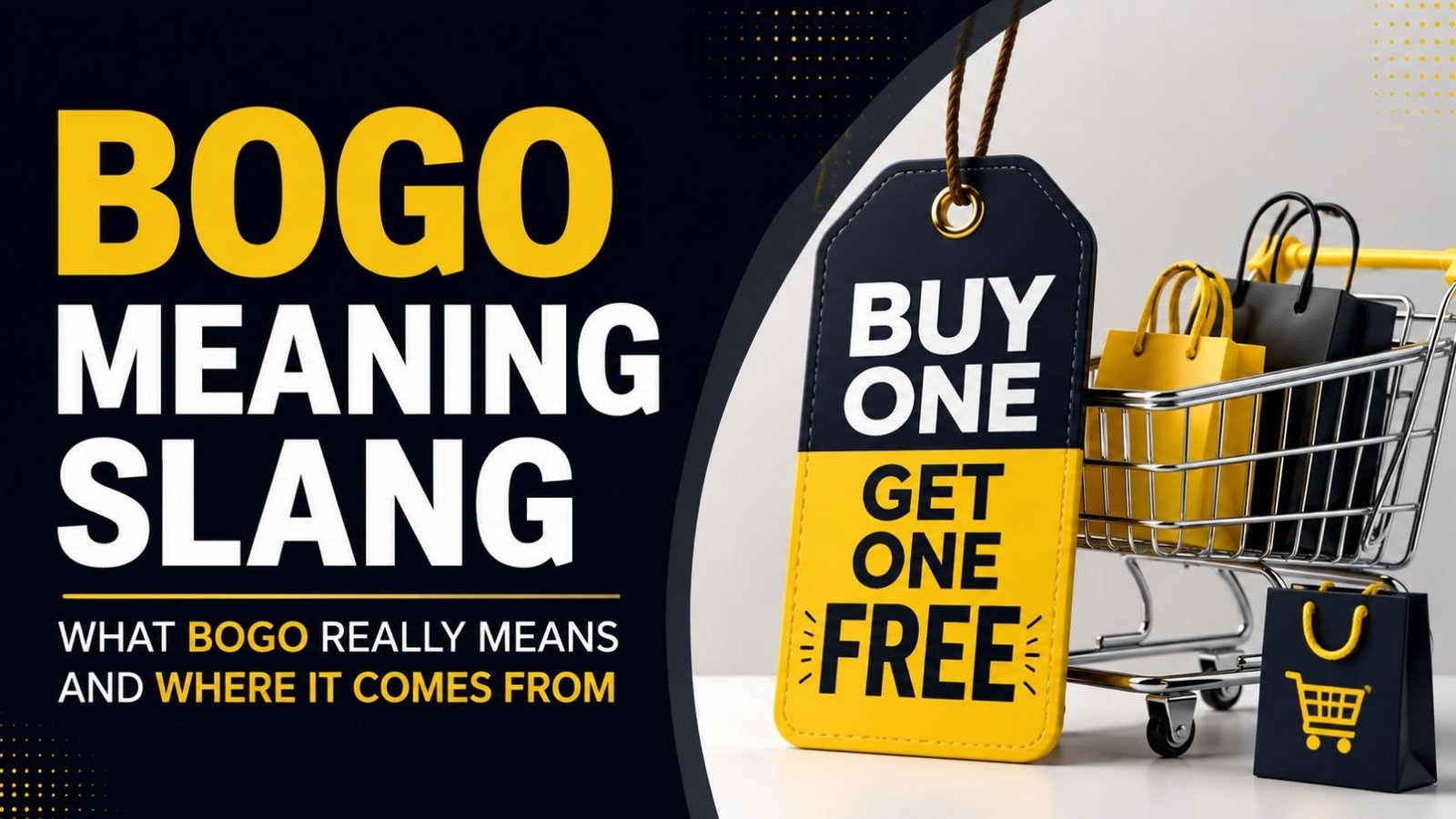
BOGO is a shorthand term that most people first see on a store sign or a receipt. It stands for buy one, get one, and it tells shoppers that a second item comes free or at a discount when they purchase the first one. The word is used across retail, food service, and casual online slang, and it now shows up in text messages, TikTok captions, and even in unrelated internet memes.
This guide breaks down every common meaning of BOGO, including its retail definition, its pronunciation, its history, and its slang uses in different online communities. It also covers a few unrelated meanings that share the same four letters, such as a Cebuano word and a Philippine city name, so readers searching for those terms get an accurate answer too.
What Does BOGO Mean?
BOGO is an acronym for buy one, get one. It is pronounced as a single word, “boh go,” rather than spelled out letter by letter, similar to how people say PIN or SKU. In everyday use, it almost always refers to a shopping deal.
Retailers use the term to mean that if a customer buys something, they get another one at no extra cost, or at a reduced cost. The exact terms depend on the store and the specific promotion.
Tip: If you see “BOGO” without any extra letters after it, most shoppers assume the second item is free. If the deal is only a partial discount, stores usually add a number, such as BOGO 50, to make that clear.
BOGO Meaning Buy One Get One Free
The clearest and most common version of BOGO is “buy one, get one free.” This is a promotional offer where customers receive an additional product for free, or at a discount, when they purchase one item.
Retailers use this format because it feels generous to the shopper while still protecting profit margins. BOGO promotions can drive sales volume, help move excess inventory, and attract new customers by offering perceived value.
See More: What Does WYFF Mean?
Common BOGO Variations
| Deal type | What it means | Example |
| BOGO free | Buy one item, get the second one at no cost | Buy one pair of shoes, get a second pair free |
| BOGO 50 | Buy one item at full price, get the second at half price | Buy a shirt at full price, get another shirt for half off |
| Buy two get one free | Buy two items, get a third item free | Buy two bottles of shampoo, get a third free |
| BOGOF | The British version of the same deal | A UK grocery ad reading “buy one get one free” |
⚠️ Common mistake: Shoppers sometimes assume BOGO 50 cuts the total bill in half. It does not. Only the second item is discounted by fifty percent, so the total saving on the full purchase is closer to twenty five percent.
BOGO Meaning Acronym: What the Letters Stand For
BOGO breaks down like this:
- B: Buy
- O: One
- G: Get
- O: One
Put together, it reads “buy one, get one.” It is a promotional offer where purchasing one item gives the customer another item, either free or at a discounted price. The acronym works because it is short, easy to say out loud, and easy to print on a sign.
BOGO Meaning Slang Origin
The retail use of BOGO did not appear overnight. The concept of buy one, get one free is often traced back to the eighteenth century and retail entrepreneur Josiah Wedgwood, who used bundled offers to move pottery. The modern shorthand came much later, once stores needed a quick way to print the offer on coupons and signage.
The history of BOGO as a term goes back several decades to the era of printed coupons and department store promotions, well before online shopping existed. Retailers realized that a “free” second item felt more exciting to a shopper than a plain percentage discount on the receipt, so the wording spread quickly across grocery stores, pharmacies, and clothing chains.
The technique is now known across the marketing industry by the acronym BOGOF, or simply BOGO. Once the term became standard in stores, casual speakers started saying “BOGO” the same way they say any other clipped word, and it slowly became slang for any two for one deal, even outside of stores.
How Is BOGO Used in a Sentence?
BOGO usually functions as a noun or an adjective in casual speech.
As a noun:
- “There’s a BOGO on toothpaste this week.”
- “I only bought it because of the BOGO.”
As an adjective:
- “It’s a BOGO deal on drinks after 3 p.m.”
- “Grab the BOGO shampoo while it lasts.”
As part of a phrase:
- “Everything in the store is BOGO this weekend.”
Because BOGO started as a marketing label, it almost never appears as a verb. People do not say “I BOGOed a shirt.” It stays attached to the product or the deal itself.
BOGO Grammar: Part of Speech and Word Forms
| Form | Example | Notes |
| Noun | “The BOGO ends Sunday.” | Refers to the deal itself |
| Adjective | “A BOGO sale on jackets.” | Describes the type of sale |
| Plural | “Three BOGOs this month.” | Adding an s is standard in casual writing |
| Capitalization | BOGO or Bogo | All capitals is most common in retail writing; lowercase “bogo” is common in texting and slang |
BOGO does not have a standard past tense, since it functions as a label rather than an action word. Writers who need a verb form usually say something like “ran a BOGO promotion” instead of inventing a new verb.
BOGO Meaning In Different Contexts
BOGO Meaning Chipotle
Chipotle regularly runs limited-time BOGO promotions on its entrées, often tied to a theme such as school spirit or a sports event. A recent example let guests wearing school apparel receive a buy one, get one entrée offer for a set window of time at participating locations.
These offers typically require the free item to be an entrée of equal or lesser value than the one purchased, and they come with restrictions on delivery orders and combining with other coupons. Chipotle has also tied BOGO promotions to major sporting events, including a matchday offer for guests who wore a soccer jersey to a participating restaurant during the World Cup.
BOGO Meaning Starbucks
Starbucks is known for buy one, get one free deals, often shortened to BOGOF, because the format works well for lower priced items like a cup of coffee. These promotions typically run for a limited afternoon window and apply to specific drink sizes or categories rather than the entire menu.
BOGO Meaning Supreme
In streetwear resale communities, “BOGO” keeps its retail meaning but gets applied to limited drops. Sellers and buyers use it to describe a bundled listing, such as offering a second item free or discounted when a buyer purchases a specific piece from a brand like Supreme. The core meaning does not change. Only the product category does.
BOGO Meaning Police
There is no established slang definition of BOGO inside law enforcement terminology. The closest widely known connection is Chief Bogo, a police character from the 2016 animated film Zootopia. Some searches for “BOGO meaning police” are simply people trying to identify that character’s name rather than looking for a genuine slang term used by real officers.
BOGO Meaning Korean
BOGO does not carry a distinct meaning in the Korean language. Searches combining “BOGO” and “Korean” are usually about the retail term appearing in Korean online shopping platforms, where BOGO is used as a loaned English marketing term the same way it is used in the United States.
BOGO Meaning In Tagalog And Bisaya Slang
This is where BOGO takes on a completely different meaning, unrelated to shopping.
In Bisaya, the language spoken in and around Cebu in the Philippines, “bogo” means dumb or foolish. It specifically describes someone who is stupid or slow witted, and it is considered a genuinely offensive word in Cebu and Davao, carrying a more serious tone than milder Bisaya insults.
Cebuano speakers note that “bogo” is not automatically offensive the way it can sound. Among friends, it is often used casually and even playfully, similar to how “bobo” works in Tagalog in relaxed settings. Tone, relationship, and context all affect how strongly the word lands.
📍 Note: Bogo is also the name of a real city in northern Cebu. Longtime residents point out that the town name and the slang insult are pronounced differently, even though they are spelled the same way. Some sources say the insult’s origin is popularly linked to Bogo City, though that connection is disputed and not confirmed as fact.
| Term | Language | Meaning |
| Bogo | Bisaya or Cebuano | Dumb, foolish, slow witted |
| Bobo | Tagalog | Dumb, similar meaning to bogo |
| Ka bogo | Bisaya | An intensified version, meaning “so stupid” |
| Bogo, Cebu | Place name | A city in northern Cebu, Philippines |
Because this meaning is unrelated to the retail acronym, readers should rely on context to know which BOGO a sentence is referring to. “The store had a BOGO sale” is retail slang. “Ka bogo nimo” is a Bisaya phrase with no connection to shopping.
BOGO Meaning On TikTok And In Slang Text
Bogos Binted
“Bogos binted” refers to a screenshot of a text conversation in which one person asks the other if they got their photos printed, and the reply is “bogos binted?” followed by an alien face emoji. The original post came from Tumblr in July 2016, and it slowly picked up attention over the following years.
Many people believe “bogos binted” is a garbled, mumbled, or misheard version of “your photos printed,” turned into nonsense through a strange typing or autocorrect style. The phrase went fully viral starting in 2018 and 2019, when people began using it out of context in absurd memes, and it exploded further in 2020 with videos, animations, and fan art built around the phrase.
It is important to separate “bogos binted” from the retail BOGO. They share a few letters, but the meme has no real connection to shopping deals. It is internet nonsense that took on a life of its own.
BOGO In Everyday Texting
Outside of memes, people use “bogo” in lowercase texting the same way they would use the retail term, just casually shortened. A text like “there’s a bogo on my app rn” simply means a buy one, get one offer is active in a shopping app.
Pronunciation Guide
BOGO is pronounced as a single word, “boh go,” instead of being spelled out letter by letter. This puts it in the same category as other retail and tech acronyms that are said as words rather than individual letters, such as PIN or SKU.
- Simple pronunciation: boh go
- Stress: the emphasis falls on the first syllable
- Common mistake: saying it as four separate letters, “B O G O,” which is understandable but not how most retail workers and shoppers actually say it out loud
See More: GNG Meaning In Text
BOGO Versus BOGOF
Shoppers in the United States mostly use BOGO. Shoppers in the United Kingdom often use BOGOF.
| Term | Full phrase | Common region |
| BOGO | Buy one, get one | United States |
| BOGOF | Buy one, get one free | United Kingdom |
Both terms describe the same basic promotion, and marketing writers frequently treat BOGOF and BOGO as interchangeable, even though BOGOF technically spells out that the second item is free rather than simply discounted.
Other Types Of BOGO Deals
Not every BOGO promotion is about a free item for the shopper. A few brands have adapted the acronym for different purposes.
One version is “buy one, give one,” a social impact model where a brand donates a second item to someone in need for every item a customer buys. TOMS shoes popularized this approach, and it has since spread to other brands built around a charitable mission.
✅ Correct usage: “This brand runs a buy one, give one program” describes a donation model.
❌ Incorrect usage: Calling a straightforward two for one store discount a “buy one, give one” deal, since nothing is actually being donated.
Common Mistakes With BOGO
Incorrect: Assuming BOGO always means the second item is completely free.
Correct: Checking the specific wording, since BOGO 50 and similar versions only apply a partial discount.
Incorrect: Writing “BOGO’s” to make the word plural.
Correct: Writing “BOGOs,” since no apostrophe is needed for a simple plural of an acronym.
Incorrect: Assuming every online use of “bogo” refers to a store discount.
Correct: Checking context, since “bogo” can also refer to a Bisaya slang term for foolish, a Philippine city, or the “bogos binted” internet meme.
Similar And Related Words
| Term | Meaning | How it differs from BOGO |
| Discount | A general price reduction | Not tied to buying a second item |
| Clearance | Reduced pricing to remove old stock | Usually a flat percentage off, not a second item deal |
| Two for one | Buy two items for the price of one | Nearly identical to BOGO, though phrased differently |
| BOGOF | Buy one, get one free | The British version of BOGO, spelling out that the item is free |
Why BOGO Works So Well As A Marketing Tool?
BOGO deals are popular with retailers for a simple reason: shoppers respond to them more strongly than they respond to plain discounts of the same value. A fifty percent off sign and a BOGO sign can represent the same total saving on a purchase, yet BOGO tends to feel more rewarding.
Part of this comes down to how people value the first item they buy versus the second one. The first unit of a product usually feels essential. The second unit feels like a bonus, so getting it free or discounted feels like a bigger win than the math actually suggests. This is one reason BOGO promotions are common with everyday items, such as toothpaste, cereal, or drinks, where buying two at once is realistic for most households.
Grocery stores, pharmacies, and quick service restaurants also like BOGO because it moves inventory quickly without permanently lowering the listed price of an item. Once the promotion ends, the price returns to normal, and the store has not trained shoppers to expect a lower baseline price going forward. A straight discount can be harder to remove later without upsetting regular customers.
There is a tradeoff worth mentioning here too. Some critics point out that two for one promotions on perishable food can lead to waste, since shoppers buy more than they can use before an item spoils. This is a real concern in the grocery industry, separate from the simple definition of the word, but it helps explain why some retailers now offer BOGO deals only on shelf stable items rather than fresh produce or dairy.
How To Spot A Good BOGO Deal Versus A Weak One?
Not every BOGO offer saves the same amount of money. Reading the fine print carefully is the easiest way to tell a strong deal from a weak one.
A few things worth checking before assuming a BOGO is a bargain:
- Whether the second item must be of equal or lesser value than the first
- Whether the deal applies to the entire store or only specific items
- Whether prices were raised slightly right before the promotion started
- Whether the offer requires a loyalty account, an app, or a specific time window
- Whether the deal can be combined with other coupons or rewards points
✅ Correct approach: Compare the BOGO price against the item’s regular price history before deciding it is a good deal.
❌ Incorrect approach: Assuming any sign that says BOGO is automatically the cheapest way to buy that product.
A Short History Of The Word BOGO In American Retail
The shorthand form of BOGO became especially common once printed weekly circulars and coupon booklets became a standard part of grocery marketing in the United States. Before that, stores were more likely to spell out the full phrase “buy one, get one free” on a sign, since space on early advertising materials was less constrained by digital formatting.
As advertising moved toward smaller print ads, radio mentions, and eventually digital banners, a shorter term became more practical. BOGO fit neatly into a headline, a coupon box, or a receipt line, and shoppers quickly learned to recognize it without needing the full phrase spelled out. By the time online shopping became common, BOGO was already an established piece of retail vocabulary, so it carried over naturally into ecommerce banners, email subject lines, and social media ads.
Today, BOGO appears just as often on a retailer’s app or website as it does on an instore sign, which is part of why the term now shows up so frequently in casual text messages and social captions rather than only in printed advertising.
See More: Calloway Meaning Slang
BOGO In Casual Slang Beyond Shopping
Because BOGO is short, easy to say, and instantly recognizable, some speakers have stretched its meaning slightly beyond literal shopping. It occasionally gets used loosely to describe any situation where doing or getting one thing naturally comes with a second thing attached, even when no money or purchase is involved.
This looser usage is informal and depends heavily on context. A sentence like “it’s basically a BOGO” said about two unrelated events happening together is understood as a joke or a casual comparison, not a literal retail claim. This kind of flexible, half joking use is common in slang generally, where a word tied to one specific meaning gets borrowed for a related but looser idea.
It is worth noting that this expanded use has not replaced the original retail meaning. Anyone searching for what BOGO means will almost always land on the shopping definition first, since that remains by far the dominant and most widely understood use of the word.
Frequently Asked Questions
What does BOGO mean?
BOGO stands for buy one, get one, a promotional offer where purchasing one item gives the shopper another item free or at a discount.
How do you pronounce BOGO?
BOGO is pronounced as a single word, “boh go,” the same way PIN or SKU are said as words rather than spelled out.
Is BOGO a noun or an adjective?
It functions as both. It can act as a noun, as in “grab the BOGO,” or as an adjective, as in “a BOGO sale.”
What does BOGO mean in Bisaya or Tagalog slang?
In Bisaya, “bogo” means stupid or slow witted, and it is considered offensive in parts of the Philippines, especially in Cebu and Davao. This meaning has nothing to do with the retail acronym.
What is the difference between BOGO and BOGOF?
BOGO is the American shorthand for “buy one, get one.” BOGOF is the British shorthand for “buy one, get one free.” Both usually describe the same type of deal.
What does “bogos binted” mean?
It is a nonsense phrase from a viral internet meme, widely read as a mumbled or garbled version of “your photos printed,” paired with an alien emoji. It is unrelated to the shopping acronym.
Does BOGO always mean the second item is free?
Not always. Some BOGO deals only offer a partial discount, such as fifty percent off the second item, so it is worth reading the fine print.
What does BOGO mean at Chipotle?
At Chipotle, BOGO usually refers to a limited time entrée promotion where a guest can get a second entrée free after purchasing one, often tied to a specific date or theme.
Is BOGO used outside of shopping?
Yes. Casual speakers sometimes use it loosely for any two for one situation, even outside of a store, though the shopping meaning remains the most common one.
What does BOGO mean in police slang?
There isn’t an established police slang meaning. The main connection is a fictional police character named Chief Bogo from the animated film Zootopia.
Conclusion
BOGO is a simple, well known retail acronym that stands for buy one, get one, describing a deal where a second item comes free or discounted after a customer buys the first. It is pronounced as a single word, and it shows up everywhere from grocery store signs to fast food promotions, with stores like Chipotle and Starbucks using it regularly as a way to bring in customers.
Outside of shopping, the same four letters carry very different meanings depending on where they appear. In Bisaya slang, “bogo” describes someone foolish, while “bogos binted” is pure internet nonsense with no real translation at all. Knowing the context around the word is the easiest way to tell which BOGO meaning actually applies.

Hira Shah is a passionate writer and the author behind Meanz Corner. With 4 years of experience in researching words, meanings, slang, phrases, and names, she creates simple and helpful content for readers. Her goal is to make complex meanings easier to understand through clear, accurate, and reader-friendly explanations.

2 Comments