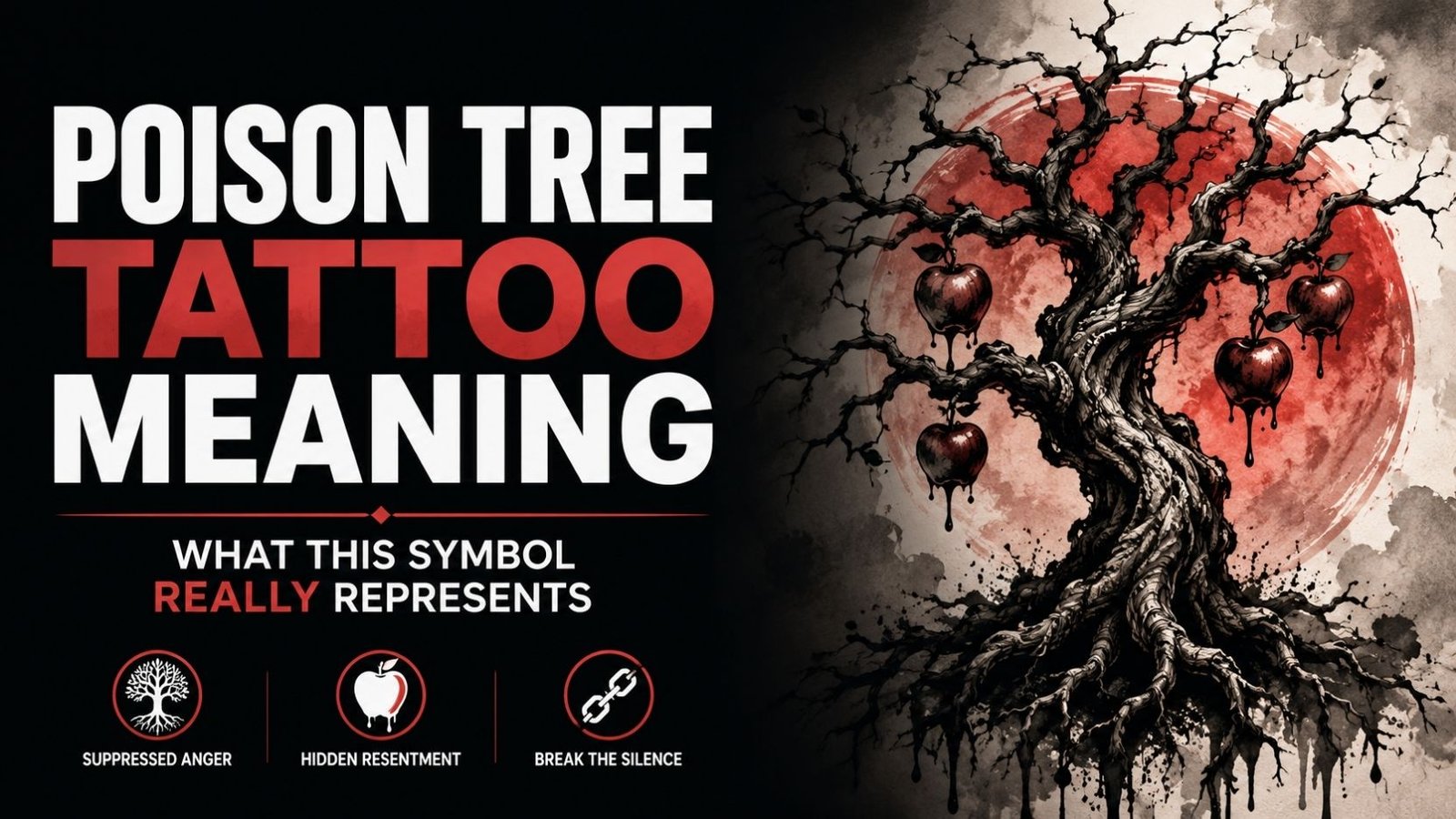
A poison tree tattoo meaning centers on one simple idea: hidden anger grows. The design shows a dark, twisted tree, often bearing strange fruit or bare branches, that stands for emotions a person never let out. Most people choose it after a betrayal, a toxic relationship, or a period of staying silent about real pain. It is less about looking edgy and more about telling a private story on skin.
The symbol matters because it puts words to a feeling many people struggle to explain. Bottled-up anger does not just disappear on its own. It sits, it grows, and it eventually affects the person carrying it. A poison tree tattoo turns that quiet process into something visible, which is part of why it connects so strongly with people who have lived through it.
What Is a Poison Tree Tattoo?
A poison tree tattoo is a piece of body art built around a dark or gothic-looking tree. It usually avoids the soft, peaceful look of a typical tree tattoo on purpose.
Common visual features include:
- Twisted or cracked bark
- Bare, reaching branches instead of full leaves
- Dark or dripping fruit hanging from the limbs
- Roots drawn thick and gripping, almost like claws
- A generally unsettling, unnatural shape
The tree is not meant to be pretty. It is meant to look like something grew wrong, because the emotion behind it grew wrong too.
Poison Tree Tattoo Meaning Explained
At its core, a poison tree tattoo represents suppressed anger and the damage it causes when it is never spoken out loud.
The meaning breaks down into a few connected ideas:
Suppressed anger. The tree represents feelings that were never expressed to the person who caused them.
Hidden resentment. Instead of confronting someone directly, the wearer (or the story behind the tattoo) shows resentment that was buried instead.
Consequences of silence. The poisoned fruit represents what that buried anger eventually becomes if it is left unchecked.
Emotional growth or warning. For some people, the tattoo is a reminder to speak up before feelings turn toxic. For others, it marks a moment they already lived through.
These meanings are not mutually exclusive. Many people who get this tattoo relate to two or three of them at once.
Where the Poison Tree Symbol Comes From?
The poison tree tattoo meaning traces back to a specific piece of literature. English poet William Blake wrote “A Poison Tree” in 1794, and it appeared in his collection Songs of Experience.
The poem describes a simple but sharp idea. When the speaker is angry at a friend, they say so, and the anger fades. When the speaker is angry at an enemy, they say nothing. That silence works like a seed. It is watered by fear and fake smiles, and it slowly grows into a tree. The tree produces a poisoned piece of fruit, and the enemy, drawn to it, eats it and dies.
Blake was known for writing about raw emotion without softening it, and this poem is a clear example. It is short, but the metaphor is direct: hidden anger does not vanish, it grows into something dangerous. Because the imagery is so vivid, it translates naturally into tattoo art, which is why so many people reference Blake, even loosely, when they explain their poison tree tattoo.
Not everyone who gets this tattoo has read the poem. Many people connect with the general meaning, the visual of a corrupted tree, without knowing its literary root. Both readings are valid, since the symbol works on its own even without the poem attached to it.
Poison Tree Tattoo Meaning In The Bible
The Bible connection people search for usually points to Genesis, not to Blake’s poem directly, though the two ideas overlap.
In the Genesis account, the Tree of Knowledge of Good and Evil produces forbidden fruit. Eating it brings consequences that were warned about beforehand. People who lean on this reading connect the poison tree tattoo to:
- Temptation and forbidden choices
- Consequences that follow a decision
- The idea that something appealing on the surface can carry real cost
This is a separate tradition from Blake’s poem, but the two symbols share the same core image: fruit that looks tempting but leads to harm. Some wearers deliberately blend both meanings, using the tattoo to represent personal anger and a broader idea of consequence. Others use only the biblical reading and skip the anger symbolism entirely.
Poison Tree Tattoo Meaning And Mental Health
The mental health reading of this tattoo is one of the most common reasons people actually get it, even more than the literary background.
For many wearers, the tree represents:
- Emotions that were suppressed for survival, such as staying quiet in an unsafe relationship
- Anger that turned inward and affected the wearer’s own well-being before it affected anyone else
- A reminder that bottling up feelings has a cost, even when speaking up feels harder
- A marker of the point where the wearer chose to confront old pain instead of hiding it
Used this way, the tattoo is less a symbol of staying angry and more a symbol of what happens when a person stops staying silent. Some people pair it with other recovery-related symbols, such as a semicolon, to represent choosing to continue their story rather than end it. That pairing is a personal choice, not a fixed rule attached to the poison tree design itself.
Poison Tree Tattoo Meaning For Women
For many women, the poison tree tattoo represents surviving something specific: a toxic relationship, a betrayal, or a period of staying quiet to protect themselves.
Common themes in this version of the meaning include:
- Reclaiming a story after being silenced by someone else
- Marking the end of a relationship built on dishonesty
- Turning private pain into something visible and owned
Design choices often reflect this. Smaller, more detailed tattoos placed on the ribs, wrist, or behind the ear are common when the meaning is personal rather than a public statement.
Poison Tree Tattoo Meaning For Guys
For men, the same core meaning applies, but the framing sometimes shifts toward control and consequence rather than survival.
Common themes include:
- A warning against letting anger build without an outlet
- A reminder of a specific grudge or betrayal that shaped a major decision
- A symbol of strength through restraint, choosing not to act on anger destructively
Larger, bolder placements, such as the forearm, chest, or back, are more common when the wearer wants the design to feel powerful rather than subtle.
There is no rule that ties a specific meaning to gender. These are simply patterns people describe when explaining why they chose the design.
Poison Tree Tattoo Meaning: A Simple Breakdown
| Symbol Element | What It Represents |
| Twisted or bare branches | Anger that grew without being expressed |
| Dark or dripping fruit | The damage caused once resentment fully develops |
| Gripping roots | How deeply the emotion is tied to the person’s past |
| Withered or falling leaves | Loss, grief, or something that died along the way |
| Overall unnatural shape | A feeling or situation that was never allowed to heal properly |
Poison Tree Tattoo Vs Tree Of Life Tattoo
People researching this design often compare it to the tree of life tattoo, since both use a tree as the central image but mean almost opposite things.
| Feature | Poison Tree Tattoo | Tree of Life Tattoo |
| Core meaning | Suppressed anger, resentment, consequence | Growth, family, connection, resilience |
| Visual style | Dark, twisted, unsettling | Full, balanced, often symmetrical |
| Common motivation | Processing pain or betrayal | Celebrating strength or heritage |
| Emotional tone | Heavy, cautionary | Hopeful, grounding |
If the story is about overcoming hardship in a positive sense, a tree of life design usually fits better. If the story is about naming a specific wound, the poison tree stays more accurate.
Common Design Elements And Placement Ideas
Poison tree tattoos vary a lot in style, but a few patterns show up often:
- Blackwork or fine line style: Common for smaller, more personal placements like the wrist or ribs.
- Realistic or gothic style: Common for larger pieces meant to stand out, such as the forearm or back.
- Added symbols: Some wearers add a snake, a skull, or a single dripping apple to sharpen the meaning further.
- Color choices: Most poison tree tattoos stay black and grey. Deep red is sometimes used only on the fruit, to draw the eye toward the “consequence” part of the design.
None of these choices change the core meaning. They simply shift how personal or how bold the tattoo feels.
Common Mistakes And Misconceptions
Misconception: A poison tree tattoo means the wearer is an angry or negative person.
Reality: Most wearers get this tattoo to process anger, not to broadcast it. It usually marks healing, not an ongoing state.
Misconception: The design only refers to William Blake’s poem.
Reality: Many people connect with the biblical reading, the mental health reading, or a general idea of buried emotion, without any reference to the poem.
Misconception: It is the same as a tree of life tattoo with a darker color scheme.
Reality: The two symbols represent different emotional territory, even though they share a tree-shaped structure.
Similar Symbolic Tattoos
A few related designs carry overlapping themes and are worth knowing if you are still deciding on a design:
- Semicolon tattoo: Represents a story that continues rather than ends, often chosen alongside mental health themes.
- Snake and apple tattoo: Leans more directly into temptation and consequence from the Genesis story.
- Broken chain tattoo: Represents breaking free from something harmful, a different angle on the same recovery theme.
Frequently Asked Questions
What does a poison tree tattoo mean?
It generally represents suppressed anger and the emotional damage that builds when feelings are never expressed.
Where does the poison tree tattoo meaning come from?
It is most closely tied to William Blake’s 1794 poem “A Poison Tree,” though many wearers use the symbol without referencing the poem directly.
Does the poison tree tattoo have a Bible meaning?
Yes, for some wearers. It is often connected to the Tree of Knowledge in Genesis, representing temptation and consequence.
Is the poison tree tattoo only for people dealing with mental health struggles?
No. Some people choose it purely for the literary or biblical meaning, while others connect it directly to personal healing.
What is the difference between a poison tree tattoo and a tree of life tattoo?
The poison tree represents suppressed anger and consequence, while the tree of life represents growth, resilience, and connection.
Is a poison tree tattoo a bad omen or negative symbol?
Not inherently. Most people wear it as a marker of something they survived or worked through, not as a celebration of negativity.
What symbols are commonly paired with a poison tree tattoo?
A snake, a single piece of fruit, or a semicolon are the most common additions, each sharpening a specific part of the meaning.
Does the poison tree tattoo meaning differ for men and women?
The core meaning stays the same, though the framing sometimes shifts slightly, with women often emphasizing survival and men often emphasizing restraint or warning.
Final Thoughts
The poison tree tattoo meaning ultimately comes back to one idea: what stays hidden does not stay harmless. Whether the reference point is William Blake’s poem, the Genesis story, or a personal experience with a toxic relationship, the symbol always points to the same warning. Anger that goes unspoken does not disappear. It grows roots.
For anyone considering this tattoo, the meaning is flexible enough to fit a specific story while still carrying real weight on its own. It works as a quiet personal reminder or as a bold statement piece, depending on how it is designed and placed. Whatever the reason behind it, the poison tree remains one of the more honest tattoo symbols available, because it does not pretend that difficult emotions are simple.

Hira Shah is a passionate writer and the author behind Meanz Corner. With 4 years of experience in researching words, meanings, slang, phrases, and names, she creates simple and helpful content for readers. Her goal is to make complex meanings easier to understand through clear, accurate, and reader-friendly explanations.


2 Comments