
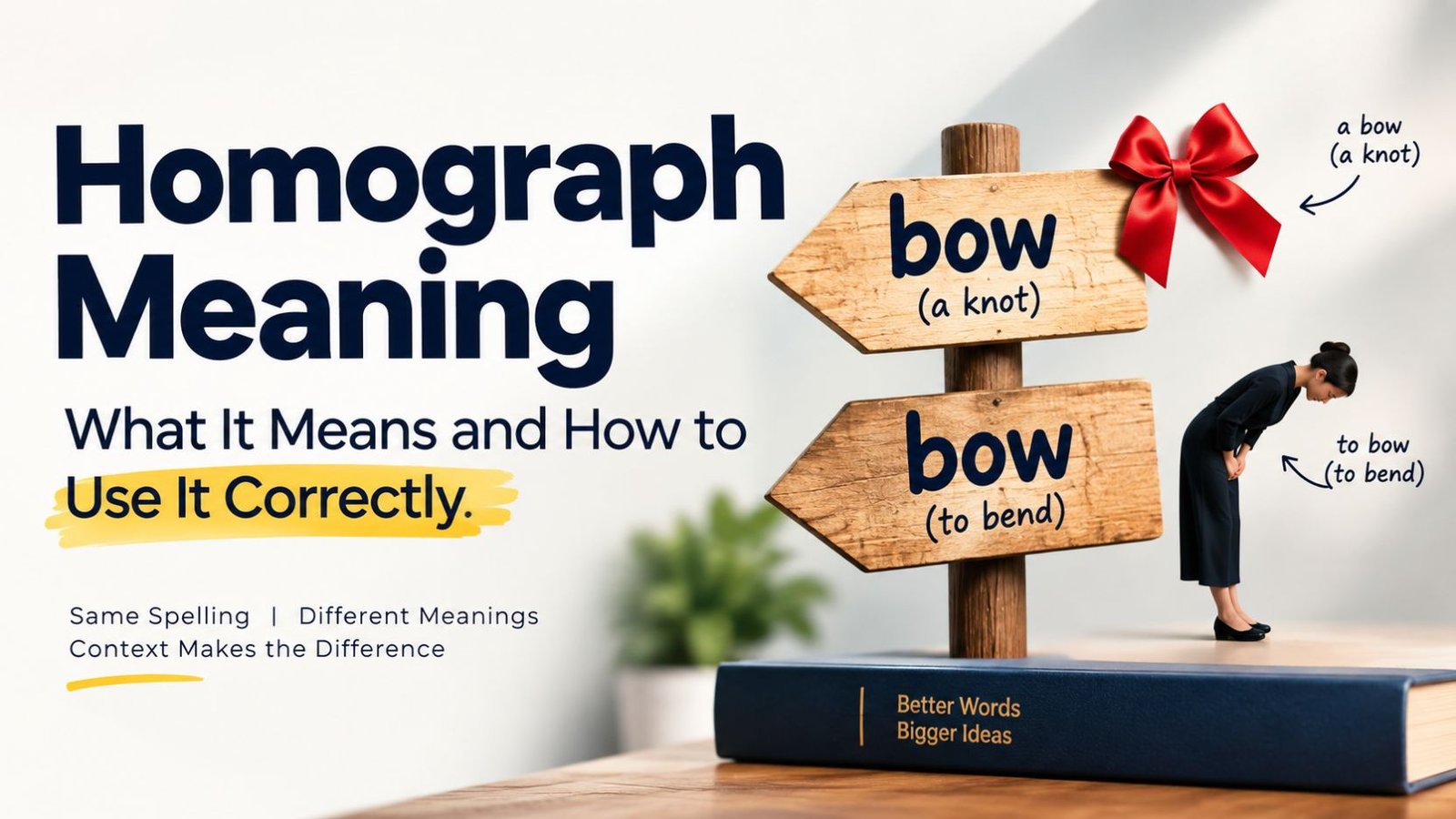
A homograph is a word that is spelled exactly the same as another word but has a different meaning. In many cases, it also has a different pronunciation. The word comes from Greek roots meaning “same writing,” which points directly to what makes a homograph a homograph: identical spelling, not identical sound or sense.
Understanding homograph meaning matters because English is full of these words, and they can easily confuse readers, language learners, and even native speakers. A single sentence can change meaning entirely depending on which sense of the word is intended. Once you understand how homographs work, reading and writing English becomes noticeably clearer, and mistakes in tone, pronunciation, and meaning become much easier to avoid.
What Does Homograph Mean?
In simple terms, a homograph is one written word form that carries two or more separate meanings. The spelling stays fixed, but the meaning shifts depending on context.
Some homographs are also pronounced differently. These are sometimes called heteronyms. Other homographs are pronounced the same way but still carry different meanings depending on how they are used in a sentence.
Here is the clearest way to remember it:
- Same spelling
- Different meaning
- Sometimes different pronunciation
- Meaning depends entirely on context
Because homographs rely so heavily on context, they are one of the more interesting challenges in English vocabulary and grammar.
See more:Affirm Meaning
Homograph Meaning and Examples
The easiest way to understand homograph meaning is through real examples. Below are some of the most common homographs in English, along with their different meanings.
| Word | Meaning 1 | Meaning 2 |
| Bow | To bend forward at the waist | A knot tied with loops, or a weapon that shoots arrows |
| Wind | Moving air | To turn or twist something, like a clock |
| Tear | A drop of liquid from the eye | To rip something apart |
| Close | Physically near | To shut something |
| Desert | A dry, sandy region | To abandon someone or something |
| Live | Currently alive | To reside somewhere, or happening in real time |
| Fall | The season of autumn | To drop downward |
| Ring | A circular piece of jewelry | A sound made by a bell, or to call someone |
| Minute | A unit of time | Extremely small |
| Row | A straight line of things | To paddle a boat, or a loud argument |
| Just | Fair and reasonable | Only, or very recently |
| Letter | A written message | A character in the alphabet |
Each of these words looks identical on the page, yet the meaning changes completely depending on how it is used in a sentence.
Fair Homograph Meaning
The word fair has two very different everyday meanings.
Meaning 1: Reasonable or just. For example, “The judge made a fair decision.” Here, fair describes something equal, honest, or unbiased.
Meaning 2: An event or gathering. For example, “We went to the county fair last weekend.” In this sense, fair refers to a public exhibition, often with rides, food, and games.
Fair can also describe light-colored skin or hair, as in “She has fair skin,” which adds a third layer of meaning depending on context.
Bow Homograph Meaning
Bow is one of the most well-known homographs because it has two completely different pronunciations.
Meaning 1 (pronounced like “boh”): A decorative knot, such as a bow on a gift, or a weapon used to shoot arrows.
Meaning 2 (pronounced like “bow” as in “how”): To bend the body forward, often as a sign of respect, such as “The performer took a bow.”
Because the pronunciation changes with the meaning, bow is often used as a classic teaching example for homographs in schools.
Wind Homograph Meaning
Wind also changes pronunciation depending on meaning.
Meaning 1 (rhymes with “pinned”): Moving air, as in “The wind was strong today.”
Meaning 2 (rhymes with “find”): To turn or twist something, as in “Please wind the clock.”
This word is a strong example of how identical spelling can lead to two entirely unrelated ideas.
Live Homograph Meaning
Live is another common homograph with a pronunciation shift.
Meaning 1 (rhymes with “give”): To be alive, or to reside somewhere. Example: “They live in Chicago.”
Meaning 2 (rhymes with “dive”): Happening in real time, or currently active. Example: “The show is live tonight.”
Fall Homograph Meaning
Fall carries two everyday meanings that are unrelated to each other.
Meaning 1: The season between summer and winter, known as autumn. Example: “Leaves change color in the fall.”
Meaning 2: To drop downward. Example: “Be careful not to fall on the ice.”
Ring Homograph Meaning
Ring can refer to an object, a sound, or an action.
Meaning 1: A circular piece of jewelry worn on the finger.
Meaning 2: The sound made by a bell or phone, or the act of calling someone. Example: “Give me a ring later.”
Just Homograph Meaning
Just is a small word with several distinct uses.
Meaning 1: Fair or morally right. Example: “That was a just punishment.”
Meaning 2: Only, or simply. Example: “I just wanted to say hello.”
Meaning 3: Very recently. Example: “She just left the room.”
Close Homograph Meaning
Close changes pronunciation depending on whether it is used as an adjective or a verb.
Meaning 1 (rhymes with “dose”): Physically or emotionally near. Example: “They live close to the school.”
Meaning 2 (rhymes with “doze”): To shut something. Example: “Please close the door.”
Desert Homograph Meaning
Desert is a strong example of how stress placement changes meaning.
Meaning 1 (stress on first syllable): A dry, sandy region with little rainfall.
Meaning 2 (stress on second syllable): To abandon someone or something. Example: “He would never desert his team.”
Tear Homograph Meaning
Tear is one of the most confusing homographs because both meanings can appear in emotional contexts.
Meaning 1 (rhymes with “here”): A drop of liquid from crying. Example: “A tear rolled down her cheek.”
Meaning 2 (rhymes with “hair”): To rip something. Example: “Don’t tear the paper.”
Row Homograph Meaning
Row has two very different meanings depending on pronunciation.
Meaning 1 (rhymes with “go”): A straight line, such as a row of seats, or the act of paddling a boat.
Meaning 2 (rhymes with “how”): A loud argument, mainly used in British English. Example: “They had a row about money.”
Minute Homograph Meaning
Minute also depends on stress placement.
Meaning 1 (stress on first syllable): A unit of time equal to sixty seconds.
Meaning 2 (stress on second syllable): Extremely small. Example: “The mistake was minute but noticeable.”
Letter Homograph Meaning
Letter is simpler than most homographs but still carries two clear meanings.
Meaning 1: A written or typed message sent to someone.
Meaning 2: A single character of the alphabet, such as A, B, or C.
Homonym vs Homograph Meaning
People often mix up homographs with homonyms, but they are not exactly the same thing.
| Term | Definition | Pronunciation |
| Homograph | Same spelling, different meaning | May be the same or different |
| Homonym | Same spelling and same pronunciation, different meaning | Always the same |
| Homophone | Same pronunciation, different spelling and meaning | Always different spelling |
In short, every homonym is technically a homograph, but not every homograph is a homonym. The difference comes down to pronunciation. If the pronunciation also matches, the word qualifies as a homonym. If the pronunciation changes, it is a homograph but not a homonym.
Homograph Meaning in Different Languages
Many readers search for homograph meaning translated into their own language for clarity. While exact translations vary, the core idea stays the same everywhere: one written word form with multiple meanings.
- In Hindi, the concept is generally explained as एक ही वर्तनी वाले शब्द जिनके अर्थ अलग होते हैं, meaning words with identical spelling but different meanings.
- In Tamil, it is explained similarly as ஒரே எழுத்துக்கூட்டு கொண்ட வேறுபட்ட பொருள் கொண்ட சொற்கள்.
- In Marathi, the idea is expressed as समान लेखन असलेले पण वेगळा अर्थ असलेले शब्द.
These translations are meant to explain the concept, not to serve as official dictionary entries, since exact linguistic terminology can vary by source and region.
Homograph Meaning for Kids
Explaining homographs to children works best with very simple language and familiar examples.
A good way to explain it to a child is this: “Some words look exactly the same but mean two different things. You have to look at the rest of the sentence to know which meaning is being used.”
Simple examples that work well for kids include:
- Bat (the animal) and bat (used to hit a ball)
- Bark (the sound a dog makes) and bark (the outer covering of a tree)
- Park (a place to play) and park (to stop a car)
Using pictures alongside these examples often helps young learners understand the idea faster than definitions alone.
See more:HG Meaning Slang
Why Context Matters So Much?
Because homographs share identical spelling, context is the only reliable way to determine meaning. Readers rely on the surrounding words, the sentence structure, and sometimes the pronunciation to figure out which meaning applies.
For example, the sentence “I saw a bat in the garden” is unclear without more context. It could mean a flying animal or, in rare cases, a sports bat left outside. Adding more detail, such as “I saw a bat flying near the garden,” immediately removes the confusion.
This is why homographs are considered an important part of reading comprehension, especially for language learners.
Common Mistakes With Homographs
Homographs often lead to small but noticeable errors, especially in pronunciation and tone.
❌ Incorrect: Pronouncing “desert” the same way in both “the Sahara Desert” and “he would never desert us.” ✅ Correct: Stress the first syllable for the place, and the second syllable for the action.
❌ Incorrect: Assuming “row” always means an argument. ✅ Correct: Check the context, since “row” can also mean a straight line or the act of rowing a boat.
❌ Incorrect: Using “close” with the wrong pronunciation in speech, saying it the same way whether it means “near” or “to shut.” ✅ Correct: Adjust pronunciation based on whether the word is functioning as an adjective or a verb.
Quick Tips for Recognizing Homographs
💡 Tip: If a word’s meaning feels unclear, check whether it could be pronounced two different ways.
💡 Tip: Look at the part of speech. Many homographs shift meaning when they move from noun to verb.
💡 Tip: Read the full sentence before deciding on a definition. Homographs rarely make sense in isolation.
⚠️ Common mistake: Assuming a word only has one meaning simply because it looks familiar.
See more:Swore Meaning
Frequently Asked Questions
What does homograph mean in simple terms?
A homograph is a word that is spelled the same as another word but has a different meaning, and sometimes a different pronunciation.
What is the difference between a homograph and a homonym?
A homonym has the same spelling and the same pronunciation. A homograph only requires the same spelling, so the pronunciation can be different.
Can a homograph have more than two meanings?
Yes. Some homographs, like “just” or “minute,” carry three or more distinct meanings depending on context.
Are all homographs pronounced differently?
No. Some homographs, like “bat” or “park,” are pronounced the same way in every meaning. Others, like “bow” or “wind,” change pronunciation depending on meaning.
How can I tell which meaning of a homograph is being used?
Look at the surrounding sentence. Context, part of speech, and sometimes pronunciation will reveal which meaning applies.
Is homograph meaning important for English learners?
Yes. Homographs are a common source of confusion for learners because the spelling gives no clue about which meaning is intended.
Why do homographs exist in English?
Homographs often developed because English borrowed words from many different languages over time. Some words evolved separately but ended up with identical spelling.
What is an example of a homograph used in a single sentence?
“After the long day, the driver decided to close the store and drive close to home.” Here, “close” appears twice with two different meanings and pronunciations.
Final Thoughts on Homograph Meaning
Homographs are a natural part of the English language, and once you understand how they work, they stop being confusing and start being interesting. The key is remembering that spelling alone never tells the full story. Meaning comes from context, sentence structure, and sometimes pronunciation.
Whether you are a student, a language learner, or simply someone who enjoys understanding words more deeply, recognizing homographs will make you a sharper reader and a more careful writer. The next time you come across a word like bow, wind, or close, take a moment to notice how the sentence around it shapes its true meaning.

Hira Shah is a passionate writer and the author behind Meanz Corner. With 4 years of experience in researching words, meanings, slang, phrases, and names, she creates simple and helpful content for readers. Her goal is to make complex meanings easier to understand through clear, accurate, and reader-friendly explanations.


One Comment