
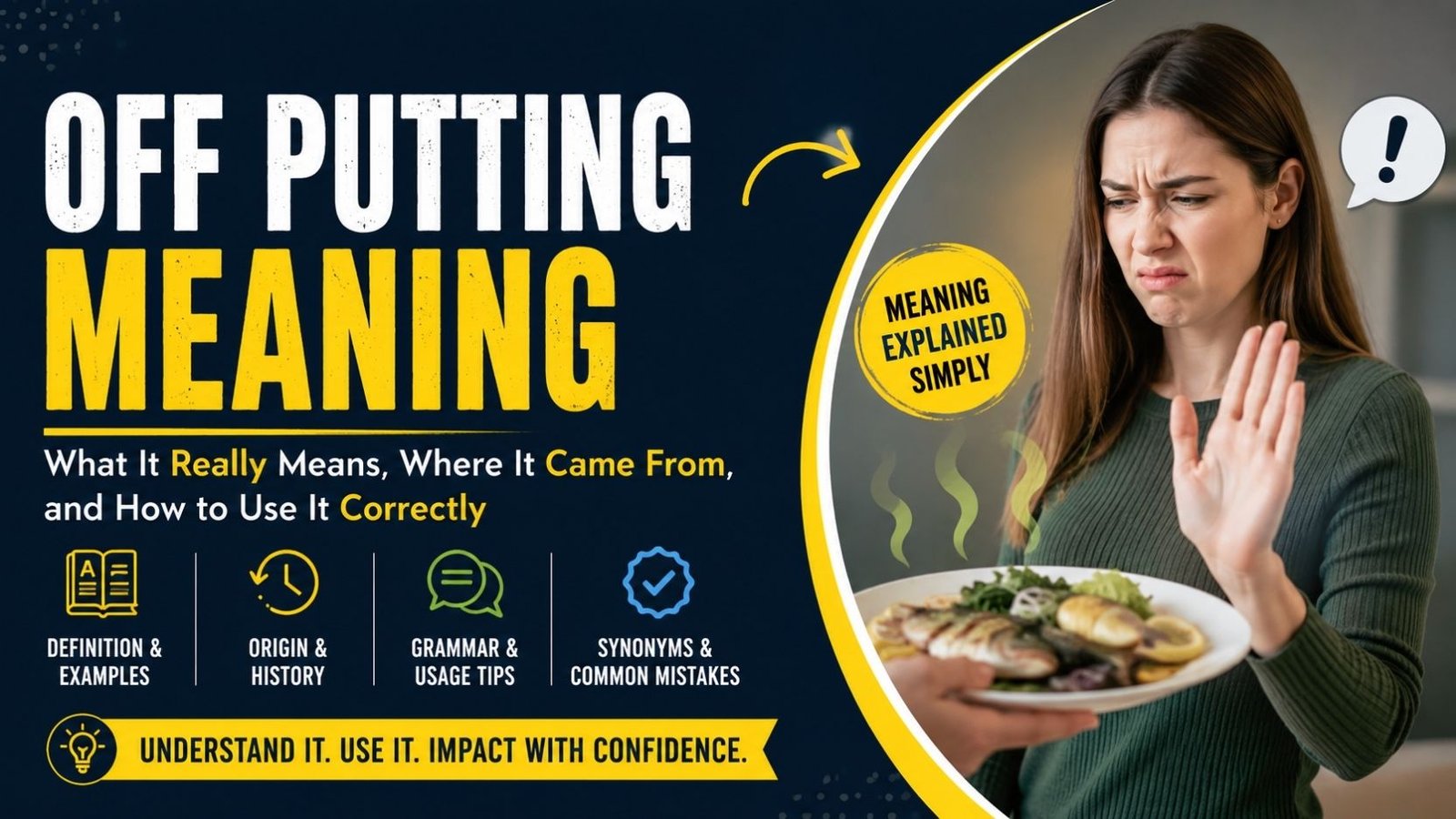
If someone tells you a smell, a habit, or a comment is “off putting,” they mean it makes them want to pull back. The off putting meaning is simple: something that discourages you, disgusts you a little, or makes you lose interest almost instantly. It is not the same as hatred. It is closer to a small warning sign that tells your brain to keep its distance.
This word shows up everywhere, from restaurant reviews to dating conversations to job interview feedback. People search for its meaning because the feeling it describes is so common, yet the word itself can feel oddly formal. Once you understand where it comes from and how it is really used, you will notice it constantly, and you will start using it with confidence in your own writing and speech.
What Does Off Putting Mean?
In plain English, off putting means unpleasant enough to discourage interest, trust, or involvement. It describes a quality, not a full judgment. Something can be off putting without being terrible.
A few native-speaker ways to say the same thing:
- It makes people want to back away.
- It creates a bad first impression.
- It quietly kills someone’s enthusiasm.
Dictionaries generally agree on this core sense. Merriam-Webster defines it as something that “puts one off,” closely tied to repellent or disconcerting. Cambridge Dictionary frames it as something slightly unpleasant or worrying enough that you do not want to get involved. Collins adds a similar idea: a quality or feature that makes you dislike something or avoid it.
Notice the word “slightly” in most of these definitions. That detail matters. Off putting rarely describes something extreme. It describes a smaller, more everyday kind of discomfort.
See more : SYFM Meaning Slang
Off Putting Meaning: Quick Overview
| Feature | Detail |
| Word | Off putting |
| Part of speech | Adjective |
| Simple meaning | Unpleasant enough to discourage interest or involvement |
| Common synonyms | Unappealing, discouraging, disconcerting, repellent |
| Common antonyms | Appealing, inviting, attractive, welcoming |
| Formality | Neutral to slightly formal, used in speech and writing |
| Origin | Scottish English, first recorded in the early 1800s |
| Typical use | Describing habits, smells, comments, appearances, or first impressions |
This table gives you the shape of the word at a glance. The rest of this guide fills in the details, including grammar, pronunciation, origin, and real examples.
Off Putting Grammar: Part of Speech and Sentence Structure
Off putting is an adjective. It describes a noun, and it usually appears in one of two places in a sentence.
Before the noun
- That was an off putting comment.
- She has an off putting habit of interrupting people.
After a linking verb
- His attitude was off putting.
- The smell in the kitchen is a little off putting.
Grammatically, off putting behaves like most compound adjectives formed from a verb plus a preposition, such as “outgoing” or “ongoing.” It does not change form for plural or singular nouns. You do not add an “s,” and there is no separate verb tense to worry about, since off putting itself is not a verb. The verb form behind it is “put off,” as in “His comment put me off.”
It also does not take a comparative or superlative ending like “off puttinger.” Instead, English speakers use “more” and “most.”
- This approach is more off putting than the last one.
- That was the most off putting interview I have ever had.
Hyphenation
You will see the word written both as “off putting” and “off-putting.” The hyphenated form, “off-putting,” is the standard spelling in most style guides and dictionaries, especially when the word appears directly before a noun. Many web searches drop the hyphen simply because it is faster to type, but formal writing should keep it.
- Correct in formal writing: an off-putting tone
- Common in casual searches: an off putting tone
Both forms are understood the same way. If you are writing for a class, a publication, or a professional document, use the hyphen.
How to Pronounce Off Putting?
Off putting is pronounced AWF-poo-ting in American English, or OFF-put-ing with a short “u” sound, similar to the word “put.” It has three syllables.
- Simple pronunciation: off–PUT–ing
- Stress: The stress falls on the first syllable of “putting,” so it sounds like OFF-PUT-ing rather than off-put-ING.
There is no tricky silent letter and no unusual sound pattern. If you already know how to say “put,” “putting,” and “off,” you already know how to say this word correctly. British and American pronunciations are close, with only a slight difference in how the “o” in “off” is shaped.
Origin of Off Putting
The origin of off putting is older than most people expect. Language researchers trace it back to Scottish English, where “off-putting” first appeared in print in a dictionary compiled by the Scottish antiquary John Jamieson in the early 1800s. Etymology sources date the adjective’s known written use to around 1808, with a broader dating range of the 1820s given by other dictionaries.
At that early stage, off putting did not mean what it means today. Its original sense was closer to “procrastinating” or “dilatory,” describing someone who kept delaying a task. This earlier meaning stayed common in Scottish and British regional English well into the twentieth century, particularly to describe a person who habitually put things off.
The word’s roots go back even further if you follow the phrase behind it. “To put off” has been used in English since at least the late 1300s, originally meaning to defer, delay, or postpone something. Over time, the same phrase picked up a second sense: to drive someone away, discourage them, or create a bad impression. That second sense is the one that eventually shaped the modern meaning of off putting.
By the late 1800s, the meaning shifted toward what we use today. Sources place this shift around 1894, when off putting started to describe something that creates an unfavorable impression rather than someone who procrastinates. From that point forward, the word slowly spread from regional British usage into standard English across the world.
So the short version of the origin story is this: off putting began life describing delay and procrastination, then transformed into a word about discouragement and unpleasantness, and it kept the same spelling the entire time.
Off Putting in a Sentence
Seeing the word in real sentences makes the meaning click faster than any definition alone.
- The restaurant’s dirty windows were off putting, so we chose somewhere else.
- I found his constant bragging off putting during the interview.
- Her blunt feedback style can feel off putting at first, even though she means well.
- The strong smell of the cleaning product was off putting enough to open every window.
- Some readers find the book’s slow opening chapters off putting.
Notice that off putting almost always follows the pattern of describing a specific trigger: a smell, a habit, a tone, a comment, or an appearance. It rarely stands alone without something causing the reaction.
Off Putting Meaning in Different Contexts
The core meaning of off putting stays consistent, but the intensity and tone shift depending on the words placed around it. This is one of the biggest reasons people search for slightly different versions of the phrase.
A Little Off Putting Meaning
When someone says something is “a little off putting,” they are softening the criticism. This phrase signals mild discomfort rather than strong dislike.
- Example: His jokes were a little off putting, but nothing serious.
This version is common in polite conversation, feedback, and reviews where the speaker does not want to sound harsh.
That’s Off Putting Meaning
“That’s off putting” is a direct, conversational reaction. It usually responds to something just said or observed.
- Example: “He talks about himself the entire date.” “That’s off putting.”
This short form works well in spoken English and casual writing, including texting and social media replies.
Being Off Putting Meaning
“Being off putting” describes an ongoing behavior or personality trait rather than a single moment.
- Example: You’re being off putting when you interrupt every sentence I start.
Here, the phrase points to a pattern, not a one-time event.
It’s Off Putting Meaning
“It’s off putting” is another everyday phrasing, often used to describe a situation, object, or experience.
- Example: It’s off putting when a website asks for your credit card before showing any prices.
Off Putting Person Meaning
Calling someone an “off putting person” means their overall manner, tone, or behavior tends to discourage people from wanting to talk to them or get close to them. It is a broader label than describing a single action.
- Example: Some interviewers seem off putting simply because they never smile.
See more: What Does ONB Mean In Text?
Endearingly Off Putting Meaning
This phrase looks like a contradiction, and in a sense, it is. “Endearingly off putting” describes something that is a bit strange, awkward, or unpolished, yet still charming because of that same strangeness.
Think of a person who mumbles, wears mismatched socks on purpose, or has an unusual laugh. On paper, those traits might sound off putting. In person, combined with warmth or personality, they can become part of what makes someone likable.
- Example: His awkward stage presence was endearingly off putting, which somehow made the audience like him more.
This combination phrase works because English allows contradictory adjectives to sit together when the overall feeling is affectionate. It is common in reviews of quirky characters, comedians, pets, and even brands that lean into an imperfect personality.
Off Putting Meaning Slang and Urban Dictionary Use
On casual platforms and slang-focused sites, off putting keeps its standard meaning but gets applied to a wider range of situations, often with humor or exaggeration. People use it for anything from a strange text message to an unusual first date story to an unappetizing food combination.
Slang usage tends to stretch the word for comic effect.
- Example: The way he answered in one-word texts was extremely off putting.
Urban Dictionary style entries usually agree with formal dictionaries on meaning, but they add real-life, often blunt examples pulled from dating, roommates, or awkward social encounters. The tone is informal, but the underlying definition, something that discourages interest, stays the same.
Off Putting Synonyms
Off putting shares meaning with several other adjectives, but each one carries a slightly different shade of feeling.
| Word | Meaning | Difference From Off Putting |
| Unappealing | Not attractive or desirable | Focuses more on lack of appeal than active discomfort |
| Discouraging | Reduces motivation or hope | Focuses on effect on effort, not necessarily disgust |
| Disconcerting | Confusing or unsettling | Adds a layer of surprise or unease |
| Repellent | Strongly causes avoidance | Much stronger and more forceful than off putting |
| Unpleasant | Not enjoyable | Broader and less specific than off putting |
| Distasteful | Offensive to taste or values | Often used for moral or ethical discomfort |
Off putting sits in the middle of this group. It is stronger than “unappealing” but softer than “repellent.” That balance is exactly why it works so well in reviews, feedback, and everyday conversation, since it criticizes without sounding extreme.
Off Putting Antonyms
The opposite of off putting describes something that draws people in rather than pushing them away.
- Appealing
- Inviting
- Attractive
- Welcoming
- Charming
- Engaging
Example: The warm lighting and friendly staff made the cafe feel inviting rather than off putting.
Off Putting Vs Off Pudding
Some searches use the phrase “off pudding meaning,” which is almost always a typo or a misheard version of “off putting.” There is no established English idiom called “off pudding.” If you saw this phrase somewhere, the writer likely meant off putting, since the two phrases sound close when spoken quickly. There is no separate meaning to learn here beyond recognizing the spelling mistake.
Off Putting Meaning in Other Languages
Because this phrase is searched globally, it helps to know how the idea translates into a few major languages. These are general translations meant to capture the core feeling, not word-for-word grammar lessons.
| Language | Common Translation Idea |
| Urdu | Close to ناگوار (unpleasant) or نفرت انگیز (something that causes dislike) |
| Hindi | Close to अरुचिकर (unappealing) or घृणित (something that causes distaste) |
| Arabic | Close to مُضايِق (bothersome or uncomfortable) |
| Chinese (Simplified) | Close to 令人不快的 (something that causes displeasure) |
| Bengali | Close to অপ্রীতিকর (unpleasant) |
These translations reflect the general feeling behind off putting rather than one single fixed word, since many languages use more than one term depending on context, tone, and formality. If you are translating for professional or academic work, checking a dedicated bilingual dictionary for the exact phrase in context is the safest approach.
Common Mistakes With Off Putting
Even confident English speakers occasionally misuse this word. Here are the most frequent mix-ups.
❌ Incorrect: The food was very off putted.
✅ Correct: The food was very off putting.
Off putting does not change form. It stays the same whether you are describing one thing or several things, and it is never written as “off putted.”
❌ Incorrect: She off puts me.
✅ Correct: She puts me off.
The adjective is “off putting.” The verb phrase is “put off,” not “off put.” Keep the word order of the verb form correct: subject, put, object, off.
❌ Incorrect: This is the most off puttingest experience.
✅ Correct: This is the most off putting experience.
There is no “-est” ending for this adjective. Use “most” instead.
❌ Incorrect: Off-putting only means bad smells.
✅ Correct: Off-putting can describe smells, habits, comments, tones, appearances, and more.
The word is broad. Do not limit it to one narrow category in your writing.
Similar Words That Are Easy to Confuse
A few English words look or sound similar to off putting but mean something different.
- Outgoing: describes a friendly, social personality, the opposite feeling of off putting.
- Offputting spelled without a space: not a standard spelling; always keep it as two words, hyphenated or not.
- Off-key: describes musical notes that are wrong or out of tune, unrelated to this word.
- Off-color: describes a joke or comment that is inappropriate, which can overlap with off putting in tone but is not identical in meaning.
Keeping these separate helps avoid confusion in both writing and conversation.
Off Putting Meaning in English Usage Today
In everyday American and British English, off putting shows up constantly in three main areas.
Food and smell People describe unusual textures, strong smells, or unappetizing presentation as off putting. It is one of the most common contexts for the word.
Personality and behavior Interrupting, bragging, oversharing, or being overly blunt are frequently labeled off putting in social and workplace settings.
First impressions Websites, resumes, book covers, and opening scenes in films are often reviewed using this word when they fail to hook someone quickly.
Across all three areas, the underlying meaning never changes. Something creates a small, immediate resistance in the listener, reader, or viewer.
See more: BBW Meaning In Text
Frequently Asked Questions
What does off putting mean?
It means something is unpleasant enough to discourage interest, trust, or involvement, without necessarily being extreme.
How do you use off putting in a sentence?
Place it before a noun, as in “an off putting smell,” or after a linking verb, as in “the smell was off putting.”
Is off putting a noun or an adjective?
It is an adjective. It describes qualities of people, objects, smells, comments, or experiences.
How do you pronounce off putting?
It is pronounced off-PUT-ing, with stress on the first syllable of “putting.”
What is the difference between off putting and unpleasant?
Unpleasant is broader and can describe ongoing discomfort. Off putting specifically describes something that discourages interest or involvement, often on first contact.
What is the origin of off putting?
It comes from Scottish English, first recorded in the early 1800s, originally meaning procrastinating. The modern meaning of creating a bad impression developed by the late 1800s.
Is off putting formal or informal?
It works in both. It is common in casual conversation and equally acceptable in professional writing, reviews, and journalism.
Can a person be described as off putting?
Yes. People, habits, comments, appearances, smells, and situations can all be described as off putting.
What does endearingly off putting mean?
It describes something odd or awkward that becomes charming rather than truly unpleasant, often used for quirky personalities or characters.
Is off pudding a real phrase?
No. It is almost always a misspelling or mishearing of off putting.
Conclusion
Off putting describes that small, familiar feeling of wanting to step back from something, whether it is a strong smell, an awkward comment, or a bad first impression. The word has traveled a long way from its early 1800s Scottish roots, where it once meant procrastinating, to its modern sense of creating discouragement or dislike. Once you understand this shift, the word stops feeling formal or unusual and starts feeling like exactly what it is: a precise, useful way to describe a very common human reaction.
Whether you are writing a review, describing a personality trait, or just trying to explain why something felt slightly wrong, off putting gives you a clear, natural word for it. Use it with confidence, keep the hyphen in formal writing, and remember that it almost always points to something specific, a smell, a habit, a tone, or a moment, rather than a vague, all-purpose complaint.

Hira Shah is a passionate writer and the author behind Meanz Corner. With 4 years of experience in researching words, meanings, slang, phrases, and names, she creates simple and helpful content for readers. Her goal is to make complex meanings easier to understand through clear, accurate, and reader-friendly explanations.



One Comment