
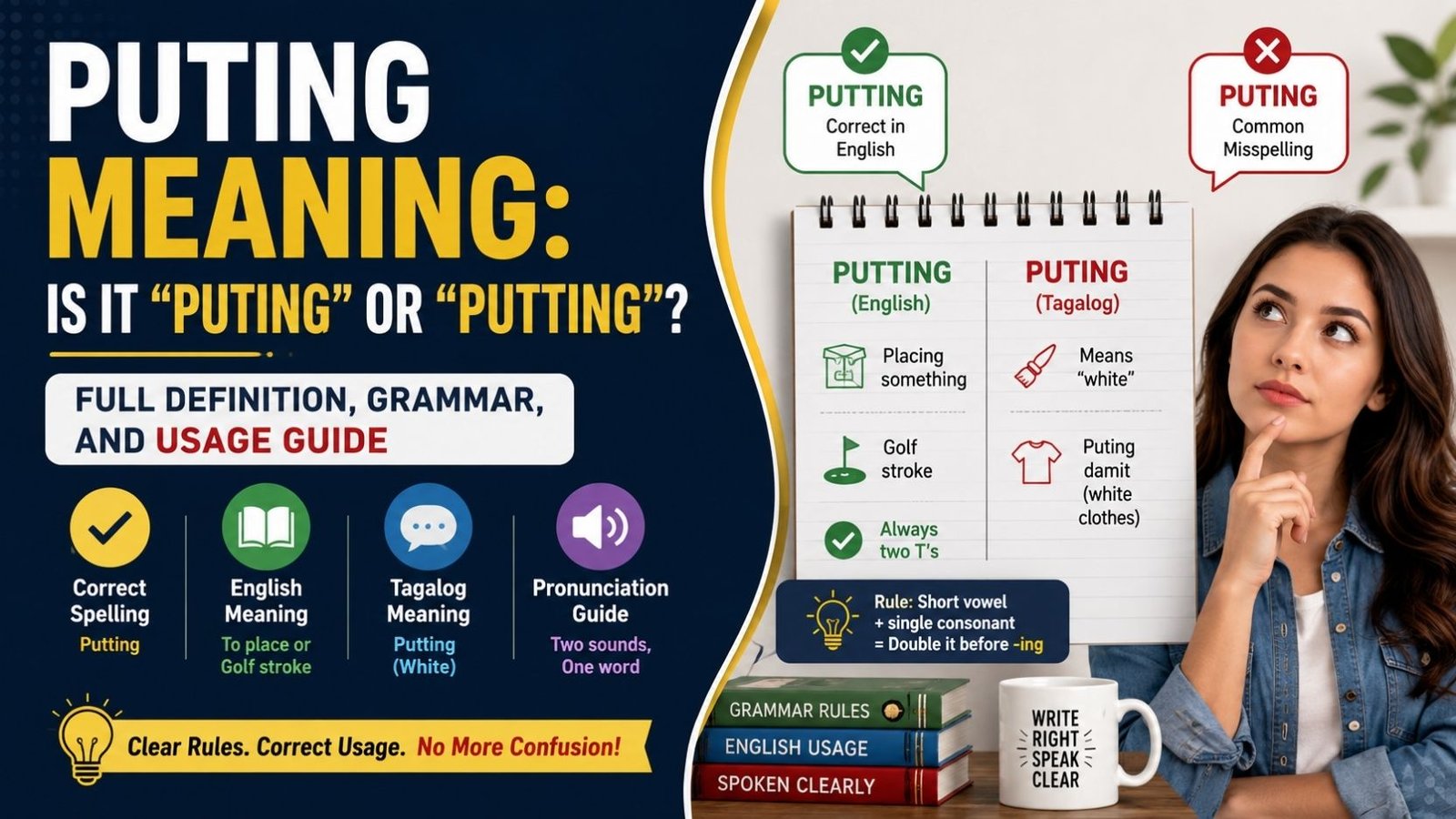
“Puting” is not a standard English word. In almost every search, it is either a misspelling of “putting,” the present participle of the verb “put,” or the Tagalog word for “white.” The correct English spelling always doubles the T: putting. This article explains both meanings clearly.
Many people search “puting meaning” because English spelling rules feel confusing here. A short vowel before a single consonant usually gets doubled before “-ing.” Once you understand this one rule, you will never misspell the word again, and you will also know how to use it correctly in a sentence.
Puting Meaning: Quick Answer
There are really two separate answers, depending on why someone typed this word.
- In English, the correct spelling is “putting.” It means placing something somewhere, or, in golf, gently tapping a ball toward the hole.
- In Tagalog (Filipino), “puting” is a real, correctly spelled word. It means “white” and is used before a noun, as in “puting damit” (white clothes).
Both meanings are covered fully below, so you can find the one that matches your search.
Putting or Puting: Which Spelling Is Correct?
In English, “puting” is always incorrect. The correct form is “putting,” with two T’s.
This confusion happens because of a common English spelling pattern. When a short, one-syllable verb ends in a single consonant after a single vowel, that final consonant is usually doubled before adding “-ing.”
| Base verb | Vowel sound | Correct -ing form | Incorrect form |
| put | short | putting | puting |
| sit | short | sitting | siting |
| run | short | running | runing |
| stop | short | stopping | stoping |
Tip: If the verb has a short vowel sound and ends in one consonant, double that consonant before “-ing.” This is why “putting” needs two T’s.
Putting Meaning in English
“Putting” has two distinct meanings in English, and they are pronounced slightly differently depending on which one is meant.
Meaning 1: The Act of Placing Something
This is the everyday meaning. “Putting” is the present participle and gerund of the verb “put.” It describes the action of moving something to a location or a new state.
- Example: She is putting the plates on the table.
- Example: He kept putting off the meeting.
Meaning 2: The Golf Term
In golf, “putting” refers to the gentle stroke used to roll the ball across the green and into the hole. This sense comes from the verb “putt,” a related but separate word.
- Example: His putting improved after weeks of practice on the green.
- Example: The tournament came down to a single putting contest.
Common mixup: “Put” and “putt” are different verbs. “Put” is general-purpose. “Putt” exists only in golf. Both happen to become “putting” when you add “-ing,” which is why the word can mean two different things depending on context.
See more: GNG Meaning In Text
Grammar: Part of Speech and Word Forms
“Putting” functions as a verb form in most sentences, though it can also act as a noun (a gerund).
| Word form | Example |
| Base verb | put |
| Present participle / gerund | putting |
| Simple past | put |
| Past participle | put |
| Third person singular | puts |
As a verb, “putting” follows a helping verb: “I am putting the book away.”
As a noun (gerund), it acts as the subject or object of a sentence: “Putting things off never helps.”
Notice that “put” is one of the few English verbs where the past tense and the past participle stay identical to the base form. Only the “-ing” form changes, and it always uses the doubled T.
How to Pronounce Putting?
The everyday meaning and the golf meaning of “putting” are pronounced differently, which makes them heteronyms, words that share a spelling but not a sound.
| Meaning | Pronunciation | Sounds like |
| To place something (from “put”) | /ˈpʊtɪŋ/ | “PUUT-ing,” rhymes with “foot” |
| Golf stroke (from “putt”) | /ˈpʌtɪŋ/ | “PUHT-ing,” rhymes with “but” |
If you are reading a golf article and see “putting,” say it with the short “uh” sound. If you are reading about placing an object somewhere, use the “oo” sound instead.
Origin and Etymology of Putting
The verb “put” comes from late Old English “putian,” meaning “to thrust, push, or shove.” Over time, the meaning broadened from forceful pushing to the more general idea of placing something somewhere.
The golf-specific “putt” developed separately. Golf terminology was formalized in Scotland, where “put” was traditionally pronounced with a short vowel. By the 1700s, the spelling “putt” was introduced to keep the gentle stroke on the green distinct from the everyday verb “put,” even though both words share the same root.
Off Putting Meaning
“Off-putting” is a related word that many readers search alongside “puting meaning.” It is an adjective meaning unpleasant, unappealing, or likely to create a bad impression.
- Example: His rude comment was off-putting to the whole room.
- Example: The restaurant’s smell was off-putting, so we left.
Interestingly, “off-putting” is centuries old. It first appeared in the 1300s with a different meaning, a rebuke or a delay. The modern sense, describing something that discourages or repels, only became common in the late 1800s.
Putting vs Pouting: Don’t Confuse These Words
“Puting” is sometimes typed by mistake when someone actually means “pouting.” These words look and sound similar but mean completely different things.
| Word | Meaning | Example |
| Putting | Placing something, or a golf stroke | She is putting her shoes on. |
| Pouting | Pushing the lips out to show displeasure | The child was pouting after losing the game. |
“Pouting” comes from the verb “pout,” which describes a facial expression, usually one of sulking or mild displeasure. It has no connection to “put” or “putt” at all.
See More: Off Putting Meaning
Puting Meaning In Tagalog (Filipino)
Outside of English spelling mistakes, “puting” is also a genuine, correctly spelled Tagalog word. It comes from the root word “puti,” meaning “white.”
In Tagalog grammar, an adjective often takes the linker “-ng” when it comes directly before a noun. “Puti” becomes “puting” when it modifies a word that starts with a vowel-friendly sound, similar to how “maganda” becomes “magandang” before a noun.
- Puting damit – white clothes
- Puting bandila – white flag
- Puting-puti – very white, or pure white (an intensive form)
| Tagalog word | English meaning |
| puti | white (adjective) |
| puting | white, used before a noun |
| maputi | white or fair-skinned |
| pumuti | to turn white |
This meaning has nothing to do with English grammar. If a search brought you here because of a Filipino phrase or song lyric, “puting” almost always points back to the color white.
Putting Meaning In Construction
There is no separate, industry-specific definition of “putting” in construction. The word is used with its normal English meaning: placing or positioning materials, such as putting up drywall, putting in a foundation, or putting on a coat of paint. If you saw this phrase in a construction context, it is simply the everyday verb “put” applied to a building task, not a specialized trade term.
Putting Meaning In Hindi And Other Languages
Because “putting” is a grammatical form rather than a single fixed idea, it usually cannot be translated with one word. The base verb “put” is commonly translated in Hindi as रखना (rakhnā), meaning “to keep” or “to place.” The “-ing” ending would then be added through the target language’s own grammar rather than a direct word-for-word match.
For other South Asian languages, the safest approach is to look up the base verb “put” (to place, to keep) in a trusted bilingual dictionary for that specific language, since the exact word and its spelling vary by language and by context. Presenting an unverified translation here would risk giving you an inaccurate answer, so this article sticks to what can be confirmed.
Common Mistakes
⚠️ Common mistake: ❌ Incorrect: I am puting the keys on the table. ✅ Correct: I am putting the keys on the table. Why: The short vowel in “put” requires the final consonant to double before “-ing.”
⚠️ Common mistake: ❌ Incorrect: His atitude was off puting. ✅ Correct: His attitude was off-putting. Why: Both “attitude” and “off-putting” follow standard English spelling, and “off-putting” is hyphenated.
⚠️ Common mistake: ❌ Incorrect: She was puting her lips together in anger. ✅ Correct: She was pouting her lips together in anger. Why: The intended word here is “pouting,” from “pout,” not “putting.”
Examples Of Putting In A Sentence
- I spent the afternoon putting my books in order.
- The coach praised her putting during the final round.
- He avoided the topic by putting off the conversation.
- Putting extra effort into practice paid off for the team.
See more: SYFM Meaning Slang
Synonyms And Related Words
| Word | Meaning | Difference from “putting” |
| Placing | Setting something in a position | More formal, often used for careful positioning |
| Setting | Putting something in a fixed place or state | Often used for objects or conditions, like “setting a table” |
| Installing | Putting equipment or software into use | Specific to fixed structures, devices, or systems |
| Positioning | Arranging something in a particular spot | Emphasizes exact placement rather than general movement |
Frequently Asked Questions
What does “puting” mean?
“Puting” is not a correct English word. It is usually a misspelling of “putting.” In Tagalog, however, “puting” is a correctly spelled word meaning “white,” used before a noun.
Is it “putting” or “puting”?
“Putting” is correct in English. It has two T’s because the short vowel in “put” causes the final consonant to double before “-ing.”
What part of speech is “putting”?
“Putting” is the present participle and gerund of the verb “put.” As a gerund, it can also function as a noun.
How do you pronounce “putting”?
When it means placing something, say /ˈpʊtɪŋ/, similar to “foot.” When it refers to the golf stroke, say /ˈpʌtɪŋ/, similar to “but.”
What does “off-putting” mean?
“Off-putting” means unpleasant or discouraging, something that creates a bad impression, such as a rude tone or an unappealing smell.
What is the difference between “putting” and “pouting”?
“Putting” relates to placing something or the golf stroke. “Pouting” describes pushing out the lips to show displeasure. They come from unrelated root words.
What does “puting” mean in Tagalog?
It means “white,” used as an adjective before a noun, such as “puting bahay” (white house).
Why does “put” not change in the past tense?
“Put” is an irregular verb where the base form, the past tense, and the past participle are all identical. Only the “-ing” form, “putting,” changes in spelling.
Does “putting” have a construction-specific meaning?
No. In construction contexts, “putting” simply keeps its everyday meaning of placing or positioning materials.
Conclusion
“Puting” is not correct English spelling; the right word is “putting,” formed by doubling the T in “put” before adding “-ing.” It carries two related meanings, placing something somewhere and the gentle stroke used in golf, and each is pronounced slightly differently. The word also has a completely separate life in Tagalog, where “puting” is the correct spelling of a word meaning “white.”
Whichever meaning brought you here, the safest habit is to check both the spelling rule and the context before you use the word. A quick look at whether you mean the English verb, the golf term, or the Tagalog color word will keep your writing accurate and easy for any reader to understand.

Hira Shah is a passionate writer and the author behind Meanz Corner. With 4 years of experience in researching words, meanings, slang, phrases, and names, she creates simple and helpful content for readers. Her goal is to make complex meanings easier to understand through clear, accurate, and reader-friendly explanations.



3 Comments